
Anker Alternatives for OEM Buyers: MOQ 500 to Full OEM

Global Procurement & Sourcing Manager · 10+ years in 3C procurement & sourcing
Anker alternatives for OEM buyers are not another consumer brand. They are manufacturing routes, not a product line to rebrand. Choose authorized distribution for speed, private label from 500 units for control, or full OEM tooling for exclusivity. Match the route to your margin, timeline and IP ownership.
In June 2025, the US Consumer Product Safety Commission announced a recall of about 1,158,000 Anker PowerCore 10000 units. The model was A1263. Consumers reported 19 incidents involving overheating, fire or explosion, two minor burns and more than $60,700 in property damage.
A brand name is not a quality system. The real question is which route gives you verifiable control over cells, certification and change management.
This guide compares the benchmark brands, the four routes that replace Anker, seven categories worth sourcing and the RFQ checks that separate a factory from a trading company.
Disclosure: WOWOHCOOL manufactures charging products. This guide compares all four routes, including resale, which does not involve us.
Key Takeaways
Anker alternatives for OEM buyers: four routes, MOQ 500 to 3,000+, 65W GaN FOB $6.00-8.50 and a 7-point supplier scorecard. Compare before you quote.
- Anker sells under its own brand and does not offer a public private-label program. An "Anker alternative" is a sourcing route, not a rival logo.
- The four routes differ sharply: authorized distribution sets MOQ by agreement but gives no brand control; ODM stock private label starts at 500 units; ODM design development at 1,000–2,000; full OEM with new tooling at 3,000+.
- The 2025 recall shows why cell traceability and change-control clauses matter more than brand reputation. CPSC recorded 19 reports of overheating, fire or explosion in one US recall alone.
- A 65W multi-port GaN charger costs $6.00–8.50 FOB at 500 units. Landed cost, channel margin and certification amortization decide whether a private label program works.
- Use a seven-point supplier scorecard with pass/fail thresholds. A supplier that cannot document cell model, AQL and aging data is not an Anker-class partner.
Table of Contents
1. Why OEM Buyers Look for Anker Alternatives
Most sourcing managers do not start with "find an Anker alternative." They start with a narrower problem. Their current brand supplier cannot support the price, the packaging or the channel they need.
Three structural reasons push them toward a factory.
1.1 You cannot private-label an Anker product
Anker sells finished consumer products under its own brand. Its OEM arm works with large retail partners; it does not run a public private-label program for third-party brands. Rebranding a purchased Anker product without authorization risks trademark infringement and breach of the distribution agreement. Authorized resale is legal, but it sells Anker's brand and pricing rules.
Authorized distribution is a resale route, not a brand-building route.
1.2 Brand pricing leaves little room for a channel partner
A consumer brand carries retail margin, marketing cost, platform fees and after-sales cost. Those costs sit between factory cost and shelf price. A distributor earns a channel margin on top of that structure.
A private-label or OEM program removes the brand layer. You buy at FOB, set your own retail price and own the customer relationship.
1.3 The 2025 recall exposed supplier risk
The CPSC recall covered units made from January 2016 through October 2019. Anker offered free replacements. The case is a reminder that a brand can approve a design and still depend on a cell supplier's process control. Your contract has to reach the cell, not just the finished product.
2. Anker vs Ugreen vs Baseus vs Belkin vs INIU
Buyers looking for a charger supplier like Anker usually start with these five brands. For an OEM buyer, they are benchmarks, not suppliers. Use them to calibrate specs and price tiers. None offers a public private-label program.
| Brand | Positioning | Business model | Private-label program | Gap for OEM buyers |
|---|---|---|---|---|
| Anker | Premium mass market | Own-brand; OEM arm for large partners | No public program | Brand premium and channel price control |
| Ugreen | Upper mid-market | Own-brand consumer products | No public program | Strong spec-per-dollar benchmark |
| Baseus | Value mid-market | Own-brand consumer products | No public program | Value benchmark; select ODM work for large partners |
| Belkin | Premium and retail channel | Own-brand consumer products | No public program | Apple-ecosystem shelf presence |
| INIU | Value segment | Own-brand consumer products | No public program | Scenario-led marketing at value price points |
2.1 What the benchmark table tells you
You are not choosing between Anker and Ugreen. You are choosing whether to compete with them using a brand you own, a brand you license, or a product you resell. Use Anker for the quality bar, Ugreen for spec-per-dollar, Baseus and INIU for value positioning, and Belkin for retail channel access.
None of these brands offers a public private-label program to small or mid-sized brands. Some run OEM or ODM work for large partners under private agreements. That is the gap a factory program fills. If you want to compare factories rather than consumer brands, our China power bank factory comparison covers production capability, certification scope and audit access.
3. Anker Alternatives for OEM Buyers: Four Routes Compared
There are four practical routes. They differ in who owns the design, who holds the certificate, how much you must order, and how long you wait.
For the underlying difference, our OEM vs ODM design ownership guide covers tooling cost, IP terms and who holds the drawings.
| Route | What you get | What you give up | CE documentation holder | MOQ | Typical timeline | Best for |
|---|---|---|---|---|---|---|
| Authorized distribution | Brand demand and existing packaging | Price control, private label, exclusivity | Brand | Per distributor agreement | Stock-dependent | Retailers testing a category |
| ODM stock private label | Your logo, color and existing packaging print | New industrial design | By agreement | 500 | Sample 3–7 days; production 25–35 days | First private-label launch |
| ODM design development | Platform adaptation, custom packaging or housing changes | Fully exclusive tooling | By agreement | 1,000–2,000 | Design 25–45 days; production 35–50 days | Brands needing differentiation |
| Full OEM with new tooling | Your design IP and exclusive mold | Time and tooling investment | You as brand owner | 3,000+ | Tooling adds 2–3 months; 2–4 months end to end | Brands building a long-term SKU |
Under EU rules, the economic operator placing the product on the market can carry the DoC obligation. Name the holder in the supply agreement, not after the first shipment.

ODM stock, platform development and full OEM share assembly lines but carry different tooling and certificate ownership.
3.1 Which route fits which buyer
Choose authorized distribution if you need stock now and your customer asks for the brand. You are a reseller, not a brand owner.
Choose ODM stock private label if you want to test a market at MOQ 500 with the lowest risk.
Choose ODM design development if the stock model is too generic. You get a modified platform and custom packaging without a full mold.
Choose full OEM if your product needs a proprietary look or thermal design. Budget for tooling and a longer cycle.
EXPERT INSIGHT "The mistake I see most often is a buyer choosing full OEM before testing demand. Start with 500 units of ODM stock, validate the listing, then move to custom tooling when the sell-through data supports it. You will spend less and learn more." — Nina Nico, Global Procurement & Sourcing Manager at WOWOHCOOL, LinkedIn
For MOQ, payment and delivery terms, see our B2B ordering terms. For the production sequence behind a private-label launch, read the power bank private label production guide.
4. Top 7 Product Categories to Source
The product categories below are ordered by the demand we see in OEM inquiries and by factory readiness. FOB ranges are for 500 units and reflect Grade-A cells where applicable plus standard certification documentation. Your quote will move with cell grade, port count and packaging.
| # | Category | Benchmark spec to quote | FOB at 500 units | Why it is a gap |
|---|---|---|---|---|
| 1 | 65W multi-port GaN charger | 2C1A, PD 3.0/PPS, foldable plug | $6.00–8.50 | Highest-volume premium replacement |
| 2 | Qi2 magnetic power bank | 10,000mAh, 15W MPP, N52H magnets | $8.70–12.00 (derived) | iPhone accessory demand with certification moat |
| 3 | 140W PD 3.1 charger | 3C1A, EPR, thermal derating data | $18.00–24.00 | Laptop-first buyers, fewer credible factories |
| 4 | 20,000mAh 65W power bank | 65W USB-C, digital display | $12.00–16.00 | Travel and remote-work segment |
| 5 | Semi-solid-state power bank | 10,000mAh, thinner cell, thermal data | $14.00–18.00 | Differentiation instead of price matching |
| 6 | 2-in-1 hybrid charger | Wall charger plus power bank, 45W | $10.00–14.00 | One-device travel positioning |
| 7 | 65W GaN car charger | Dual port, 12V/24V, low-profile body | $7.00–9.00 | Fleet and rideshare channels |
The Qi2 row is derived, not a standalone quote: 10,000mAh PD 20W platform ($7.50–10.00) plus the Qi2 certification adder ($1.20–2.00 per unit).
The volume leaders are the 65W GaN charger, the 20,000mAh 65W power bank and the 65W car charger. The differentiation plays are Qi2, 140W PD 3.1 and semi-solid-state. The 2-in-1 hybrid is a niche bet on one-device travel.
4.1 Qi2 magnetic power bank: verify certification, not compatibility
Qi2 uses the Magnetic Power Profile (MPP) and requires WPC certification plus an authorized authentication IC. That requirement filters out many low-cost suppliers. If a quote is far below the range, verify whether the product is Qi2-certified or only "Qi2-compatible."
4.2 140W PD 3.1 charger: demand thermal data
PD 3.1 Extended Power Range is the laptop-first tier. Fewer factories can hold 140W across multiple ports without throttling. Request a 30-minute load test at 25°C and 35°C.
4.3 Semi-solid-state power bank: ask for cycle life
This category lets you compete on form factor and safety narrative instead of price. The buyer question is not "is it solid-state?" It is "what is the cycle life, and can you show the test report?"
Product lines for each category sit under our OEM power banks and Qi2 wireless charger OEM pages.
For the Qi2 magnetic family, the Qi2 magnetic power bank line covers magnet grades, certification and enclosure options.
5. What "Anker-Level" Means in an RFQ
"Anker-level" is not a spec. It is a set of verifiable requirements. Put these in the RFQ and ask for evidence, not adjectives.
| Category | Must specify | Evidence to request |
|---|---|---|
| Cell | Chemistry, capacity, grade, model number, supplier | Cell datasheet, UN38.3 report naming the cell model, IEC 62133-2 |
| Power | PD 3.0/3.1 revision, PPS, EPR, per-port allocation | Protocol test report, load test at rated output |
| Wireless | Qi2 MPP or Qi2-compatible, magnet grade | WPC certificate and authentication IC part number |
| Safety | Over-current, over-voltage, over-temperature, short circuit | Protection circuit schematic and test log |
| Certification | CE, FCC, RoHS, UN38.3, IEC/UL 62368-1 where required | Certificate number, issuing lab, scope covering the SKU |
| Quality | AQL level, aging regime, defect rate | QC plan, aging log, batch traceability record |
| Change control | Written approval before cell or component change | Contract clause with notification period and liability |
5.1 The two details that matter most
First, the certificate must name the product and the cell. A CE or UN38.3 report that covers a "similar model" is not evidence for your SKU. Ask for the exact model and cell reference.
Second, the AQL number must be the factory's own plan. A supplier that quotes "AQL 2.5" as a buyer target may run a looser internal plan. Ask what they actually apply, and ask for the inspection record.
Our quality control guide explains how IQC, IPQC, FQC and OQC fit together. If you suspect rebuilt cells, the B-grade cell detection guide shows what to test.
6. The 2025 Recall Lesson and the 7-Point Scorecard
The CPSC recall is a useful case study because the facts are public and specific. Recall 25-338, announced June 12, 2025, covered about 1,158,000 PowerCore 10000 units, model A1263. CPSC recorded 19 reports of overheating, fire or explosion, two minor burns and more than $60,700 in property damage. The remedy was a free replacement.
Anker's own recall page says the affected units were manufactured from January 2016 through October 2019. The remedy requires proof of purchase or a photo of the marked unit, plus confirmation of proper lithium-battery disposal.
In June 2025, Anker also confirmed that a cell supplier had made an unauthorized material change, and said it had ended cooperation with that supplier. That action was separate from the CPSC A1263 recall above. 36Kr later put Anker's 2025 power bank recalls worldwide at about 2.38 million units. At its annual shareholder meeting reported in May 2026, Anker said it had cut roughly 70% of charging SKUs.

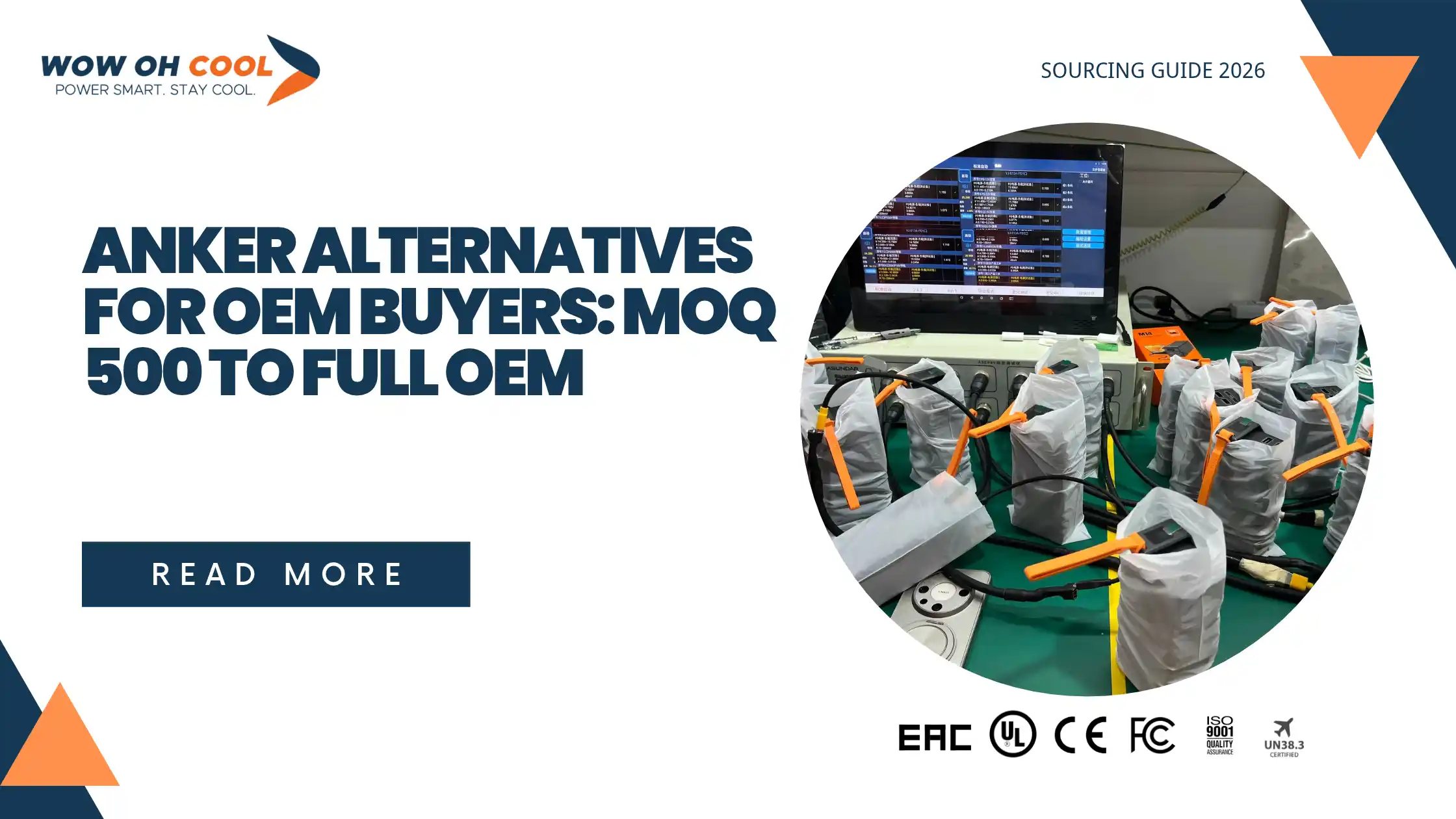
Aging and functional test records are the evidence a supplier scorecard should ask for.
6.1 What to put in the supply contract
- 1. Cell model and supplier in the purchase order. No substitution without written approval.
- 2. Change notification. Advance notice before any cell, IC or housing change.
- 3. Batch traceability. Each carton maps to a cell lot and production date.
- 4. Indemnity. The supplier carries recall and replacement cost for unauthorized changes.
- 5. Retained samples. Keep signed golden samples for each batch.
6.2 Anker-Level Supplier Scorecard: Seven Pass/Fail Checks
| # | Check | Pass threshold | Fail signal |
|---|---|---|---|
| 1 | Factory identity | Legal entity, USCC or registration number, site address | Only a trading company name |
| 2 | Certification scope | Certificate names the exact model and cell | "Similar model" coverage |
| 3 | Cell traceability | Cell model, supplier and lot on record | "Grade A" with no datasheet |
| 4 | Aging test | 100% 4-hour aging, with logs | Batch sampling only |
| 5 | AQL and defect data | AQL 0.65 normal / 0.25 tightened; defect rate below 0.3% | AQL quoted only as a buyer target |
| 6 | Change control | Written approval clause | Verbal assurance |
| 7 | Audit access | Live video or on-site audit allowed | Refuses process walkthrough |
A supplier that passes all seven is worth a premium. A supplier that fails two or more is a recall risk, regardless of price.
For the full audit sequence, use our China charger supplier verification guide and the on-site factory audit checklist.
7. Cost Model: Factory FOB vs Brand Distribution
The FOB price is only the first line. Build the full model before you choose a route.
Illustrative example: 65W multi-port GaN charger, 500 units
| Line | Low case | High case |
|---|---|---|
| FOB Shenzhen | $6.00 | $8.50 |
| Freight, insurance and packaging | $0.60 | $1.10 |
| Duty and import fees | Apply your market rate | Apply your market rate |
| Certification amortization ($2,500–4,500 ÷ 500 units) | $5.00 | $9.00 |
| Landed cost before duty | $11.60 | $18.60 |
| Wholesale price at 40% retailer margin on a $39.99 retail price | $24.00 | $24.00 |
| Gross margin before duty and marketing | $12.40 | $5.40 |
The certification line is the one buyers most often omit. At 500 units a $2,500–4,500 package adds $5.00–9.00 per unit, not cents. The program still clears $5.40–12.40 per unit before duty and marketing, but the high case leaves little room for returns. At 1,000–2,000 units the same package falls to $1.25–4.50 per unit. The numbers are illustrative.
Build your own model with the import cost and duty guide, which covers HS 8504.40, HS 8507.60 and the landed-cost formula.
7.1 What the model changes about your route
Authorized distribution has a different math. You buy at a distributor price and sell at retail. The margin is thinner, but you carry less certification and inventory risk. For a retailer testing demand, that can be the right trade.
For certification cost and timing, our certification guide for US and EU importers lists the standard packages. A CE/FCC/RoHS package with UN38.3 typically runs $2,500–4,500 and takes 4–6 weeks.
EXPERT INSIGHT "A buyer should never compare FOB quotes without normalizing what is included. Ask whether the quote covers Grade-A cells, the aging test, certification documents and retail packaging. A $1 difference per unit usually means one of those four items was removed." — Nina Nico, Global Procurement & Sourcing Manager at WOWOHCOOL, LinkedIn
Conclusion: Choose the Route Before the Supplier
Anker alternatives for OEM buyers are not another logo. They are four routes with different economics.
If you need stock now, distribution is fastest. If you need your own brand with limited risk, start with 500 units of ODM stock. If you need differentiation, move to platform design. If you need exclusivity, budget for full OEM tooling.
Whichever route you choose, verify the cell, the certificate scope and the change-control clause. The 2025 recall is a reminder that brand reputation does not replace supplier evidence.
Ready to compare a factory quote against your target retail price? Start your OEM project. We will send a line-item quote that separates product, certification and packaging, so you can compare it with any other supplier.
---
About the author
Nina Nico is WOWOHCOOL's Global Procurement & Sourcing Manager with 10+ years in 3C procurement. She specializes in B2B hardware sourcing, OEM/ODM power bank manufacturing, factory audits, supply chain quality assurance, and international trade compliance. LinkedIn
Frequently Asked Questions
Who manufactures Anker products?
Anker is a brand, not a private-label factory. It does not publish which contract manufacturers build its products, and it does not offer a public private-label program at 500 units. Its OEM arm works with large retail partners under private agreements. That is why "who makes Anker" is the wrong sourcing question. The same factory can build a reliable unit for one brand and a rebuilt-cell unit for another. Ask for the cell model, certificate scope and change-control clause.
Can I rebrand Anker products?
No. Unauthorized rebranding is trademark infringement. It also breaches the distribution agreement and exposes you to injunctions and damages. Authorized resale is legal, but the product keeps Anker's brand, packaging and pricing rules. If you need your own logo, the legal route is an ODM program from 500 units or a full OEM tool at 3,000+ units, both on a non-infringing design. Do not accept a supplier's offer to copy a branded enclosure.
What MOQ should I expect for an Anker-style product?
MOQ starts at 500 units for an existing ODM platform. That tier covers your logo, color and stock packaging. Platform design changes start at 1,000–2,000 units, and a fully custom product with a new mold starts at 3,000 units. The tier depends on who owns the design and whether a new tool is required, not on the product category alone. ODM stock is the lowest-risk way to test a market.
What lead time should I plan for an Anker-style product?
Plan 25–35 days for ODM stock and 2–4 months for full OEM. ODM stock samples ship in 3–7 days. ODM design development adds 25–45 days for design, then 25–50 days for production depending on packaging and structural changes. Full OEM to your drawings runs 30–60 days for mass production, and a new mold adds 2–3 months, for 2–4 months end to end. Add shipping time to your market.
How do I verify a supplier matches Anker-level specs?
Ask for five documents before you compare price. Request the cell datasheet, a UN38.3 report naming that cell model, a per-port load test, the factory's own AQL plan and 100% aging logs. Then compare a golden sample against the mass-production batch. Certificates that cover only a "similar model" are not enough. A supplier that cannot name its cell supplier is a trading company or a reseller, not a factory.
Is private label cheaper than authorized Anker distribution?
Private label usually earns a higher gross margin per unit. At 500 units, certification alone adds $5.00–9.00 per unit, before packaging, inventory and marketing. Authorized distribution has a lower margin and less control, yet it carries less certification and inventory risk. The right choice depends on whether you are building a brand or filling a shelf. Send your target retail price and volume to compare both routes.
Global Procurement & Sourcing Manager · 10+ years in 3C procurement & sourcing
Nina Nico is WOWOHCOOL's Global Procurement & Sourcing Manager with 10+ years in 3C procurement. She specialises in B2B hardware sourcing, OEM/ODM programme management, and supplier verification for charging accessories.
Factory Footprint
ISO 9001 Facility
Shenzhen, China
Export Countries
Engineers In-House
Comparing an Anker-Style Quote?
Send your target spec, MOQ and retail price. We will return a line-item FOB quote that separates product, certification and packaging.
Sources & References
- US Consumer Product Safety Commission, Recall 25-338
- Anker, PowerCore 10000 A1263 recall notice
- Wireless Power Consortium, Qi wireless charging standard
- 36Kr, Anker shareholder meeting and recall reporting, May 2026
- Jiemian News, Anker confirms cell supplier changed materials without approval, June 2025