

Key Takeaways
AQL 2.5 Level II is the minimum inspection standard across 3 stages (IQC, IPQC/during production, PSI): third-party PSI costs $250-400 per man-day; add a 4-hour full-load burn-in to every checklist.
- AQL 2.5 Level II is the minimum acceptable inspection standard for OEM chargers and power banks. At AQL 2.5 with a batch of 1,000 units: inspect 80 samples, reject the batch if 5+ units fail. This catches defect rates above 2.5% with 95% confidence. Never accept AQL 4.0 unless you're selling at dollar-store price points, that allows up to 32 defects per 1,000 units.
- 3 inspection stages every OEM order must pass: (1) Incoming Quality Control (IQC), verify raw materials and components before production starts; (2) In-Process Quality Control (IPQC), random line checks during SMT, assembly, and testing; (3) Pre-Shipment Inspection (PSI), AQL sampling of finished goods before container loading. Skipping any stage shifts the defect discovery risk entirely onto you.
- Third-party inspection costs $250-400 per man-day in China. A standard pre-shipment inspection takes 1-2 man-days. For a $15,000 order (1,000 units at $15/unit), a $500 inspection is 3.3% of order value, it pays for itself if it catches even 1% defect rate ($150 in replacements + freight + customs re-processing). Use SGS, Bureau Veritas, TUV, or Intertek, not a local agency the factory recommends.
- 4 specific tests to include in every PSI checklist for chargers: (1) full-load burn-in test (4 hours at 100% rated wattage, measure case temperature at 6 points); (2) hipot test (3,000V AC for 1 second, primary to secondary); (3) cable bend test (retractable or built-in cables: 5,000 cycles at 180 degrees); (4) connector insertion force test (5-20N for USB-C per USB-IF spec). If the factory can't perform all 4, find a different factory.
Table of Contents
Our 10-Layer Quality Control System
- IQC, Incoming Component Inspection: Cell grading, IC verification, material compliance
- IPQC, In-Process Monitoring: AOI, solder quality, coil alignment checks
- Stress Testing, Thermal: 4-hour full-load burn-in at 45°C ambient
- Stress Testing, Mechanical: Drop test (1.2m, 6 sides), vibration, salt spray
- Stress Testing, Electrical: Hi-pot, ESD immunity (8kV/15kV), output ripple
- Stress Testing, Safety: FOD detection, OVP/OCP/OTP triggers, short circuit
- FQC, Final Functional Test: Protocol handshake (PD 3.1, PPS, QC 5.0), charging speed
- Certification Verification: Cross-reference with UL/CE/FCC/UN38.3 test reports
- OQC, Outgoing Quality Check: Visual, packaging, labeling, barcode scan
- Traceability Logging: Unit-level test data archived for full batch recall capability
1. IQC: OEM Grade A Cell & Component Verification
Every component that enters our facility undergoes rigorous incoming inspection. We don't just buy batteries, we sort them to ensure 100% balance in our high-capacity packs.
Power Bank Cell Sorting
Every cell undergoes internal resistance (IR) testing and capacity grading. We match cells with identical performance profiles to ensure perfect balance in our high-capacity power banks.
GaN Chip Selection
Only Tier-1 GaN chips (Navitas, Innoscience, or equivalent) enter our SMT lines to guarantee thermal stability in high-wattage adapters.
Engineering Insight: Beware of factories that only do 'spot-checking' for aging tests. For high-density Power Banks and GaN chargers, 100% testing is the only way to ensure thermal safety. We provide full testing logs for every SKU.
EXPERT INSIGHT
"A factory's aging test capability tells you everything you need to know. If they can show you temperature logs for the last 10 production batches with data at 6 measurement points per unit, you're in a quality facility. If they say 'we test a few units per batch,' walk away. That's the difference between a 0.3% and a 5% field failure rate."
, Nina Nico, OEM Technical Lead at WOWOHCOOL
2. IPQC: Real-Time Production Monitoring
After SMT assembly, every unit undergoes automated optical inspection (AOI) and in-process quality checks to catch defects before they become problems.
Wireless Charger Coil Alignment
Precision coil alignment is verified by laser sensors to ensure maximum charging efficiency and 0% magnetic interference with the device.
AOI (Automated Optical Inspection)
Our SMT lines feature inline AOI cameras that detect misaligned components, solder bridges, and PCB defects in real-time, before the unit moves to the next stage.
3. The "Four Pillars" of Stress Testing
According to the US Consumer Product Safety Commission (CPSC), overheating and fire risks accounted for 65% of electronic charger-related recall incidents between 2020-2025, making stress testing the single most important QC gate for importers.
Different product categories require different "hell-level" stress tests. Here's how we ensure each type of device can withstand real-world abuse.
| Product Category | The "Crucial" Test | Our Standard | Why It Matters |
|---|---|---|---|
| GaN Charger | 4-Hour Full-Load Aging | 100% Units @ 45°C Ambient | Prevents early-life failure in high-wattage adapters |
| Power Bank | Drop & Impact Test | 1.2m Height (6 Sides) | Ensures safety if user drops device during travel |
| Car Charger | Vibration & Salt Spray | 24-Hour Constant Stress | Guarantees connection stability on bumpy roads |
| Wireless Pad | FOD (Foreign Object Detection) | Instant Shutdown (<0.5s) | Prevents fires if coins or keys placed on pad |
4. Final Quality Control (FQC) & Safety Certification
In June 2026, a Which? investigation exposed counterfeit chargers sold on major online marketplaces, some filled with modeling clay instead of proper circuits, failing basic hi-pot and insulation resistance tests. This is what happens when FQC is skipped to save $0.15 per unit.
Before any product leaves our facility, it undergoes comprehensive final inspection and certification verification.
Hybrid 2-in-1 Double Testing
Our hybrid devices undergo double testing, once as a wall charger and once as a power bank, to ensure the internal switching circuit is flawless when toggling between modes.
Compliance Verification
Every batch is cross-referenced with its UL, CE, FCC, and UN38.3 reports before shipment. We maintain a complete traceability system linking each unit to its test data. For certification requirements per market, see our US & EU certification guide.
5. OEM Factory QC vs Industry Standard
How do our quality control standards compare to typical charger manufacturers? Here's a side-by-side breakdown:
| QC Metric | Industry Average | WOWOHCOOL Standard |
|---|---|---|
| Defect Rate | 0.65–1.0% | < 0.3% |
| Aging/Burn-in Test | Spot-check (5–10% of units) | 100% units, 4 hours minimum |
| AQL Critical Defects | 0.065 | 0.0 (zero tolerance) |
| AQL Major Defects | 1.0–1.5 | 0.65 |
| QC Stages | 2–3 (IQC + FQC) | 4 full stages (IQC, IPQC, FQC, OQC) |
| Testing Equipment | Generic / uncalibrated | Keysight, Fluke, Tektronix (NIST-traceable) |
| Traceability | Batch-level only | Unit-level with full test data logs |
| Certification Support | CE/FCC basic | CE, FCC, UL, PSE, KC, Qi2, UN38.3 |
6. Understanding Inspection Levels & AQL
According to industry quality standards (ISO 2859/AQL), the acceptable defect rate for consumer electronics is 0.65-1.0%, with premium OEM manufacturers maintaining rates below 0.5% through rigorous testing protocols.
AQL (Acceptable Quality Limit) is the foundation of statistical quality control. It defines the maximum percentage of defective items allowed in a batch. Understanding AQL helps balance quality needs with production realities.
Standard AQL Levels for Chargers
| Defect Type | AQL Level | Example Defects |
|---|---|---|
| Critical | 0.0 or 0.065 | Safety hazard, electric shock risk, fire hazard |
| Major | 1.0 or 1.5 | Performance failure, wrong voltage output, broken enclosure |
| Minor | 2.5 or 4.0 | Minor scratches, color variation, loose packaging |
Sample Size Based on Batch Quantity
Using ISO 2859-1 inspection level II:
- Batch of 1,201-3,200 units →Sample 125 units
- Batch of 3,201-10,000 units →Sample 200 units
- Batch of 10,001-35,000 units →Sample 315 units
- Batch of 35,001-150,000 units →Sample 500 units
WOWOHCOOL Standard: We use stricter internal AQL levels (Critical: 0.0, Major: 0.65, Minor: 1.5) than most clients require, catching issues before they reach your market.
7. Comprehensive QC Inspection Checklist
A thorough inspection covers multiple aspects of the charger. Here's what your QC process should include:
Visual & Appearance Inspection
- Housing: No cracks, dents, scratches, or discolorations
- Logo & Labeling: Correct placement, spelling, and branding
- Color Match: Consistent with approval samples (Delta E < 2.0)
- Texture: Consistent finish (matte/gloss) as specified
- USB Port: No debris, bent pins, or misalignment
- Plug Pins: Proper plating, no corrosion, correct dimensions
- LED Indicators: Correct color, brightness, and position
- Assembly Gaps: Uniform gaps (< 0.5mm) between parts
Functional & Electrical Testing
- Input Voltage: Verify rated input (100-240V for universal chargers)
- Output Voltage: Within ±5% of specified output
- Output Current: Meets rated current under load
- Standby Power: < 0.3W for energy efficiency compliance
- Power Efficiency: ≥90% for standard chargers, ≥95% for Level VI
- No-load Power Consumption: < 0.5W
- Output Ripple & Noise: < 200mV peak-to-peak
- Charging Compatibility: Tests with target devices
Protection Feature Testing
- Over-Voltage Protection (OVP): Triggers at 120-130% of rated output
- Over-Current Protection (OCP): Limits current at 110-150% of max
- Short Circuit Protection: Withstands shorted output for 1 hour
- Over-Temperature Protection: Shuts down at 80-100°C
- ESD Immunity: Survives 8kV contact, 15kV air discharge
Packaging & Labeling Check
- Barcode/UPC/EAN: Scannable and correct
- Model Number: Matches purchase order
- CE/FCC/RoHS Marks: Present and accurate
- User Manual: Included and in correct language
- Cable & Accessories: Present per specification
- Box Condition: No damage, proper sealing
- Master Carton: Correct count, labeling, barcodes
8. Essential Testing Equipment for OEM Factory QC
Proper testing requires appropriate equipment. Here's what professional QC facilities use:
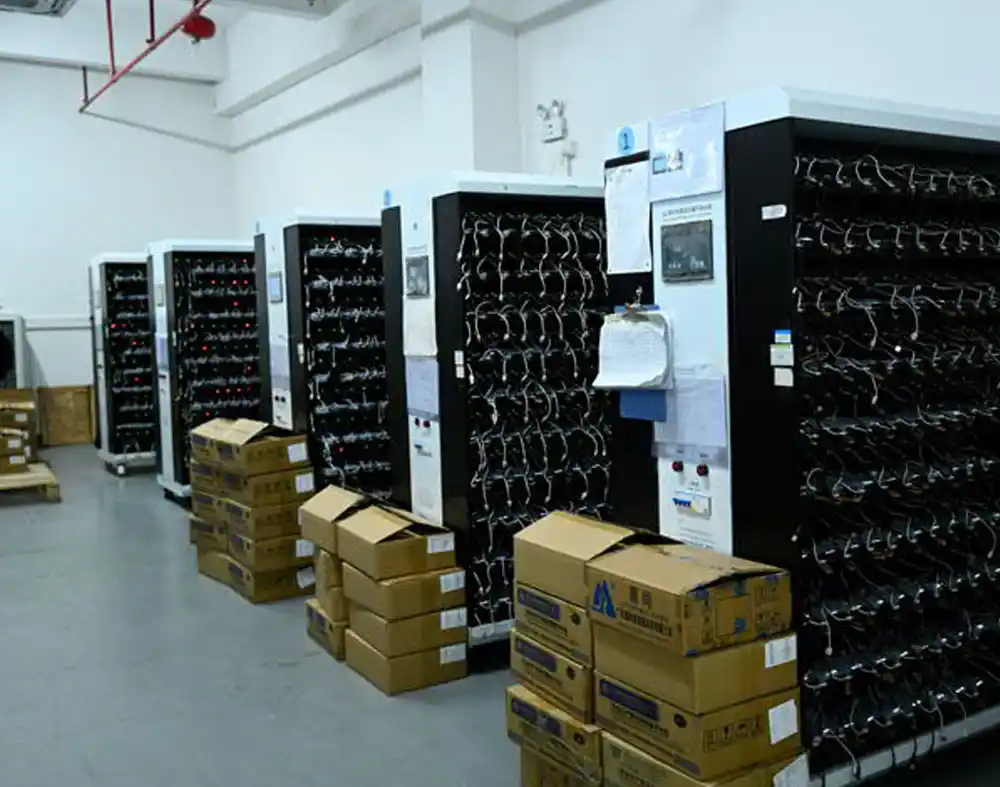
100% full-load burn-in aging test at 45C ambient: every WOWOHCOOL charger undergoes 4-hour continuous testing, catching infant-mortality failures before shipment, targeting <0.5% field defect rate
Electronic Load
Simulates device loading to test charger output under various conditions. Recommended: Keysight DL3021, or similar 150W+ DC electronic load with CC/CV/CR modes.
Digital Multimeter
Measures voltage, current, and resistance accuracy. Recommended: Fluke 87V or Keysight 34461A for precision measurements.
Oscilloscope
Analyzes output ripple, noise, and transient response. Recommended: Keysight DSOS104A or Tektronix MDO3104 with 100MHz+ bandwidth.
Hi-Pot Tester
Tests dielectric strength between primary and secondary circuits. Safety-critical test for all chargers.
EMC Test Equipment
For radiated and conducted emissions testing. Most factories use third-party EMC labs rather than in-house equipment.
Burn-in Test Chamber
Aging test equipment that operates chargers at elevated temperature (40-45°C) for 4-24 hours to identify early failures.
WOWOHCOOL's QC lab is equipped with Keysight, Fluke, and Tektronix testing equipment, all calibrated annually to NIST-traceable standards.
9. OEM QC Inspection Process: Step-by-Step Walkthrough
A systematic approach ensures consistent quality evaluation:
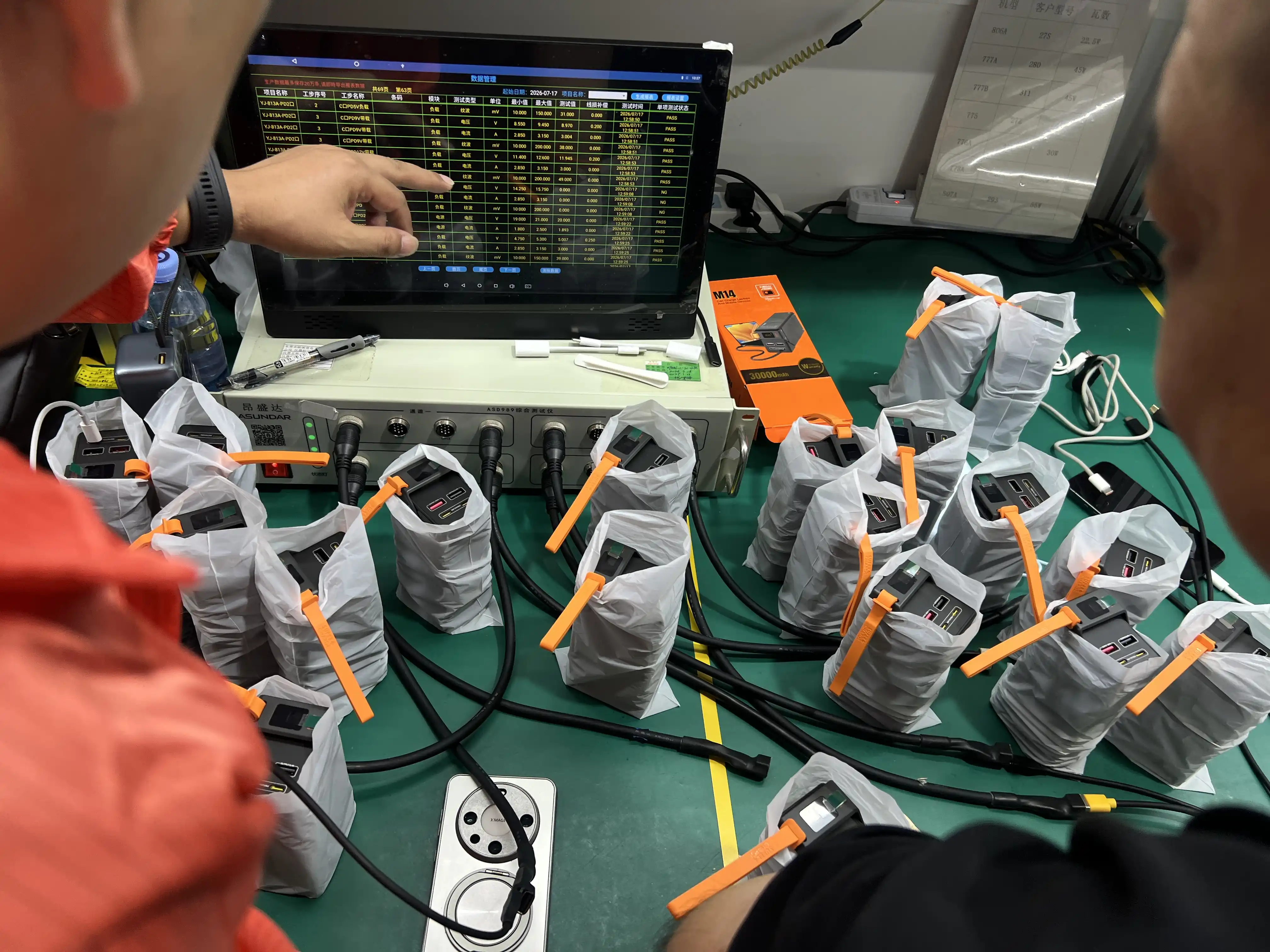
AQL sampling inspection for 20,000mAh power bank batch: random sample testing covers capacity verification, voltage stability, fast charging protocol handshake, and physical inspection, standard AQL 0.65 for critical defects per ISO 2859-1
Pre-Inspection Preparation
Review purchase order specifications, approval samples, and any special requirements. Establish acceptance criteria and AQL levels with the supplier before inspection.
Random Sampling
Select samples randomly from different boxes/cartons across the batch. Use the appropriate sample size based on batch quantity and inspection level.
Visual Inspection
First pass all samples through visual inspection under standardized lighting (800-1000 lux). Sort defects into Critical, Major, and Minor categories.
Functional Testing
Test all samples for electrical performance using calibrated equipment. Record actual readings vs. specifications.
Destructive Testing (Sample Basis)
Hi-pot testing, drop tests, and cable pull tests on small sample sizes to verify safety and durability.
Results Evaluation
Compare defect counts against AQL limits. Calculate defect rate and determine pass/fail status.
Documentation & Reporting
Document all findings with photos. Create detailed inspection report with defect descriptions, measurements, and recommendations.
10. Common Charger Defects & Prevention
Understanding common defects helps you focus your inspection efforts:
Output Voltage Out of Tolerance
Acceptance: ±5% of rated output
Prevention: Request voltage regulation curves and test under various load conditions (25%, 50%, 75%, 100%).
LED Indicator Malfunction
Acceptance: Correct color, brightness, and blink patterns
Prevention: Test LED operation in all charging states (no load, charging, full, error conditions).
USB Port Loose or Detached
Acceptance: Ports withstand 10N insertion force, 50 removal cycles
Prevention: Request USB port pull/push tests. Check solder quality via X-ray if possible.
Excessive Output Ripple
Acceptance: < 200mV p-p for most applications
Prevention: Use oscilloscope to measure ripple under full load. High ripple can damage sensitive devices.
Color Mismatch
Acceptance: Delta E < 2.0 vs. approval sample
Prevention: Provide color standards with Delta E measurements. Test under standardized D65 lighting.
11. Third-Party Inspection Services
For brands without in-house QC teams, third-party inspection services provide independent verification. Major providers include:
Asia Quality Focus (AQF)
Specialized in electronics, competitive pricing, same-day reporting available.
QIMA (formerly AsiaInspection)
Global coverage, digital platform, ESG and social compliance audits.
SGS
Premium option with laboratory testing capabilities, widely recognized certification.
Bureau Veritas
Full-service inspection, testing, and certification with global presence.
Typical third-party inspection costs range from $150-400 per inspection day depending on complexity and location.
12. Building Supplier QC Capability
The best approach is working with suppliers who have strong inherent QC processes. Here's what to look for and how to develop it:
Supplier QC Checklist
- ★ISO 9001 certified with current audit certificates
- ★Dedicated QC team with documented procedures
- ★In-line inspection at each production stage
- ★AQL-based final inspection before shipment
- ★Calibrated testing equipment (evidence of calibration certificates)
- ★First Article Inspection (FAI) process for new products
- ★Traceability system (batch/lot tracking)
- ★Corrective Action Request (CAR) process for defects
- ★Statistical Process Control (SPC) for critical parameters
- ★Customer quality feedback integration
WOWOHCOOL's OEM/ODM services include comprehensive quality management with documented SOPs, IPC standards, and continuous improvement programs meeting ISO 9001:2015 requirements.
13. QC Standards: Quality as Your Competitive Advantage
Quality control isn't about catching defects. It's about preventing them. A well-designed QC program reduces costs, protects your brand, and builds long-term customer trust.
Whether you're importing power chargers, wireless chargers, or custom OEM products, investing in quality control pays dividends in reduced returns, better reviews, and stronger brand reputation.
Ready to source quality chargers? Contact our team to discuss your quality requirements and how we can help you achieve them.
Book a Virtual Factory Tour
See our QC lab in action. Our engineering team will walk you through our 10-layer testing process via live video call.
"Quality control is not a department, it is a mindset that must run through every stage of production," says Nina Nico, Global Procurement & Sourcing Manager at WOWOHCOOL. "From incoming component inspection to final outgoing checks, each step exists to catch defects before they reach your customers. That is how we maintain our 0.3% defect rate."
For a complete overview of factory QC standards, see our factory verification checklist. Learn about charger safety certifications and compliance requirements in our charger safety standards guide.
WOWOHCOOL FACTORY STAT
WOWOHCOOL's 4-stage QC system (IQC, IPQC, FQC, OQC) applies to all products, from TFT display power banks to GaN chargers, with 100% 4-hour aging tests on every unit and a target defect rate of 0.5%. ISO 9001 certified since 2013, their Shenzhen factory produces 1,000,000+ units monthly with consistent quality across repeat orders.
Frequently Asked Questions
Factory defect rate, what should OEM buyers expect from a quality charger supplier?
Per ISO 2859/AQL, the acceptable defect rate for consumer electronics is 0.65-1.0%. Premium OEM manufacturers maintain rates below 0.5%. At WOWOHCOOL, our defect rate has been under 0.3% since 2013, verified by 100% functional testing, 4-hour aging on every unit, and 4-stage QC (IQC→IPQC→FQC→OQC). A factory quoting "zero defects" without showing you the QC data is not being honest, every production line has a measurable defect rate.
Burn-in aging test, what standards should OEM buyers require before accepting a charger shipment?
A burn-in aging test runs every charger at 100% rated load for 4+ hours while monitoring case temperature, output voltage stability, and ripple noise. This catches early-life failures (infant mortality) before units leave the factory, without it, these failures happen in the customer's hands. A proper burn-in setup uses temperature-controlled racks at 25°C ambient, with 6-point thermal measurement per unit. Ask your factory for a photo of their aging racks fully loaded, an empty rack in a product photo is a red flag.
How much does third-party QC inspection cost in China?
A full-day factory audit by SGS, Bureau Veritas, or TÜV Rheinland costs $350-500 per man-day within Shenzhen/Dongguan/Guangzhou. Pre-shipment inspection runs $250-350/day. For a $15,000 order (1,000 units), a $500 inspection is 3.3% of order value, it pays for itself if it prevents even one batch of defective units ($150+ in replacements + freight + customs reprocessing). Specialist firms (QIMA, V-Trust) charge $210-290/day with faster booking.
What AQL 2.5 Level II standard should OEM buyers specify in factory QC agreements?
AQL (Acceptable Quality Limit) 2.5 Level II is the minimum standard for consumer electronics. For a batch of 1,000 units: inspect 80 random samples. If 5 or fewer fail, accept the batch. If 6+ fail, reject. This catches defect rates above 2.5% with 95% confidence. Never accept AQL 4.0 (allows 14 defects per 1,000) unless you are selling at dollar-store price points. For critical safety components, specify AQL 1.0 or tighter.
How do I implement a QC program for my OEM charger order?
Step 1: Specify AQL 1.0 (critical), 2.5 (major), 4.0 (minor) in your purchase agreement. Step 2: Require 100% 4-hour burn-in aging per unit with temperature logs per batch, not batch sampling. Step 3: Budget $500 for pre-shipment third-party inspection (SGS/BV/TUV), 3.3% of a $15,000 order. Step 4: Demand 5 QC documents per batch: IQC, IPQC, FQC, OQC, and aging test logs. Step 5: Verify factory has AOI, X-ray, hipot tester, thermal chamber, oscilloscope, and PD protocol analyzer. WOWOHCOOL: 4-stage QC, 100% aging test, under 0.3% defect rate since 2013. Request QC documentation from our latest production batch.

Global Procurement & Sourcing Manager · Wireless Charging Specialist
Nina Nico is a supply chain management expert with 10+ years experience helping global B2B clients source quality chargers from WOWOHCOOL, a premium charging solution specialist in Shenzhen, China since 2013, maintaining ISO 9001:2015 with defect rates under 0.3%. She holds a degree in International Trade and is a certified supply chain professional (CSCP), with deep expertise in Qi2, GaN, and semi-solid-state battery manufacturing.
Factory Footprint
ISO 9001 Facility
Shenzhen, China
Export Countries
Engineers In-House
Need a Reliable QC Partner?
WOWOHCOOL offers rigorous 10-layer quality control with 100% aging testing on every charger. Get factory-direct pricing with certified quality assurance.
Start Your Project
Ready to Source
from the Factory?
Get a custom quote for OEM/ODM charging products. Our engineers respond within 4 hours.
Or call us directly: +86-186-2078-9739