
Power Bank Private Label: OEM Production for EU & US Brands

Global Procurement & Sourcing Manager · 10+ years in OEM/ODM Manufacturing
"Two years ago, a US Amazon seller started with 500 branded power banks. Today they sell over 10,000 units annually under their private label, with 4.5 stars and 900+ reviews."
This is how dozens of success stories unfold for brand owners in the US and Europe. The global power bank market exceeds 15 million units sold annually in Germany alone, with a market volume of roughly 700 million euros, and over 90% import-dependent. In the US, the market is even larger. Those who build a private label benefit from margins of 40-60% and a growing market (+8% annually). This guide walks you step by step from product selection through branding, certification, and legal requirements to a successful market launch, with real cost examples, concrete MOQ figures, and common mistakes to avoid.
Key Takeaways
Laser engraving is the best-value branding method at ~$0.15/unit (permanent, single-color), against ~$0.08/unit for silk screen and ~$0.25/unit for UV digital. A private-label launch budget runs $3,500-$18,000 covering tooling, packaging, certification and the first order. Six certifications are mandatory before the first shipment (CE, FCC, RoHS, UN38.3, MSDS, WEEE) at $1,500-5,000 total.
- 3 branding methods ranked by cost: laser engraving (~$0.15/unit, permanent, single-color), silk screen printing (~$0.08/unit, multi-color, wears over time), UV digital printing (~$0.25/unit, full-color, photo-quality). Laser: MOQ 500 units. Silk screen: MOQ 1,000 units. UV printing: MOQ 3,000 units. Laser is the default for premium brands; silk screen for budget lines.
- Total private-label launch budget: $3,500-$18,000 depending on complexity. Breakdown: mold tooling $0-5,000 (if using existing mold vs custom housing), packaging design $500-2,000, certification testing $1,500-5,000, first order deposit (30% of PO value). A "minimum viable launch" with existing ODM mold + laser logo + 500 units can start at $3,500.
- FOB pricing at MOQ 500 for private-label power banks (Grade-A cells, factory-direct): 5,000mAh basic ~$4.80-6.50, 10,000mAh with digital display ~$5.80-8.00, 20,000mAh 65W laptop-capable ~$12.00-16.00, semi-solid-state 10,000mAh ~$14.00-18.00. Budget factories using generic Chinese cells quote 15-25% lower, but at the cost of higher defect rates (2-5% vs <0.3%) and 3-5× higher field returns. Add $0.50-1.00/unit for custom packaging with your brand's UPC barcode and retail-ready box.
- 6 mandatory certifications before your first shipment: CE (EU), FCC (US), RoHS, UN38.3 (air freight safety), MSDS (Material Safety Data Sheet), and WEEE registration (EU). Budget $1,500-5,000 total, 4-8 weeks. Your factory should handle testing, verify by requesting the lab's contact info and calling them directly to confirm the certificate is genuine.
Table of Contents
WOWOHCOOL FACT
Over 15 million power banks are sold annually in Germany alone, a market volume of roughly 700 million euros with 8% annual growth. The US market is even larger. WOWOHCOOL has been manufacturing since 2013 in an ISO 9001-certified 5,000 m² facility in Shenzhen, producing OEM/ODM power banks with MOQ from 500 units, PD 3.1 up to 140W, and 25-30 day lead times. Over 50 brands from the US, Germany, Austria, and Switzerland source their private label power banks from us, factory-direct, no intermediaries.
1. Why Launch an OEM Power Bank Private Label?
The global power bank market is growing 8-10% annually, driven by the increasing number of mobile devices per user. In the US and Europe, hundreds of millions of power banks are sold each year, through Amazon (roughly 45% market share), electronics retailers, as promotional products, and as corporate gifts. For businesses in the US and Europe, a power bank private label offers one of the most attractive ways to position themselves in this market, without owning a factory, without R&D expertise, and without warehousing.
Getting started is easier than many think. Thanks to mature OEM processes in China, you can build your own power bank brand with a manageable investment of 8,000-18,000 EUR (500 units, all-in). Your manufacturer handles production, branding, and certification, you focus on sales, marketing, and building your brand.
Three Paths to a Power Bank Private Label
Depending on who you are, your entry point looks different:
- Amazon and E-Commerce Sellers: You need a differentiated product with good margins. Start with 500-1,000 units of a standard power bank with your logo. Test the market, collect reviews, and scale on success. Your focus: FBA-compliant packaging, strong product images, and keywords.
- Established Brands or Specialty Retailers: You already have a customer base and want to expand your product line. Focus on premium features (semi-solid-state, GaN, Qi2 wireless) and custom packaging. Your focus: brand consistency, TUV GS / UL listing, and B2B distribution channels.
- Corporate Gift and Promotional Product Buyers: You need high-quality power banks with your company logo for trade shows, events, and customer loyalty. Start with compact models (5,000-10,000 mAh) and laser engraving. Your focus: premium feel, fast delivery, and gift packaging.
Particularly in demand: models with fast USB-C PD charging, high capacity, and compact design. Semi-solid-state power banks and power banks with integrated cables or Qi2 wireless charging are increasingly gaining importance as differentiation features.
2. Step 1: Which OEM Power Bank for Your Private Label?
The first step is choosing the right base model. WOWOHCOOL offers a wide range of power bank models for your private label project that you can customize with your branding. For the US and European markets, we recommend the following categories:
- Compact Power Banks (5,000-10,000 mAh): Ideal for promotional products, giveaways, and daily use. Lightweight, affordable (from 5-8 EUR/unit at 1,000 units), and sufficient for most smartphone users. Especially popular with corporate clients and as trade show giveaways.
- Standard Power Banks (10,000-20,000 mAh): The best-selling category. Perfect for Amazon and specialty retail, with enough capacity for multiple charges. Models with integrated USB-C cable or digital charge display differentiate your product.
- High-Capacity Power Banks (20,000+ mAh): For heavy users, business travelers, and tech enthusiasts. Often with PD 3.1 up to 140W, semi-solid-state technology, and multiple ports. Higher margin, smaller target audience.
- Specialty Power Banks: 2-in-1 chargers (wall charger + power bank), Qi2 wireless power banks, or power banks with integrated retractable cables. Ideal for differentiation in saturated market segments.
Factory-Direct vs. Intermediaries: Why the Direct Route Saves 20-40%
An estimated 40-60% of power bank listings on Alibaba are trading companies, not manufacturers. These intermediaries add 15-25% to the factory price without their own quality control. A factory-direct partner like WOWOHCOOL gives you: direct access to R&D (50+ engineers), transparency into the 4-stage QC process, and the confidence that your contact is also the producer. Verify: ISO 9001, minimum 5,000 m² production floor, video audit of manufacturing.
3. Step 2: OEM Branding Methods: Laser, Silk Screen & MOQ
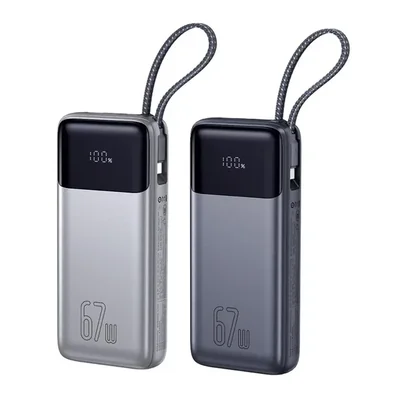
There are several methods to apply your logo to the power bank. The choice depends on the material, budget, and desired appearance. Our OEM/ODM service covers all branding methods:
| Method | Durability | Cost | MOQ | Ideal Use Case |
|---|---|---|---|---|
| Laser Engraving | Very High | Medium | 500 | Metal housings, premium brands |
| Silk Screen | High | Low | 1,000 | Plastic housings, large runs |
| UV Printing | Medium | Low | 3,000 | Small runs, multi-color logos |
| Metal Plaque / Embossing | Very High | High | 500-1,000 | Gift boxes, luxury brands |
| Label / Sticker | Low | Very Low | 10-100 | Small batches, promotional items |
For beginners, we recommend silk screen printing, the best value for money with an acceptable minimum order quantity. For premium brands, laser engraving is the best choice: elegant, virtually indestructible, and no fading. Make sure your manufacturer provides a proof sample with your logo before mass production.
4. Step 3: How to Design Your Packaging
Packaging is the first physical contact your customer has with your brand, and it is especially important in Western markets. US and European buyers expect high-quality packaging with clear product information.
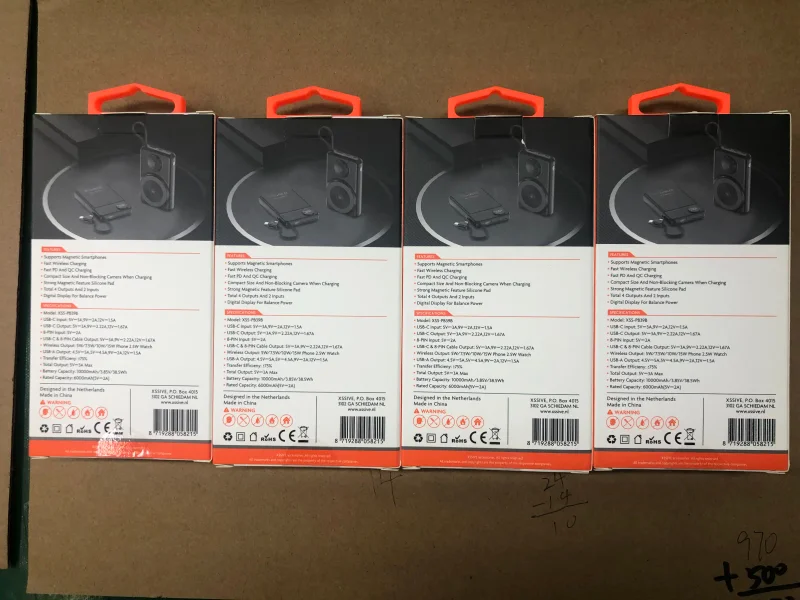
Finished private label power bank with custom retail packaging: packaging design, material selection, and certification mark placement is a 2-3 week process before mass production begins
You have several options:
- Standard Packaging with Logo: Neutral packaging with your logo printed on. Cost-effective, MOQ from 500 units, approx. 0.30-0.60 EUR/unit.
- Custom Folding Carton: Fully designed to your specifications, brand colors, product images, USPs. MOQ from 1,000 units, approx. 0.80-2.00 EUR/unit.
- Premium Gift Box: Magnetic closure, interior printing, finishing (foil stamping, spot UV). Ideal for corporate gifting. MOQ from 2,000 units, approx. 2.50-5.00 EUR/unit.
- Sustainable Packaging: Recycled or FSC-certified materials. Growing trend among Western consumers, 67% pay attention to sustainable packaging according to market research.
- Multi-Language Packaging: For the US market, English-language packaging and manuals are required. For the EU, local language packaging and instructions are mandatory (ProdSG). Your manufacturer should be able to produce these.
Amazon FBA Packaging: What You Need to Know
If you sell via Amazon FBA, your packaging must meet FBA requirements: minimum package size 15 x 10 x 2 cm, barcodes (GTIN/UPC) on the outside, no loose parts, and a secure closure. Excessively large packaging leads to high storage fees (since 2024: expanded volume-based fees). Have your manufacturer provide FBA-compliant packaging samples before mass production.
5. Step 4: OEM Private Label Cost, FOB Pricing & MOQ Breakdown
Cost is the crucial question for most beginners.
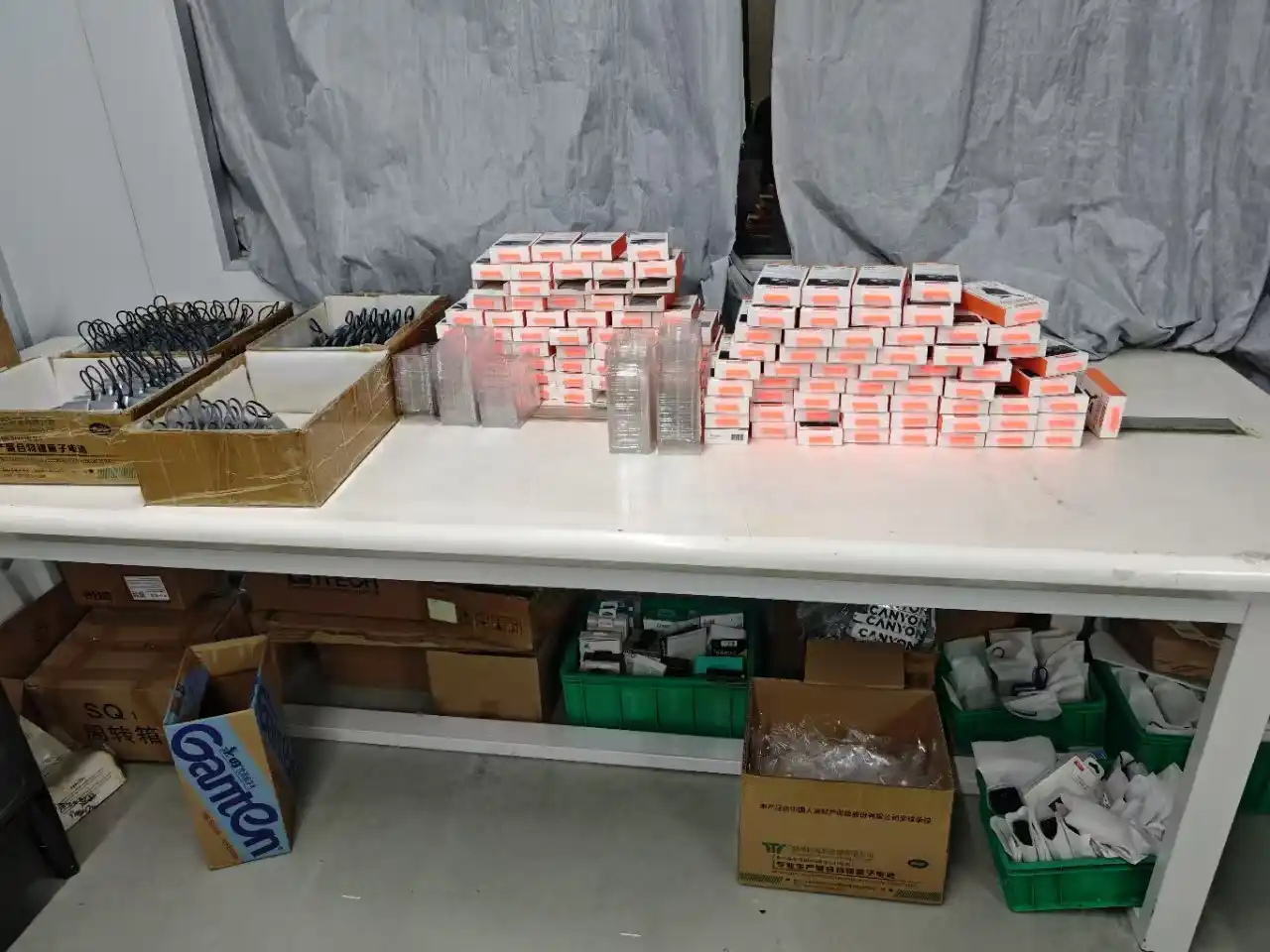
Packaging sampling inspection for 10,000mAh private label power bank: verify print quality, barcode scannability, and FBA-compliant dimensions, packaging defects account for 12% of Amazon FBA rejections
Here is a transparent cost breakdown, all figures are all-in for import into Europe (US figures are similar, with slight variations in duties and shipping):
Standard Power Bank 10,000 mAh: All-In Cost Per Unit
| Cost Item | 500 Units | 1,000 Units | 5,000 Units |
|---|---|---|---|
| Unit Price Power Bank (FOB) | 10.00 € | 8.50 € | 6.80 € |
| Logo (Silk Screen) | 1.20 € | 0.80 € | 0.50 € |
| Custom Packaging | 1.50 € | 1.00 € | 0.70 € |
| Shipping (Air Freight + Customs) | 3.50 € | 2.50 € | 1.80 € |
| Import VAT / Duties (19%) | 2.85 € | 2.24 € | 1.59 € |
| Take-Back / WEEE / Packaging Reg. (pro rata) | 0.15 € | 0.10 € | 0.05 € |
| Total Cost Per Unit | 19.20 € | 15.14 € | 11.44 € |
| Total Investment | 9,600 € | 15,140 € | 57,200 € |
One-Time Fixed Costs (Before Your First Order)
- EU Battery Take-Back Registration (e.g., Stiftung EAR): approx. 150-250 EUR (one-time + annual fee)
- WEEE Registration (EU): approx. 120-180 EUR (one-time + annual fee)
- Packaging Act Licensing (e.g., LUCID): approx. 50-100 EUR/year (volume-dependent)
- Trademark Registration (USPTO): 250-350 USD per class (optional, but recommended)
- Trademark Registration (EUIPO): 300-600 EUR (optional, but recommended)
- Sample Order (3-5 units incl. express shipping): 150-300 EUR
- FCC Certification (US): approx. 2,000-5,000 USD (mandatory for US market)
- UL Listing (US, optional): approx. 3,000-8,000 USD
- Third-Party QC Inspection (optional): 300-500 USD per inspection
At a typical retail price of 29.99-49.99 EUR/USD (Amazon) or 39.99-69.99 EUR/USD (own store), you retain a gross margin of 40-65%, after deducting Amazon fees (approx. 15%), marketing (approx. 10%), and overhead (approx. 5%), a net margin of 15-30%.
Typical payment terms with the manufacturer: 30% deposit upon order confirmation, 70% before shipment (T/T). For beginners, FOB Shenzhen is common; DDP (Delivered Duty Paid) is more convenient, the manufacturer handles all shipping and customs formalities, and import duties are already included in the price.
6. Step 5: OEM Certifications for Importers: CE, FCC, UL & UN38.3
To sell in the US and Europe, your private label power bank needs specific certifications and markings. These are non-negotiable and must be clarified before ordering. Missing certificates lead to customs stops, legal warnings, and fines:
- CE Marking (EU): Mandatory for the EU market. The manufacturer must issue a CE Declaration of Conformity and affix the CE mark to the product. Verify: is the CE marking on the power bank itself or only on the packaging? The former is correct.
- FCC (US): Mandatory for the US market. The FCC Declaration of Conformity ensures the device does not cause harmful interference. Your product must display the FCC ID or compliance statement.
- RoHS: Proof of hazardous substance compliance, mandatory for all electronic devices in the EU market.
- UN38.3: Mandatory for transporting lithium batteries, without this certificate, your goods will not be transported by air or sea freight. Includes eight individual tests including overcharge, short circuit, and impact testing.
- UL Listing (US, optional): UL 2056 or UL 2743 certification is voluntary but a strong selling point in the US market. Products with UL listing often achieve 10-20% higher prices and are preferred by retailers.
- TUV GS (EU, optional): The GS mark (Tested Safety) is voluntary but a strong selling point in the German market. Products with the GS mark often achieve 10-20% higher prices and are preferred by retailers.
Certification document costs range from 3,000 to 8,000 EUR depending on the product. An experienced OEM manufacturer can minimize these costs by providing existing test certificates for the base model. Important: Have the certificates shown to you as PDFs BEFORE ordering and verify their validity, fake certificates are a known problem.
7. Step 6: Regulatory Compliance & Your Legal Obligations as an Importer
Most important rule first: As soon as you place power banks on the market in the US or EU, you are legally considered the "manufacturer" or "importer of record", even if the devices were produced in China. You bear full responsibility for registration, labeling, and take-back compliance.
EU: Battery and WEEE Regulations
For EU importers, battery and electronic waste regulations are the most important legal obligations. Key requirements at a glance:
- National Battery Register Registration: Mandatory for anyone placing batteries or battery-powered devices on the EU market for the first time. In Germany, registration is done online at stiftung-ear.de. Processing time: 4-6 weeks.
- Take-Back Scheme: You must sign a contract with an approved take-back system (e.g., GRS Batteries, CCR REBAT). This organizes the collection and recycling of waste batteries. Cost: approx. 100-200 EUR/year depending on volume.
- Labeling Requirements: Every power bank and packaging must display the crossed-out waste bin symbol, the registration number, and, where applicable, the chemical symbol (Pb, Cd, Hg).
- Reporting Obligations: Quarterly reporting of battery quantities placed on the market to the national register, with an annual summary.
WEEE: Waste Electrical and Electronic Equipment
In addition to battery regulations, you must register the power bank itself (the electronic device) under WEEE, also with the national register. Power banks fall under Category 6 (small IT and telecommunications equipment). Same applies: registration, take-back scheme, and quarterly reporting.
Packaging Act
For your product packaging, you need licensing in the national packaging register (e.g., LUCID in Germany). Cost: from approx. 50 EUR/year for small volumes. Without registration, a distribution ban applies.
US: FCC and State-Level Requirements
For the US market, FCC certification is mandatory. Additionally, some states (such as California with Proposition 65) have their own labeling and substance restrictions. UL listing, while voluntary, is strongly recommended for Amazon and retail channels, many retailers will not stock products without it.
EU Battery Regulation 2023/1542: What's Changing
The new EU Battery Regulation 2023/1542 introduces expanded labeling requirements from August 2026: QR code with performance data, voltage, capacity, weight, manufacturer information, and critical raw material data. Important: The mandatory digital battery passport starting February 2027 does NOT apply to power banks, it only covers EV, industrial, and LMT batteries over 2 kWh.
Sanctions for Violations: Fines up to 100,000 EUR (EU), product delisting on Amazon and other platforms, account suspension, and in the worst case, recall campaigns with costs of 650,000-1,000,000 EUR (per Allianz Risk Barometer). In the US, CPSC fines can exceed 15 million USD for serious violations. Registration is not an option, it is mandatory.
8. Step 7: Supplier Sample Inspection and Quality Control
Always order samples of the fully branded power bank before mass production. This is the most important quality assurance step in the entire process. A reputable manufacturer delivers samples within 3-7 days. Inspect systematically:
- Logo Position and Quality: Is the print clean, straight, and durable? Rub with a damp cloth, good silk screen printing does not smear.
- Packaging: Does the power bank fit securely in the packaging? Are all prints correct and in the right language?
- Charging Performance: Measure with a USB-C meter, does the actual charging output match the specifications? Deviations over 10% are a quality defect.
- Compatibility: Test with iPhone, Samsung, and at least one other device.
- Safety: Does the power bank get unusually hot under continuous load? A good BMS (Battery Management System) protects against overcharging and short circuits.
Only approve mass production once the sample meets your requirements. A professional manufacturer will produce correction samples if needed.
Third-Party Quality Control: Is It Worth It?
During mass production, third-party quality control by SGS, TUV Rheinland, or Bureau Veritas is recommended. An inspector checks a random sample (typically AQL 2.5) before shipment for compliance with your specifications. Cost: 300-500 USD per inspection. For an order of 1,000+ units, this investment is generally worthwhile, it has saved many importers from a shipment with a 15% defect rate.
A good OEM manufacturer also has its own 4-stage QC process: IQC (Incoming QC), IPQC (In-Process QC), FQC (Final QC), and OQC (Outgoing QC), including a 4-hour aging test for each individual power bank. Ask about this process in detail, vague answers are a warning sign. Read our guide on quality control for OEM production in China for more details.
9. Step 8: How to Launch Your Private Label
Once your private label power bank is produced and all registrations are complete, the market launch begins. The most important sales channels for the US and European markets:
Amazon FBA: The Fastest Route to Your First Sale
Amazon is the most important channel for launching, with roughly 45% market share in many Western markets. With a professional product listing, A+ Content, optimized keywords, and high-quality product images, you can quickly generate first sales and reviews. This is crucial: products with 50+ reviews and 4+ stars have 3x higher conversion rates than new listings.
- Amazon Brand Registry: Register your brand before listing, protects against copycats and gives access to A+ Content.
- GTIN/UPC: You need a valid GTIN (UPC in the US) for your product. Purchase these from GS1 (approx. 140 EUR/USD per year for a prefix).
- Advertising Budget: Plan 500-1,500 EUR/USD per month for the first 3-6 months for Amazon PPC to build visibility and first reviews.
- Returns: Expect a 3-8% return rate for power banks, factor this into your margin.
Additional Sales Channels
- Own Online Store: Shopify or WooCommerce for long-term brand building. Full control over pricing and customer data. Recommended from 50+ orders/month.
- B2B Corporate Gifting: Companies seek high-quality power banks with their logo for trade shows and events. Higher margins (60-80%), lower return rates (under 3%), recurring orders.
- Specialty Retail: Electronics stores and specialty retailers like to list private labels with UL/GS certification and professional packaging. A professional trade presentation and a wholesale/retail price calculator are essential here.
Many successful power bank brands start on Amazon and later build additional channels. The advantage: you learn the market, collect customer feedback, and can optimize your product before investing in more expensive sales channels.
10. The 5 Most Common Mistakes, and How to Avoid Them
From over 10 years of OEM experience with US and European customers, we know the typical pitfalls. Avoid these five cardinal mistakes:
Mistake 1: Not registering for compliance: and then the legal warning arrives
This is by far the most common and expensive mistake. Importers order 1,000 power banks, list them on Amazon, and six weeks later receive a legal warning for missing compliance registration. Result: product suspension, fines up to 100,000 EUR (EU) or CPSC action (US), destruction of remaining stock. Solution: Apply for all mandatory registrations BEFORE your first order. Processing time: 4-6 weeks. And: appoint an authorized representative in the region if your company is not based there.
Mistake 2: Only looking at the lowest price
The cheapest supplier on Alibaba is rarely the best. A price difference of 1-2 EUR per unit can mean: inferior battery cells (instead of Grade A Samsung/LG), missing protection circuits, or even no CE/FCC compliance. The result: 15% defect rate, negative Amazon reviews, and returns that eat up every initial saving. Solution: Compare 3-5 manufacturers, verify ISO 9001, and explicitly ask about the cell brand used.
Mistake 3: Not checking certificates before ordering
"No problem, we'll send the certificates later", this sentence is a red flag. Without valid CE, FCC, and UN38.3 certificates, your goods will be held at customs. Fake certificates are a known problem in China. Solution: Have all certificates shown to you as PDFs before the deposit. Verify CE certificates via the EU database (NANDO). FCC IDs can be checked on the FCC website. UN38.3 test reports must come from an accredited laboratory (e.g., SGS, TUV) and name the specific battery model.
Mistake 4: Not ordering samples: and then 1,000 units with a crooked logo
The sample order is your last chance to discover errors before they are reproduced 1,000 times. A crooked logo, a wrong color shade, or a wobbly USB-C port, all of this you only see on the physical sample. Solution: Order 3-5 samples with your logo and packaging. Test with a USB meter and various end devices. Only release mass production after written sample approval.
Mistake 5: Underestimating logistics and ancillary costs
The FOB price is only half the truth. Shipping, customs, import duties, compliance fees, Amazon storage fees, and returns quickly add up to 40-60% of the product price. A power bank model at 8 EUR FOB ultimately costs you 14-18 EUR, before you see a cent of margin. Solution: Calculate using our cost table in Section 5 and add a 10% buffer for unforeseen expenses. Negotiate DDP terms with your manufacturer for planning certainty.
11. Conclusion: Your Roadmap to a Power Bank Private Label
A power bank private label is a realistic and achievable goal for US and European entrepreneurs and brand owners. With an experienced OEM manufacturer, thoughtful product selection, strong brand presentation, and good marketing, you can successfully position yourself in this growing market.
The entire process from product selection to delivery typically takes 8-12 weeks (OEM) or 12-16 weeks (ODM). Your roadmap in brief:
- Week 1-2: Define your target audience, select a base model, compare 3-5 manufacturers
- Week 2-4: Apply for mandatory registrations (runs in parallel), select manufacturer
- Week 3-5: Finalize logo design, coordinate packaging design, order samples
- Week 5-7: Inspect and approve samples, start mass production (25-35 days)
- Week 8-10: Quality control, shipping, customs clearance, prepare Amazon listing
- Week 10-12: Receive goods, stock Amazon FBA or your own store, launch
The key to success lies in preparation: define your target audience precisely, choose the right product, handle compliance and certifications early, and invest in appealing branding and good marketing.
As an experienced OEM partner with over 10 years of manufacturing experience, WOWOHCOOL guides you from initial product selection through branding to delivery of your finished private label power bank. With over 10 years of experience in OEM manufacturing for US and European customers, we know the market requirements precisely, including all regulatory pitfalls. We support you with certification, packaging design, and quality assurance, so you can focus on what you do best: building your brand and delighting your customers.
According to MarketsAndMarkets, the global power bank market will reach a volume of 18.5 billion USD by 2028, with an annual growth rate of 8.2%. For brand owners, the US and European markets offer particularly great potential with their high willingness to pay and strong B2B segment.
What Does the 2026 OEM Timeline and Market Opportunity Look Like?
Realistic end-to-end timeline: 60-90 days from specification sign-off to delivery; the global power bank market will reach 18.5 billion USD by 2028, growing 8.2% annually.
"A power bank private label is the fastest way to break into the Western electronics market," says Nina Nico, OEM expert at WOWOHCOOL. "With the right production partners, full regulatory compliance, and proper certification, you can receive market-ready products within 8-12 weeks, factory-direct, no intermediaries."
Learn more: Top Power Bank Manufacturers China: OEM Partner Guide, Import Costs from China: Customs & Certificates, and Certifications for the US & EU Market: CE, FCC, UL & RoHS.
EXPERT INSIGHT
"A power bank private label is the fastest way to break into the Western electronics market. With the right production partners, full regulatory compliance, and proper certification, you can receive market-ready products within 8-12 weeks, factory-direct, no intermediaries."
, Nina Nico, OEM Expert at WOWOHCOOL
Frequently Asked Questions
What is the total all-in cost to launch a power bank private label?
All-in costs (product + logo + packaging + shipping + customs + duties) range from 11-18 EUR per unit at 1,000 units for a standard 10,000mAh power bank. At 500 units: 14-22 EUR, at 5,000 units: 8-14 EUR. Plus one-time costs: EU take-back system registration (~200 EUR), WEEE registration (~150 EUR), and certification testing ($1,500-5,000 USD). A minimum viable launch with existing ODM mold + laser logo + 500 units starts at $3,500. For the US market, budget FCC certification ($2,000-5,000 USD) and UL 2056 listing ($3,000-8,000 USD, 2-3 months). Total launch budget range: $3,500-18,000 depending on customization depth and certification scope.
What MOQ applies for private-label power banks with custom packaging?
Laser engraving (logo only): MOQ 500 units, ~$0.15/unit, permanent monochrome. Silk screen printing (multi-color logo): MOQ 1,000 units, ~$0.08/unit. UV digital printing (full-color, photo-quality): MOQ 3,000 units, ~$0.25/unit. Standard packaging with your logo: MOQ 500 units, ~€0.30-0.60/unit. Custom folding carton with full brand design: MOQ 1,000 units, ~€0.80-2.00/unit. Premium gift box with magnetic closure and foil stamping: MOQ 2,000 units, ~€2.50-5.00/unit. The complete power bank unit: MOQ 500 for OEM on existing models, MOQ 1,000-3,000 for full ODM with new mold. Model mixing within the same capacity tier counts toward total MOQ.
What certifications are mandatory for selling private-label power banks in the US and EU?
EU mandatory: CE marking, RoHS, REACH, UN38.3 (lithium battery transport safety, $4,000-7,000, 4-6 weeks), WEEE registration, and national battery take-back scheme registration. EU 2027 requirement: Battery Regulation 2023/1542 mandates a digital Battery Passport with carbon footprint declaration and recycled material documentation, start building traceability files now. US mandatory: FCC Part 15B, UN38.3. US strongly recommended: UL 2056 (power bank safety standard, $3,000-8,000, 2-3 months), required by most major retailers and increasingly mandatory for Amazon. Budget $1,500-5,000 total and 8-12 weeks for complete certification. Always verify certificates on the issuing body's public database, fake certificates are a known problem in the industry.
What are my legal obligations as a power bank importer in the EU?
Under the EU Battery Directive, anyone placing battery-powered devices on the EU market is a "producer" and must: (1) register with national take-back systems in each country you sell to, (2) join a compliance scheme and submit quarterly sales/collection reports, (3) ensure WEEE marking on products and packaging, (4) provide a Declaration of Conformity and technical file (test reports, risk assessments, BOM, design drawings) on demand. Non-compliance penalties: fines up to 100,000 EUR, product delisting on Amazon, customs seizure without compensation. Registration takes 4-6 weeks, plan this BEFORE your first order. From 2027, EU Battery Regulation 2023/1542 adds mandatory Battery Passport and carbon footprint requirements. In the US: FCC compliance is mandatory; some states like California (Proposition 65) have additional labeling requirements.
How do OEM buyers start a power bank private label order?
Step 1: Define your target market (EU/US/both) and retail price point, this determines capacity, certifications, and packaging tier. Step 2: Choose your power bank model from an existing OEM catalog to minimize tooling cost and lead time. Step 3: Select branding method (laser for premium, silk screen for budget) and packaging tier. Step 4: Request 3-5 production-grade samples and test actual capacity, charging speed, and build quality. Step 5: Register for EU take-back systems and WEEE BEFORE placing your order (4-6 weeks processing). Step 6: Finalize artwork, pay 30% deposit, production begins. WOWOHCOOL offers free consultation on product selection, branding, regulatory compliance, and certification with MOQ from 500 units. Request a no-obligation quote for your specific power bank private label project.
Global Procurement & Sourcing Manager · Global Procurement & Sourcing Manager · CSCP Certified
Nina Nico is a supply chain management expert with 10+ years experience helping global B2B clients source OEM/ODM power banks and charging accessories from WOWOHCOOL, a premium charging solution specialist in Shenzhen, China since 2013. She holds a degree in International Trade and is a certified supply chain professional (CSCP), with deep expertise in quality assurance, regulatory compliance, and supply chain optimization for the US and European markets.
Factory Footprint
ISO 9001 Facility
Shenzhen, China
Export Countries
Engineers In-House
Start Your Power Bank Private Label
Request a no-obligation quote for your power bank private label now. MOQ from 500 units, 25-30 day lead time, factory-direct from Shenzhen. Full CE/FCC/UL certification support included.