
On-Site Factory Audit Checklist: 25 Points for Charger OEM Buyers

Global Procurement & Sourcing Manager · 10+ years
You booked the flight to Shenzhen: twelve hours in economy, three days on the ground, six factories to visit. If the audit does not catch a trading company posing as a manufacturer, or a factory running the aging room only when buyers are watching, the first defective shipment costs 8-15× the audit budget. The 25 checkpoints below are what a WOWOHCOOL OEM buyer sees, in order, from 200+ client audit failure patterns.
A factory audit is a 25-point on-site verification that separates a real ISO 9001 charger manufacturer from a trading company posing as one. A thorough audit costs $300-800 and prevents defective shipments that run 8-15× that figure. Below: six zones, three live QC tests, and eight evidence photos.
Key Takeaways
A charger factory audit is a repeatable protocol, not a tour. The 25 checkpoints across 6 zones separate a real ISO 9001 manufacturer from a trading company impersonation. Before the first defective shipment lands.
- 4 pre-visit documents disqualify 20-30% of suppliers before boarding
- 6 audit zones: Gate → SMT → Assembly → Aging → QC Lab → Warehouse. In order
- 3 live QC tests: Hi-Pot 3,000 V AC, 65W thermal (FLIR imaging), USB-C PD handshake
- 8 geo-tagged photos: permanent audit record for later verification or dispute
- Total first-order QC budget $600-1,350: 3-5% of PO value for first order, under 1% at repeat volume
Table of Contents
1. Before the Visit: 4 Documents OEM Buyers Must Request
Never board the plane without these four in your inbox. They cost nothing to request and disqualify 20-30% of suppliers before the flight.
Doc 1: Business License with Unified Social Credit Code
Every registered Chinese business has a Unified Social Credit Code (统一社会信用代码): 18 characters, alphanumeric. Cross-check it on the National Enterprise Credit Information Publicity System. Confirm registered capital, established date, business scope, and legal representative. A factory claiming 5,000 m² and 10 years of operation with registered capital under RMB 1M is almost certainly a trading company.
Doc 2: ISO 9001 Certificate: Verify at the Registrar
The certificate PDF lists the certification body (BSI, SGS, TÜV Rheinland). Every legitimate registrar has an online lookup. If the certificate does not resolve on the registrar's site, or the address does not match the business license, you are dealing with a fabricated cert. This 5-minute check catches 15% of self-declared "ISO 9001" suppliers.
Doc 3: Baidu Maps Satellite View
Search the factory address on Baidu Maps and switch to satellite view. Compare the building footprint to the claimed floor area. A factory claiming 5,000 m² that occupies a 400 m² unit in a mixed-use building is misrepresenting scale. This also reveals whether the "factory" address is actually a residential tower or a Shenzhen SEZ industrial park.
Doc 4: Names of QC Manager and Production Manager
Ask for both, in Chinese and pinyin. Greet them by name on arrival. If the sales representative fumbles the names, or if the QC manager "is on vacation this week", the audit target is likely a virtual factory.
2. Zone 1: The Gate and Reception (First 15 Minutes)
The first 15 minutes at the gate reveal whether a factory is real or staged. Four signals to check: full company signage matching the business license, a visitor log with 3-10 daily entries, a client photo wall with recognizable brands, and a dedicated (not shared) entrance.
Checkpoint 1: Signage and Company Branding
Legitimate factories display the full company name in Chinese and English on the gate, with logo consistent with the business license and website. A factory with no visible signage, or with signage that differs from the registered name, is a red flag. Often a shared building where multiple trading companies rotate their "factory tour" clients.
Checkpoint 2: Guard Log
Ask to see the visitor log at the security desk. A busy OEM factory logs 3-10 visitors per day (auditors, freight forwarders, component vendors). An empty log or a log with only your visit recorded suggests staged operations.
Checkpoint 3: Reception Area
Look for: trophies from industry associations, a client photo wall with recognizable brands, a display case of production samples, and certification frames (ISO 9001, CE, FCC) with visible dates. Empty walls or generic "office" decor at a claimed manufacturer is diagnostic.
Checkpoint 4: Red Flag: The Shared Entrance
If the sales representative takes you through a lobby shared with unrelated businesses (a logistics company, a trading firm, a residential floor), the "factory" is renting a floor in a mixed-use building. Real manufacturers own or lease dedicated industrial floors with restricted access.
3. Zone 2: The SMT Line (30 Minutes)
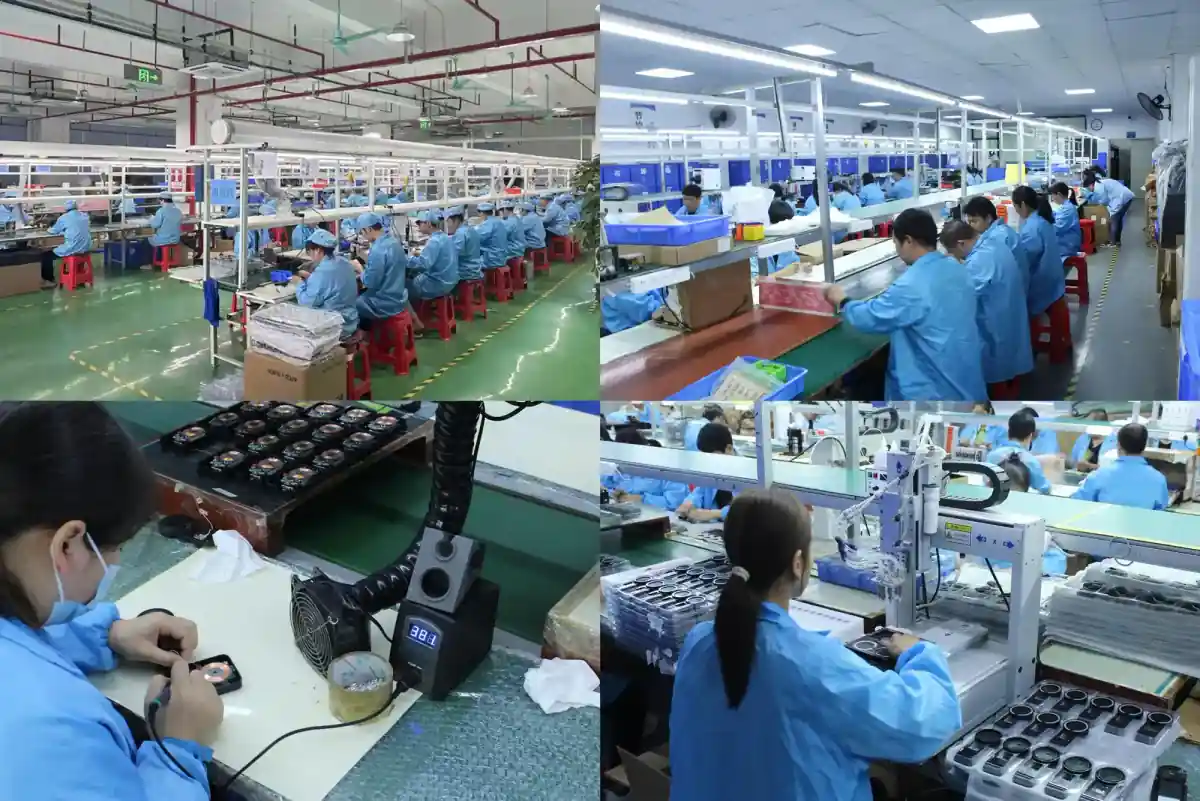
Surface Mount Technology (SMT) is where PCB boards are assembled. A real charger factory has one or more SMT lines running daily. This zone catches trading companies faster than any other.
Checkpoint 5: SMT Machine Brand and Vintage
Look at the brand plate on the pick-and-place machines. Legitimate factories run Panasonic (NPM series), Yamaha (YSM series), JUKI (RS series), or Fuji (NXT). No serious charger OEM runs unbranded machines. A factory showing you "brand-less" or heavily-taped-over equipment is either using counterfeit machines or has borrowed the line for the tour.
Checkpoint 6: Reflow Oven Configuration
The reflow oven should have dual-side heating (top + bottom zones) and a temperature-profile printout posted next to the machine. Ask what the peak temperature is for the current profile: the answer for lead-free SAC305 solder should be 240-250 °C. A vague answer is a red flag.
Checkpoint 7: Solder Paste Inspection (SPI)
A real SMT line has an SPI machine after paste printing, before component placement. This is 3D metrology equipment (KOH YOUNG, MIRTEC, VI Technology). Its absence means the line cannot catch paste defects, which produce 30% of charger field failures.
Checkpoint 8: Automated Optical Inspection (AOI)
An AOI machine after reflow scans every board for placement and solder defects. On real production lines, AOI runs at 30-60 boards per minute. If the AOI is off, or the operator says "we run it later", the factory is not using it in-line.
Checkpoint 9: Red Flag: Manual Placement and Dust
Manual component placement on a charger production line is a red flag except for through-hole rework. Dust on the SMT equipment: accumulation on belts, feeders, or reflow oven exterior. Means the line has not run recently. Real production lines are cleaned and warm.
4. Zone 3: The Assembly Line (30 Minutes)
Checkpoint 10: ESD Protection
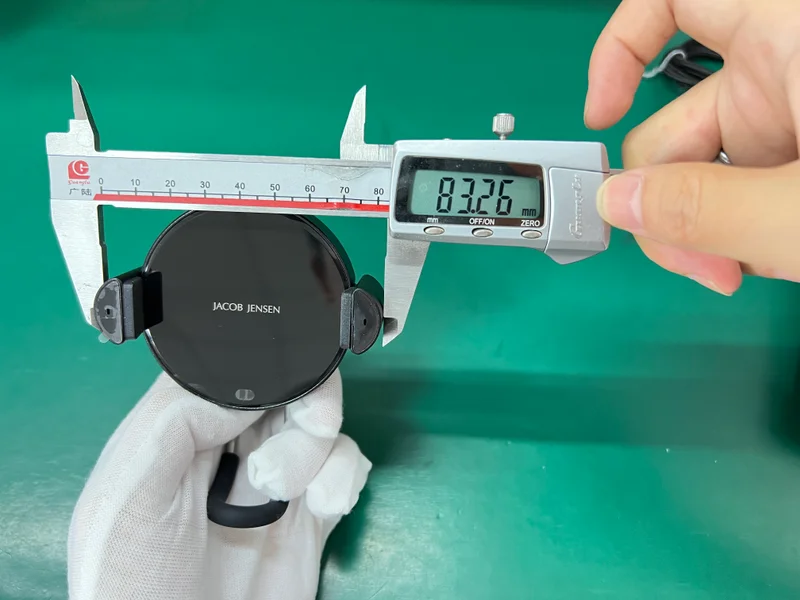
Every worker on an electronics assembly line wears an anti-static wristband tethered to the workstation, and an ESD smock. Floors are ESD-mat covered. A line where workers are in casual clothing with no wristbands cannot produce chargers with a defect rate below 3%.
Checkpoint 11: Parts Bins with Batch Codes
Component bins should be labeled with the part number, supplier, and batch/lot code. Blank bins or hand-written labels are diagnostic of a factory that cannot trace defects back to specific component lots. Meaning quality problems cannot be isolated.
Checkpoint 12: In-Process QC on the Line
The In-Process QC (IPQC) inspector should be physically on the line, checking every 20-50 units. If IPQC is described as "in the office" or "at the end of shift", the line is not being monitored during production.
Checkpoint 13: Assembly Speed Reality Check
Ask the production manager the daily output per line and compare to what you see. A line with 15 workers producing "5,000 units/day" of GaN chargers is technically possible; a line with 5 workers claiming the same throughput is misrepresenting capacity. Math check: at 2 workers per station, 8-hour shift, and 45-second cycle time per unit, one station produces roughly 640 units/day.
Expert Insight
"I had a US importer save $400 by skipping the on-site audit and lose $47,000 six weeks later when the aging step turned out to be photo-only. The aging jig I saw at my last visit? Empty every time. The factory ran aging for the audit and turned it off after. On-site audit is not overhead — it is the cheapest insurance premium in the sourcing stack."
— Nina Nico, Global Procurement & Sourcing Manager, WOWOHCOOL
5. Zone 4: The Aging Room (Critical for Chargers)
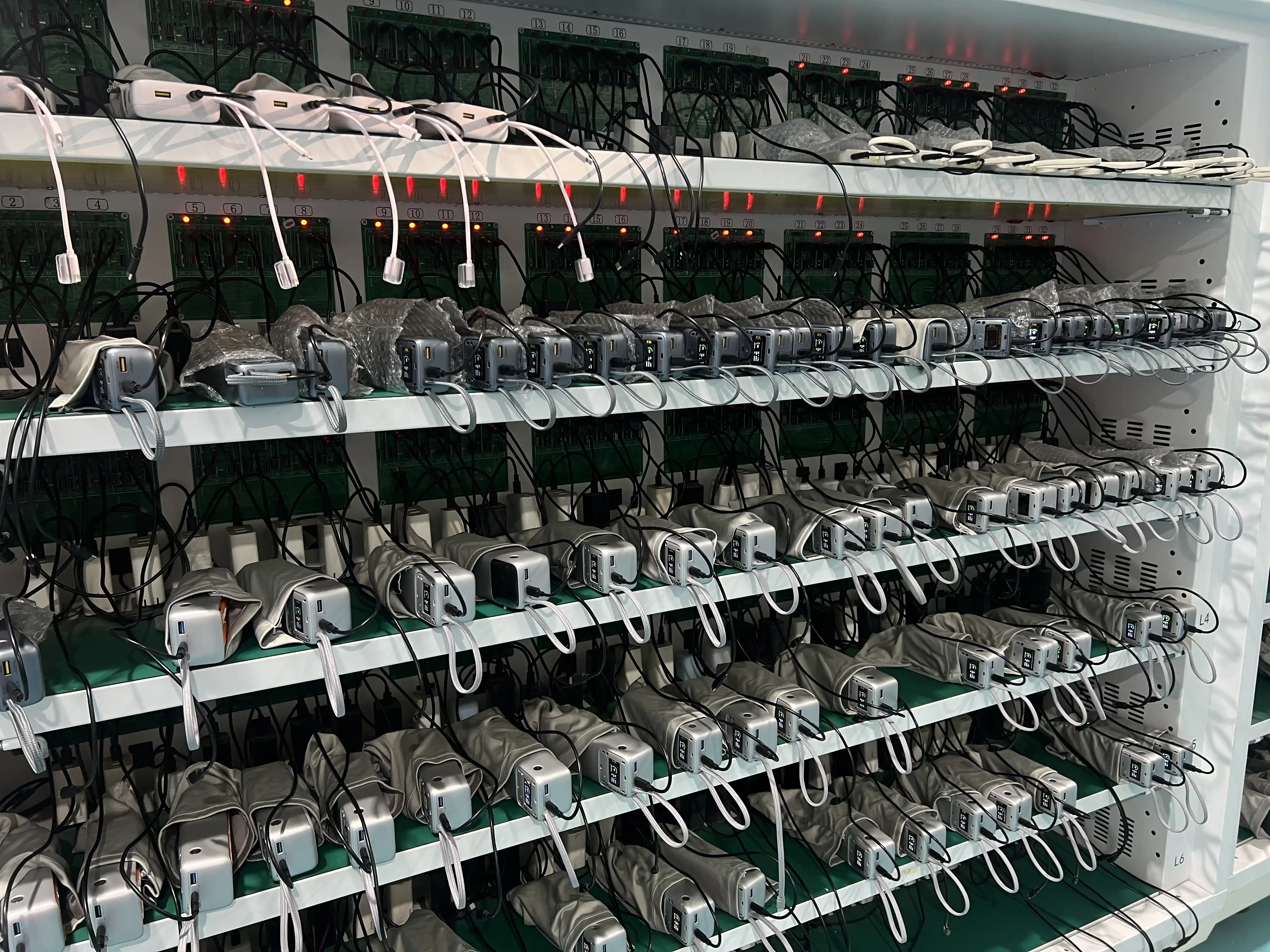
The aging room is where finished chargers run under load for hours before packing. This is the highest-value zone in a charger factory and where quality separates from mediocrity.
Checkpoint 14: 100% 4-Hour Aging vs Batch Sampling
WOWOHCOOL runs 100% four-hour aging at 45 °C — every charger, every batch. Industry-average is 2-hour batch sampling covering 2-5% of units. Ask the QC manager what percentage of units go through aging and for how long. Answers below "100% for 4 hours" indicate a factory that has not caught up to modern QC.
Checkpoint 15: Aging Jig Capacity
Count the aging jigs on the wall and the units per jig. Multiply by the four-hour cycle. If the claimed daily throughput exceeds aging capacity, either the aging is not 100% or the daily throughput number is inflated.
Checkpoint 16: The Day's Aging Log
Request today's aging log. It should show: batch numbers under test, start/end times, ambient temperature, load current, and any failure events. A blank log, or a log with only entries from previous months, means aging is not running today.
Checkpoint 17: Red Flag: Empty Jigs Mid-Day
If you visit at 11 AM on a weekday and half the aging jigs are empty with the aging room lights off, aging is running on a "when we feel like it" schedule. This is one of the most common findings in first-time audits of budget suppliers.
6. Zone 5: The QC Lab (Live Test Demonstration)
The QC lab visit proves whether testing is real: three live tests on production-batch samples, covering Hi-Pot at 3,000 V AC for 1 second, 65W thermal load for 30 minutes (case ≤ 55 °C), and a USB-C PD 3.1 handshake showing PDO negotiation. A serious factory runs all three without objection.
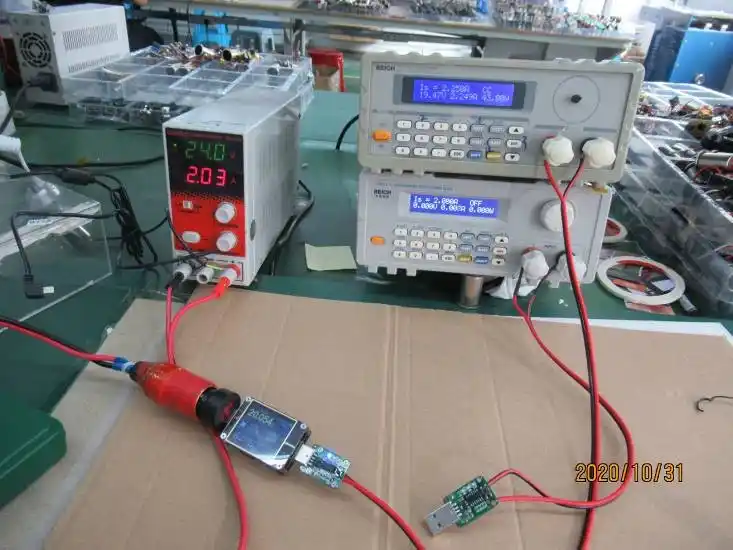
Checkpoint 18: Hi-Pot Test (Dielectric Withstand)
Ask the QC engineer to run a Hi-Pot test on a random charger from today's batch. The test applies 3,000 V AC between primary and secondary sides for 1 second — the charger must not conduct. The Hi-Pot machine (Chroma 19053 or Kikusui TOS5300) shows a green pass indicator. A factory that "does Hi-Pot at the end of the week" is not testing.
Checkpoint 19: Thermal Test on Full Load
Ask for a 65W charger to be loaded to 100% output for 30 minutes and thermally imaged with a FLIR camera. Case temperature should stabilize at 45-65 °C depending on ambient. WOWOHCOOL's GaN V chargers stabilize at 52.4 °C at 25 °C ambient. A charger that reaches 75 °C or above has undersized thermal design.
Checkpoint 20: USB-C PD Protocol Analyzer
A USB-C PD analyzer (Total Phase Advanced Cable Tester, Ellisys Explorer, or CyberDrive UPB100) shows PD negotiation on a laptop screen. Ask the engineer to trigger a PD 3.1 handshake and show the PDOs (Power Data Objects) advertised. A factory with no PD analyzer cannot verify PD compliance and will ship chargers that fail with new devices.
Checkpoint 21: Ripple + Noise on Oscilloscope
Connect the charger output to an oscilloscope (Tektronix MDO3024 or Rigol MSO5000 series) with 20 MHz bandwidth. At 15W load, ripple should be below 25 mVpp. Above 50 mVpp indicates poor filtering, which causes device malfunction with sensitive electronics.
Checkpoint 22: Red Flag: Refusal to Run Live Tests
If the factory says "our test equipment is being calibrated" or "the QC engineer is off today", the equipment is either non-functional or the personnel do not exist. Legitimate factories have redundant equipment and always have an on-shift QC engineer.
7. Zone 6: The Warehouse and Shipping
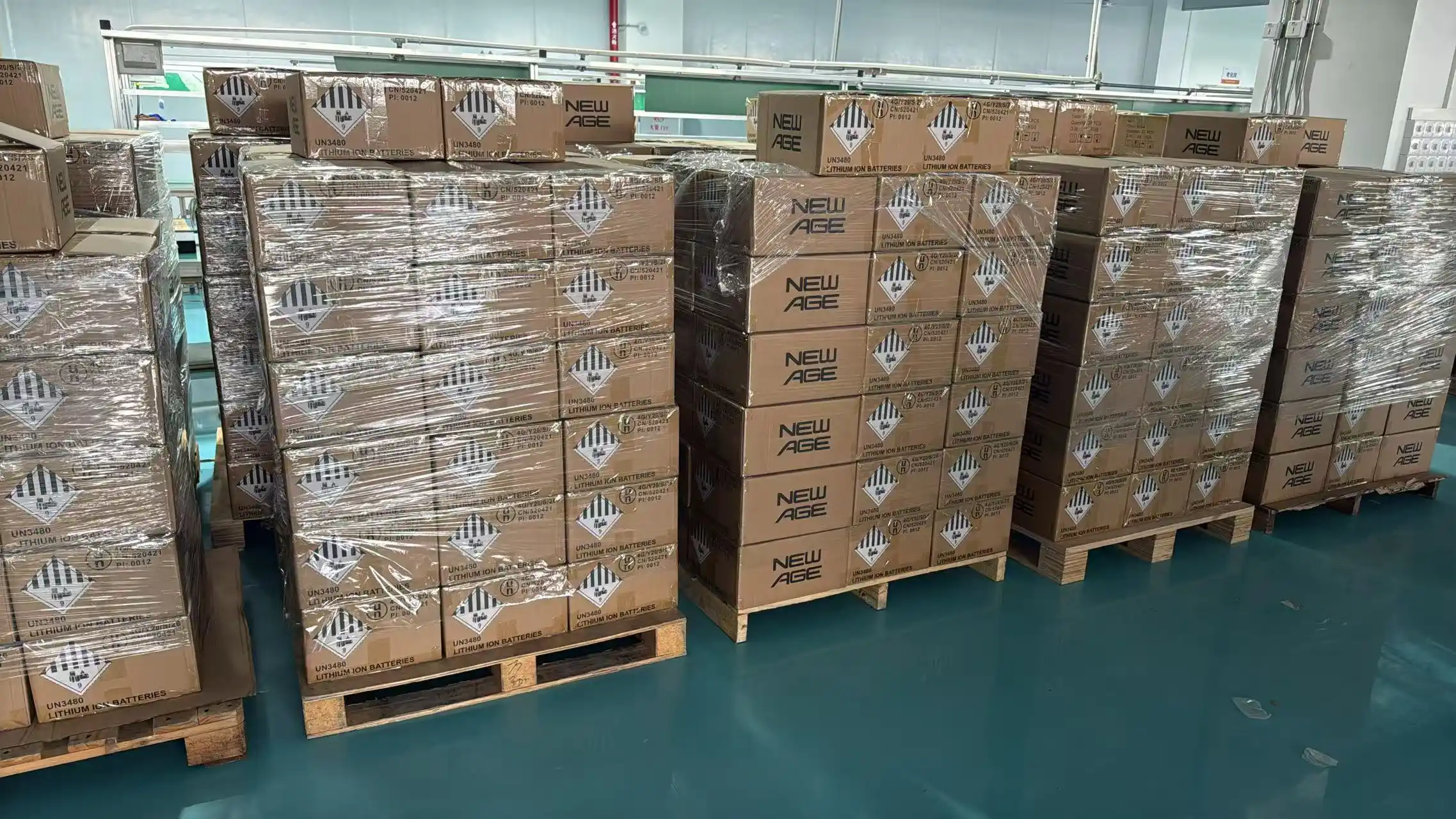
Checkpoint 23: Bar-Coded Cartons with Client PO Numbers
Finished-goods cartons should be bar-coded and labeled with the client PO number, batch code, and destination country. Unlabeled or generically-labeled cartons ("A1", "B2") indicate a factory that cannot trace shipments. A certain source of mix-ups and reshipments.
Checkpoint 24: Sample Retention Shelf
ISO 9001 factories retain one sample per production batch for two years. This is on a dedicated shelf with batch codes visible. If the sample shelf is empty or the retained samples are all from 2023, the factory has not been producing recently.
Checkpoint 25: Red Flag: Empty Warehouse or Staging
A "factory" with an empty warehouse is a staging factory: the goods are actually produced elsewhere and shipped through this address for customs purposes. Cross-check the warehouse activity with the guard log entries for freight forwarder pickups over the past two weeks.
8. 8 Photos to Take + Factory Audit Cost Benchmarks
If the audit runs short, take these eight photos with geolocation enabled on your phone. They form a permanent record that can be audited later.
| # | Photo | What It Proves |
|---|---|---|
| 1 | Factory sign at the gate (geo-tagged) | Address matches business license |
| 2 | SMT line brand plate visible | Real equipment, not staged |
| 3 | Aging room clock + running load | Aging is actually running |
| 4 | QC lab test equipment on shelf | Test capability exists |
| 5 | Certificate wall (ISO, CE, FCC dates) | Certifications are current |
| 6 | Sample retention shelf with batch codes | ISO 9001 practice actually followed |
| 7 | Business card of QC manager | Named person exists to be contacted |
| 8 | Group photo with production manager | Broker/factory owner distinction |
Cost Benchmarks by Audit Type
| Audit Type | Cost (USD) | When to Use |
|---|---|---|
| Supplier verification (paperwork) | $100-200 | Pre-visit qualification |
| On-site factory audit | $300-800 | First-time supplier, new SKU, every 18-24 months |
| Pre-shipment inspection (PSI) | $200-350 | Every order — third party |
| DUPRO (during production) | $250-400 | High-value or new-product orders |
| Comprehensive qualification | $1,000-2,500 | Multi-year sourcing agreements |
Complementary reading: our factory verification paperwork checklist covers the desk-side supplier verification, and the 4-stage QC process guide details the IQC → IPQC → FQC → OQC framework you are inspecting for.
Frequently Asked Questions
What is the difference between a factory audit, supplier verification, and pre-shipment inspection?
Supplier verification is desk research: business license check, ISO cert verification, financial background: cost $100-200. Factory audit is on-site: walkthrough, equipment inspection, live tests, red flag hunting: cost $300-800. Pre-shipment inspection (PSI) is per-order: inspecting finished goods before they leave the factory at 80-100% production completion: cost $200-350. A first-time supplier requires all three; repeat suppliers need only PSI on each order.
Can I do a factory audit remotely, or do I need to fly to China?
Remote video audits catch documentation issues but rarely catch physical staging (empty aging rooms, borrowed SMT lines, brokered facilities). For first-time suppliers or orders above $50,000, an in-person audit is worth the flight. For subsequent visits to a verified supplier, a video walk-through led by the same QC manager can substitute at 40-50% of on-site cost.
How long does an on-site factory audit take for a charger or power bank supplier?
Half a day (3-4 hours) for a focused audit covering the 25 checkpoints in this article. A full-day audit adds financial due diligence, environmental compliance review, and social audit elements: 7-8 hours total. Most buyers underinvest. A 2-hour audit is a photo op, not verification. Budget the full 4 hours to reach Zones 4-6 (aging, QC lab, warehouse) where verification value peaks.
How much does a professional factory audit cost in Shenzhen (SGS/Bureau Veritas/QIMA)?
$300-600 per auditor-day in Shenzhen for a single-auditor day. Multi-day comprehensive audits run $1,000-2,500. QIMA is typically the most cost-effective for a first audit at ~$309 flat. SGS $350-550/day. Bureau Veritas $350-550/day. Intertek $400-600/day. All four publish English-language reports within 5-7 business days. Bring your own audit priorities. Third parties run a generic checklist unless you specify what matters.
What MOQ and payment terms should I expect from a WOWOHCOOL factory audit visit?
WOWOHCOOL MOQ is 500 units for ODM, 3,000 units for full OEM with logo + color + packaging + certification. Payment: 30% deposit + 70% before shipment via T/T for first order; 30/70 or net-30 after 3 orders; L/C available above $50,000. Factory visits include a 30-minute walkthrough with the QC manager plus a live nail test / thermal / Hi-Pot demonstration at no cost. Request a visit at wowohcool.com/contact/.
Global Procurement & Sourcing Manager · 10+ years · EN, ZH
Nina leads WOWOHCOOL's global sourcing and has personally run 200+ factory audits across Guangdong and Zhejiang provinces. Specialties: charger/power bank OEM verification, AQL 2.5 Level II sampling, EU Battery Regulation 2023/1542, and GaN charger manufacturing.
Factory Footprint
ISO 9001
Shenzhen, China
Export countries
Engineers
Book a WOWOHCOOL Factory Audit Visit · MOQ 500
30-minute walkthrough with our QC manager, live Hi-Pot / thermal / PD demos, all 25 checkpoints on our floor. Our engineers respond in 4 hours or less.
Sources & References
- ISO 9001:2015 — Quality Management Systems — factory audit anchor standard
- ISO 2859-1 — Sampling Procedures for Inspection by Attributes — AQL framework
- IEC 62368-1 — Audio/Video and ICT Equipment Safety — Hi-Pot and thermal test protocols
- Alibaba — OEM Electronics Supplier Verification Guide — audit categories overview
- Sinospect — China Factory Audit Checklist — reference general audit categories
- Unit Circuits — SMT Factory Audit Checklist — SMT-specific verification
- WOWOHCOOL QC Laboratory — internal audit protocol from 200+ client visits (2013-2026)