
UGREEN GaN Charger Alternatives for OEM Buyers (2026)

Global Procurement & Sourcing Manager · 10+ years in 3C procurement & sourcing
UGREEN GaN charger alternatives for OEM buyers are three sourcing routes: authorized wholesale, logo-on-genuine resale, or a factory-built charger program under your own brand. UGREEN's public wholesale program doesn't offer private label and prohibits Amazon resale, so the route decision comes before the supplier decision.
A UGREEN-class 140W charger means PD 3.1 at 28V/5A, a published port-allocation table and a 240W e-marker cable — specs a factory can quote at $18.00–24.00 FOB from 500 units.
Disclosure: WOWOHCOOL manufactures charging products. This guide compares all routes, including authorized resale, which does not involve us.
Key Takeaways
UGREEN GaN charger alternatives for OEM buyers: compare wholesale, logo-on-genuine resale and private label routes, plus PD 3.1 specs and MOQ 500.
- UGREEN is a listed brand, not a white-label factory. Its wholesale program has no fixed MOQ but prohibits third-party Amazon resale and offers no private-label program.
- A UGREEN-class 140W charger means PD 3.1 EPR at 28V/5A, three or four ports with a published allocation table, and a 240W e-marker cable in the box. Without the cable, the charger is capped at 100W.
- The real spec gaps are rarely wattage. They are per-port allocation, hot-plug renegotiation, GaN device traceability, plug-configuration certification and packaging MOQ.
- At 500 units, a 140W PD 3.1 charger runs $18.00–24.00 FOB. The 65W tier runs $6.00–8.50. Certification adds $5.00–9.00 per unit at that volume.
- Choose the route first: wholesale for speed, logo-on-genuine for corporate gifting, ODM stock from 500 for your own brand, ODM development from 1,000–2,000, full OEM from 3,000.
Table of Contents
1. Why B2B Buyers Look for UGREEN Alternatives
UGREEN GaN charger alternatives for OEM buyers resolve into three routes: authorized wholesale, logo-on-genuine resale, or a factory-built program under your own brand. The choice is driven by channel rules before product specs — UGREEN's wholesale terms prohibit Amazon resale and its public program offers no private label.
A retailer wants a charger program under its own label. A distributor wants a price that leaves room for margin. A brand wants a spec it can defend in a tender. UGREEN solves the product problem and creates a channel problem.
Three structural reasons push buyers toward a factory.
1.1 UGREEN's public wholesale program does not offer private label
UGREEN's public wholesale page describes tiered pricing, local warehouses and a simple application: send your product list, destination country and estimated volume. It doesn't mention private label, logo molding, custom packaging or exclusive SKUs.
That isn't a hidden limitation. It's the brand model. UGREEN sells UGREEN.
Third-party resellers advertise logo and packaging customization on genuine UGREEN stock, usually around 100 units, but the product keeps UGREEN branding and the internal design is untouched. That is corporate gifting, not brand building.
If your requirement is "my logo on the enclosure, my model number on the label, my packaging in the retail chain," the brand route cannot deliver it.
1.2 The wholesale program restricts your channel
If you buy as a UGREEN wholesale distributor, the terms prohibit third-party retail of its products on Amazon. You may sell through your own website, a physical store or other marketplaces, but not Amazon.
For an Amazon-first seller, that single clause removes the route. For a regional distributor with retail accounts, it is workable but narrows your exit options. Channel restrictions are part of the price of carrying a brand.
The scenarios in this guide are illustrative composites, not individual client records.
Consider a distributor who built a 65W charger listing around UGREEN stock, then read the wholesale terms before placing the second order. Amazon was 60% of her plan. She kept UGREEN for physical retail and moved her online line to an ODM platform at 500 units, with her own logo and no channel restriction.
1.3 Brand margin leaves little room for a distributor
A distributor buying a consumer brand near wholesale earns a turnover spread, not a brand margin. The retail price already carries the brand's marketing, marketplace fees and after-sales cost. Consider a $99–129 retail charger: a 40% retailer margin leaves $59.40–77.40 wholesale, and a distributor buying near that level earns a few points before logistics.
A private-label or OEM program removes the brand layer: you buy at FOB, set your own retail price and own the customer relationship. The trade-off is certification, inventory and product liability.
That is the real choice — brand convenience or channel control.
1.4 How UGREEN compares with Anker, Baseus and Belkin for B2B buyers
Buyers often shortlist these four brands together. For a sourcing decision, compare what each brand offers a business buyer, not which charger wins a review.
| Brand | Positioning | Public private-label program | What it leaves open for a B2B buyer |
|---|---|---|---|
| UGREEN | Upper mid-market; strong PD 3.1 and multi-port lineup | No | The factory route: same spec class, your brand and packaging |
| Anker | Premium mass market | No public program | Price and margin room above the brand premium |
| Baseus | Value mid-market | No public program | Value positioning with a verified factory behind it |
| Belkin | Premium retail and Apple-channel presence | No public program | Retail channel access, not a sourcing route |
The table compares sourcing criteria, not product quality. None of these brands is a private-label supplier. If your program needs your logo on the enclosure, the decision moves to a factory, not to another brand.
2. What UGREEN Actually Is: A Brand With a Supply Chain
UGREEN is reported to be the world's No. 2 charging brand by retail sales value. It was founded in Shenzhen in 2012 and listed on the Shenzhen Stock Exchange in July 2024 under ticker 301606. Charging is its largest product segment.
Reported figures from its 2025 annual report put revenue at RMB 9.49 billion, with charging and creative products contributing RMB 4.36 billion. Most of that revenue comes from outside China.
The manufacturing model is hybrid. UGREEN runs in-house lines for new-product trials and core components, and relies on contract manufacturers for large-scale mass production. Public CQC and TAF certification records for several Nexode SKUs name a third-party production factory rather than a UGREEN plant.
That structure is normal for a fast-growing consumer brand. It is also the reason a buyer should separate "UGREEN-level" from "UGREEN-made."
UGREEN-level is a specification: PD 3.1, a defined port matrix, thermal performance, certification scope and packaging quality. UGREEN-made is a commercial relationship you cannot access. The factories that build for UGREEN also build for other brands, under other logos, often on adjacent platforms.
This is where the alternative exists. You are not copying a brand's secret. You are specifying the same class of product and auditing the factory that makes it.
EXPERT INSIGHT "A brand name tells you who approved the design, not who controls the BOM today. Ask for the GaN device part number, the current PCBA revision and the change-control procedure." — Nina Nico, Global Procurement & Sourcing Manager at WOWOHCOOL, LinkedIn
3. The Nexode Benchmark: What a UGREEN-Class Charger Must Match
UGREEN's Nexode line is a useful benchmark because the company publishes detailed port tables. Use it to calibrate your RFQ, not to clone a product.
| Tier | Typical ports | Single-port maximum | Multi-port behavior | Cable in box | What to match in the RFQ |
|---|---|---|---|---|---|
| 30W | 1× USB-C | 30W | Not applicable | Usually none | PD 3.0, PPS, foldable or fixed plug |
| 65W | 2× USB-C + 1× USB-A | 65W on one C port | Shared 65W total; USB-A 22.5W | Usually none | PPS range, case temperature, plug certification |
| 100W | 3× USB-C + 1× USB-A | 100W on C1 or C2 | 65W+30W two-port; 45W+30W+22.5W three-port; 45W+30W+10.5W four-port | Usually none | 5A e-marker cable, allocation matrix |
| 140W | 3× USB-C + 1× USB-A | 140W on C1 at 28V/5A | C2 100W; C3 and USB-A 33W. The 3-port variant splits 65W+65W in two-port use and 65W+45W+22.5W with all three | 240W EPR C-to-C | 240W e-marker cable, AVS, thermal design |
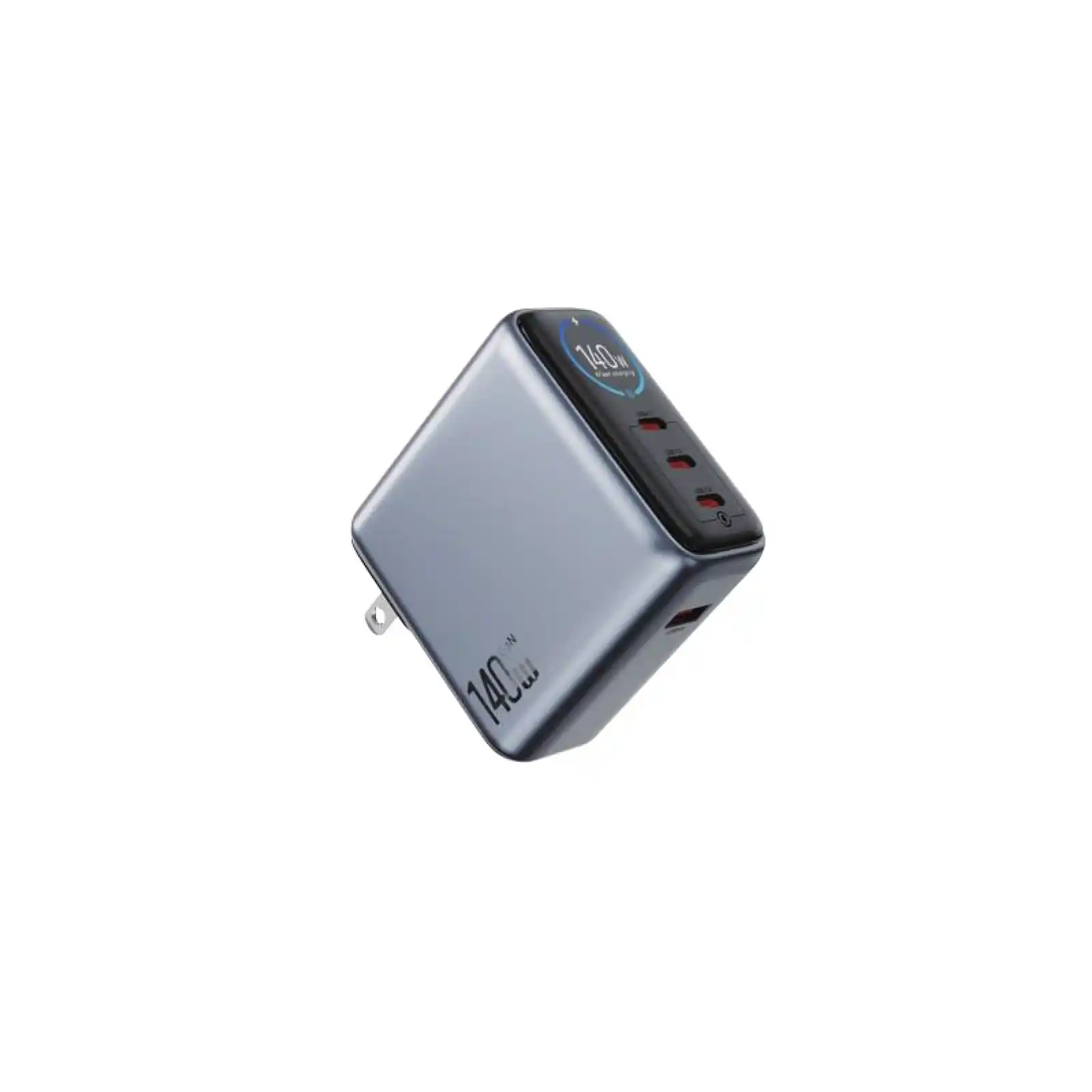
Three details in that table matter more than the headline wattage.
First, the 100W tier does not deliver 100W on every port. The total budget is 100W. Two ports split 65W+30W. Four ports split 45W+30W+10.5W. A buyer who writes "100W, 4 ports" in an RFQ without an allocation table will receive whatever the factory's default firmware does.
Second, the 140W tier depends on the cable. The charger can negotiate 28V/5A only if the cable is EPR-rated and e-marked for 240W. A 5A cable rated for 100W is not enough. This is the most common field failure in 140W programs.
Third, port counts change the thermal budget. A 140W four-port charger is a different thermal problem from a 140W three-port charger. Ask for case temperature at rated load, not a marketing claim about "cool operation."
If you want to compare the factory line against these tiers, the GaN V charger lineup lists the platforms, port configurations and wattage options we build. Use it as a reference sheet, not as a substitute for your own specification.
4. PD 3.1 in an RFQ: The 140W Chain Has Three Links
USB Power Delivery 3.1 introduced Extended Power Range in 2021. SPR remains capped at 100W (20V at 5A). EPR adds 28V, 36V and 48V at up to 5A, which yields 140W, 180W and 240W. AVS is mandatory in EPR and adjusts voltage in 100mV steps from 15V to the charger's maximum.
A 140W charger is only one link in the chain. The other two are the cable and the device.
| Link | Requirement | What happens if it is missing |
|---|---|---|
| Charger | PD 3.1 EPR source with 28V PDO and AVS | Falls back to 100W SPR |
| Cable | 240W EPR-rated, 5A, e-marked | Negotiation caps at 100W or lower |
| Device | EPR sink that requests 28V | Charger stays in SPR |
The cable rules are stricter than most buyers expect. A standard USB-C cable without an e-marker is limited to 3A and 60W. A 5A e-marked cable supports 100W. A 140W load needs a 240W EPR-rated cable with an e-marker configured for EPR.
USB-IF certifies USB-C-to-C cables at 60W or 240W only. The old 100W cable tier was retired in 2021.
In an RFQ, write the cable as a separate line item: length, current rating, EPR rating, e-marker chip, print on the jacket, and whether it is included in the box or sold separately. "240W cable included" is not a specification. "1.5m, 5A, 240W EPR, e-marked, rated for 50V, with 240W marking on the overmold" is. Ask the e-marker cable supplier for the chip model and the programmed current rating.
For the full protocol and cable breakdown, see USB-C PD 3.1 EPR and cable rules explained.
5. GaN Generation Labels Are Not a Specification
"GaN II," "GaN III" and "GaN V" are vendor shorthand. No standards body assigns generation numbers, and two chargers sold as the same generation can perform very differently.
The label describes a marketing position, not a measurable property. WOWOHCOOL uses GaN V as the name of its own fifth-generation platform, not as a certificate, which is why we publish the device part number, efficiency curve and case temperature behind it. For the underlying device comparison, see GaN vs silicon charger comparison.
That does not make GaN claims useless. It makes them untestable unless you ask for the device behind the label.
Put these four lines in the RFQ instead:
- 1. GaN device part number and manufacturer. The power stage should be traceable to a named device, not a generic "GaN chip."
- 2. Efficiency at 25%, 50%, 75% and 100% load. A single peak-efficiency number hides the operating range that matters.
- 3. Case temperature at rated output. Measure at 25°C ambient after 60 minutes, with the enclosure assembled.
- 4. Switching frequency and thermal design. Higher frequency enables smaller magnetics but raises switching loss and layout sensitivity.
A supplier that cannot answer these questions is selling a label. A supplier that answers them with test data is selling an engineering process.
For the generation terminology and how it maps to real devices, see our GaN generations guide. For the manufacturing and QC side, see GaN V charger manufacturing.
6. Multi-Port Power Allocation: The Line Buyers Forget
The allocation table is where most multi-port GaN charger OEM programs fail in the field. Buyers compare total wattage, then discover that the laptop port drops to 45W when a phone is plugged in, or that inserting a device causes a brief disconnect.
UGREEN publishes different splits for different SKUs. The 100W four-port model runs 65W+30W in two-port use, 45W+30W+22.5W in three-port use and 45W+30W+10.5W with all four active. The 140W three-port model runs 65W+65W in two-port use and 65W+45W+22.5W with all three. Same brand, same wattage family, different behavior.
Your RFQ needs its own matrix:
| Scenario | Port A | Port B | Port C | Port D | Renegotiation behavior |
|---|---|---|---|---|---|
| 1 device | Full rating | — | — | — | None |
| 2 devices | Define | Define | — | — | Define reconnect time |
| 3 devices | Define | Define | Define | — | Define reconnect time |
| 4 devices | Define | Define | Define | Define | Define reconnect time |
Then add three test requirements:
- Hot-plug test. Insert and remove a load on each port while the others are active. Log voltage drop and renegotiation time.
- Minimum guaranteed port. State which port must always deliver the laptop tier, even when other ports are occupied.
- Protocol per port. PPS on every C port is not automatic. Samsung 45W Super Fast Charging 2.0 needs PPS and the right current profile.
A buyer in Dubai skipped this step in one such scenario. He ordered 140W chargers for a laptop bundle and supplied 100W cables to save $1.20 per unit. Customers received 100W charging and returned the kits. The savings were smaller than the return freight.
7. Plugs and Packaging: One Body, Multiple Certifications
Plug configuration is a certification decision, not a cosmetic one.
There are two common approaches:
- Fixed plug. One body per market: US foldable blades, EU round pins, UK fused plug, AU angled pins. Lower tooling cost per variant, but more SKUs and more safety approvals.
- Interchangeable plug heads. One body plus clip-on heads for US, EU, UK, AU, KR and JP. Fewer bodies and lower inventory, but each head configuration still needs to be covered by the safety report for the markets you sell into.
The mistake is assuming one certificate covers every plug variant. It doesn't.
CE testing covers the construction and the plug you submit. UKCA is a separate approval. Japan's PSE (DENAN) and Korea's KC add their own requirements.
If you sell a travel kit with four heads, confirm that the test report covers the exact combination you ship.
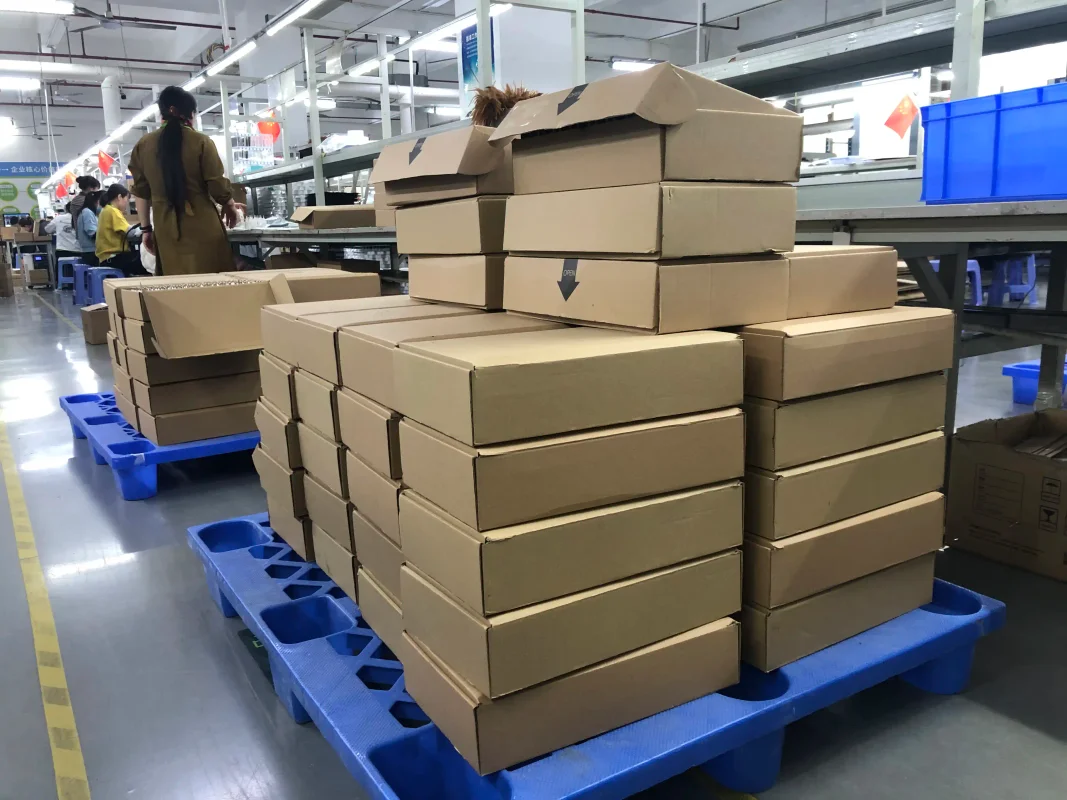
Packaging has the same discipline. Stock packaging with a logo print starts at 500 units. A custom branded box starts at 2,000. Between those two points, buyers often underestimate the manual, cable compartment, barcode, FNSKU label and language variants.
| Item | Entry point | What to specify |
|---|---|---|
| Logo on stock packaging | 500 units | Print method, color, placement, artwork file |
| Custom retail box | 2,000 units | Box structure, board grade, print, insert, manual language |
| Cable compartment | Depends on box | Cable length, bag, tie, whether the 240W rating is printed |
| Barcode / FNSKU | Any volume | GS1 number, label placement, Amazon compliance |
| Certification marks | Any volume | Correct mark, certificate number, manufacturer name and address |
For certification packages and timelines, see our US and EU charger certification guide. For the UK specifically, UKCA vs CE for charger importers covers the current duplication issue.
8. UGREEN GaN Charger Alternatives for OEM Buyers: Three Route Families
The market presents five order structures for a private label GaN charger program, but they fall into three families.
| Route | What you get | What you give up | Typical MOQ | Timeline | Channel limits |
|---|---|---|---|---|---|
| UGREEN authorized wholesale | Brand demand, local stock | Pricing power, private label, differentiation | No fixed MOQ; terms by region and volume | Stock, often 3 days from local warehouse | No third-party Amazon resale |
| Logo on genuine UGREEN | Brand plus light customization | Product definition, exclusivity | Around 100 | Stock plus print time | Brand channel policy applies |
| ODM stock private label | Your logo and packaging on an existing platform | Exclusive ID, deep customization | 500 | Sample 3–7 days; production 25–35 days | None from us |
| ODM design development | Platform modification, custom packaging | A completely new ID | 1,000–2,000 | Design 25–45 days; production 35–50 days | None from us |
| Full OEM with new tooling | Your own ID and IP | Time and tooling investment | 3,000+ | Tooling 2–3 months; total 2–4 months | None from us |
The first two are brand routes. The last three are manufacturing routes.
For the same route logic applied to power banks, see the Anker alternatives guide for OEM buyers.
Choose wholesale if you need stock this quarter and the channel restriction is acceptable. Choose logo-on-genuine if the product is a corporate gift and the UGREEN brand is part of the value.
Choose ODM stock if you need your own brand quickly. Choose ODM development if the enclosure or port layout must differ. Choose full OEM only if the product definition is yours and the volume supports tooling.
Most first programs should start at 500 units. It tests the spec, the packaging and the sell-through without committing tooling capital. Confirm the payment schedule, deposit terms and MOQ tiers in the B2B ordering terms and MOQ before you sign.
If you want a line-item quote for an ODM or OEM route, send your specification to our engineering team. We will separate product, cable, certification and packaging so you can compare it with any other quote.
9. UGREEN-Class Spec vs Factory FOB
FOB pricing for a 65W or 140W PD 3.1 GaN charger OEM program is well defined at the platform level. The variables are port count, wattage tier, cable inclusion, plug configuration and packaging.
| Tier | Benchmark to quote | FOB at 500 units | What the quote must state |
|---|---|---|---|
| 30W single-port | PD 3.0, PPS, one C port | $3.50–5.00 | Plug type, cable included or not |
| 65W multi-port | 2C1A or 3C, PPS | $6.00–8.50 | Allocation table, case temperature |
| 100W multi-port | 3C1A, 100W on C1/C2 | $9.00–13.00 | 5A e-marker cable, per-port matrix |
| 140W PD 3.1 | 3C1A, 28V/5A on C1 | $18.00–24.00 | 240W EPR cable, AVS, thermal data |
These are FOB Shenzhen prices and exclude freight, duty and certification fees. They assume standard certification documentation and standard packaging unless stated otherwise.
A 240W EPR cable is a separate BOM line. If it is not bundled, quote it separately. Custom packaging, a second plug variant and a custom color each add cost and time.
The cheapest quote is rarely the cheapest program. A $1.00 difference per unit usually means one of five items was removed: the cable, the aging test, the certification documents, the packaging or the plug variant. Our GaN charger selection guide by power tier breaks down the cost structure by tier.
10. Cost Model: Brand Retail vs Factory FOB
Use an illustrative 140W program to see where the money goes. The numbers below are a model, not a quote.
Assumptions: 140W PD 3.1, 3C1A, 500 units, 240W cable included, standard packaging, CE/FCC/RoHS package.
| Line | Low case | High case |
|---|---|---|
| FOB Shenzhen | $18.00 | $24.00 |
| Freight and insurance | $1.50 | $2.50 |
| Certification amortization ($2,500–4,500 ÷ 500) | $5.00 | $9.00 |
| Landed cost before duty | $24.50 | $35.50 |
| Reference retail price | $99.00 | $129.00 |
| Wholesale at 40% retailer margin | $59.40 | $77.40 |
| Gross spread before duty and marketing | $34.90 | $41.90 |
At 2,000 units, the same certification package falls to $1.25–2.25 per unit. That single line changes the economics more than a 5% FOB negotiation.
The brand route has a different shape. If you buy authorized stock near wholesale and sell near wholesale, the spread is a few points before logistics. You carry less certification and inventory risk, but you also can't set the retail price.
For a retailer testing demand, that can be the right trade. For a brand building a category, it rarely is.
In a third scenario, a brand buyer compared two factory quotes for the same 140W spec. The lower quote was $2.10 per unit cheaper. It excluded the 240W cable, used stock packaging and quoted certification as a pass-through cost. Normalized to the same scope, the higher quote was $0.40 cheaper.
The lesson isn't that one factory lied. It's that FOB numbers are meaningless until the scope is identical.
For duty rates and the full landed-cost formula, see our import cost guide.
EXPERT INSIGHT "Never compare charger quotes at the FOB line. Normalize the cable, plug variant, certification documents, aging test and packaging first — a $1 difference per unit is almost always one of those five items." — Nina Nico, Global Procurement & Sourcing Manager at WOWOHCOOL, LinkedIn
11. The 8-Point RFQ Scorecard
Use pass/fail thresholds, not impressions. A supplier that cannot answer one line is not disqualified, but the answer tells you where the risk sits.
| # | Check | Pass criteria | Fail signal |
|---|---|---|---|
| 1 | Certificate-to-SKU match | Report lists the exact model and plug variant | Certificate shows a series name only |
| 2 | GaN device traceability | Part number and manufacturer on the BOM | "GaN chip" with no part number |
| 3 | EPR chain test | 140W verified with charger, cable and device | 140W claim tested with a 100W cable |
| 4 | Allocation matrix | Published table for 1–4 ports plus hot-plug behavior | "Smart allocation" with no numbers |
| 5 | Thermal data | Case temperature at rated load, 25°C ambient, 60 minutes | "Low temperature" with no measurement |
| 6 | QC plan | 4-hour 100% aging; AQL 0.65 normal / 0.25 tightened; defect rate below 0.3% | AQL quoted only as a buyer target |
| 7 | Change control | Written approval for cell, IC, firmware or enclosure changes | No change clause in the contract |
| 8 | Packaging control | Barcode, FNSKU, manual language and certification marks verified at OQC | Packaging checked only at final shipment |
The factory audit side is covered in our supplier verification process and QC and AQL guide.
Conclusion: Match the Spec Before You Choose the Route
UGREEN GaN charger alternatives for OEM buyers are a channel decision, not a brand swap. At 500 units, a 65W multi-port program runs $6.00–8.50 FOB, while a 140W PD 3.1 program runs $18.00–24.00 and lands at $24.50–35.50 before duty against a $99–129 retail price.
Choose wholesale if you need branded stock and can live with the Amazon restriction. Choose logo-on-genuine for a gift or short campaign. Choose ODM stock from 500 units for your own brand, ODM development from 1,000–2,000 for a different enclosure, or full OEM from 3,000 for exclusivity.
The specification is where the program succeeds or fails. PD 3.1 is a chain, not a wattage. GaN is a device, not a generation label. Multi-port power is an allocation table, not a total. Packaging is a 2,000-unit commitment, not a design file.
Get those four right, and the factory conversation becomes a comparison of evidence rather than claims.
Ready to match a UGREEN-class spec under your own brand? View the GaN charger platforms or send your specification for a line-item quote. We will separate product, cable, certification and packaging so you can compare it with any other supplier.
Frequently Asked Questions
Is UGREEN a manufacturer or a brand?
UGREEN is a brand company with a hybrid manufacturing model. It was founded in Shenzhen in 2012 and listed on the Shenzhen Stock Exchange in 2024 under ticker 301606. It runs in-house lines for new-product trials and core components, and uses contract manufacturers for large-scale production. Public certification records for several charger models list third-party production factories. For buyers, the practical answer is that UGREEN is a brand you can resell, not a factory you can contract.
Can I private-label a UGREEN charger?
Not through UGREEN's official wholesale program, and there is no public UGREEN OEM program for third-party brands. The program offers tiered pricing and local stock, but it does not list private label, logo molding, custom packaging or exclusive SKUs. Third-party resellers offer logo and packaging customization on genuine UGREEN stock, usually around 100 units, while keeping UGREEN branding and the original internal design. That is corporate gifting, not private label. A true private-label program requires a factory route.
What MOQ should I expect for a UGREEN-class GaN charger?
It depends on how much you change. ODM stock with your logo and stock packaging starts at 500 units. ODM design development with platform changes runs 1,000–2,000. Full OEM with new tooling starts at 3,000. A custom retail box alone typically moves the order to 2,000 units. UGREEN's own wholesale program states no fixed MOQ, but that applies to branded stock, not to a private-label program.
Does a 140W OEM program need a special cable?
Yes. A 140W charger needs a 240W EPR-rated, 5A, e-marker cable. A standard cable without an e-marker is limited to 60W. A 5A e-marked cable supports 100W but not 140W. USB-IF certifies USB-C-to-C cables at 60W or 240W only. If the cable is missing or under-rated, the charger negotiates down to 100W or lower, even though the charger itself is capable of 140W.
How do I verify a factory matches UGREEN-level specs?
Ask for five documents and one test.
- Certificate matching the exact SKU and plug variant.
- GaN device part number and manufacturer.
- Efficiency data at four load points.
- Case-temperature data at rated output.
- Allocation matrix for one to four ports.
The test: a live 140W run with the supplied cable and a device that requests 28V. If any document is missing or the test caps at 100W, the claim is not verified.
Global Procurement & Sourcing Manager · 10+ years in 3C procurement & sourcing
Nina Nico is WOWOHCOOL's Global Procurement & Sourcing Manager with 10+ years in 3C procurement. She specialises in B2B hardware sourcing, OEM/ODM programme management, and supplier verification for charging accessories.
Factory Footprint
ISO 9001 Facility
Shenzhen, China
Export Countries
Engineers In-House
Matching a UGREEN-Class Spec?
Send your target wattage, port layout and packaging scope. We will return a line-item FOB quote that separates product, cable, certification and packaging.
Sources & References
- UGREEN Wholesale Program
- UGREEN Nexode 140W 4-port charger (X569), official product page
- Texas Instruments, USB Type-C and USB Power Delivery: Designing for EPR
- UL Solutions, 240W USB-C cable performance testing and safety considerations
- Pandaily, Ugreen Group Hong Kong IPO filing and Frost & Sullivan ranking