
GaN vs Silicon Charger: 3-Year Total Cost of Ownership for OEM

Marketing Manager & Founder · 10+ years in Charger Technology & Market Analysis
GaN chargers now account for over 50% of units above 65W, with GaN power IC costs dropping 8-12% annually. GaN achieves 95%+ efficiency vs 85% for silicon, runs 30% cooler, and fits 240W into a 65W-sized enclosure. The EU Ecodesign Regulation (ESPR) and Common Charger Directive have made GaN the compliance path for chargers above 45W. This guide walks through the 3-year total cost of ownership (TCO) that OEM buyers actually pay: unit FOB cost, field return rates, warranty replacement, freight, and energy — not just the spec-sheet comparison.
Key Takeaways
GaN chargers are 40% smaller and 30% lighter than silicon equivalents, cutting freight cost per unit by 25-30%. Efficiency runs 93-95% vs 83-85%, which removes the heatsink and enables sealed, slim designs. The GaN BOM premium is $1.60-2.00/unit, but the landed-cost advantage flips the equation above 5,000 units, and silicon still wins for sub-30W fixed installations.
- GaN chargers are 40% smaller and 30% lighter than equivalent silicon chargers, a 65W GaN charger fits in a pocket; a 65W silicon charger fills a palm. This directly reduces freight cost per unit by 25-30% for container shipping.
- Efficiency gap: GaN achieves 93-95% vs 83-85% for silicon at full load. The 10% efficiency delta means 10W less heat to dissipate, eliminating the need for internal heatsinks and enabling sealed, slim industrial designs.
- GaN BOM cost premium is $1.60-2.00 per unit at OEM scale, but the total landed cost advantage (smaller packaging, lighter freight, fewer warranty returns) flips the equation at volumes above 5,000 units.
- GaN enables 240W single-port chargers in the same volume as a 65W silicon design. Silicon hits a thermal wall at ~100W without active cooling. For enterprise laptop and multi-port hub OEMs, GaN is no longer optional.
- Silicon still wins for sub-30W fixed-installation chargers where size and weight don't matter, wall outlets, built-in USB ports, and cost-sensitive emerging markets. Don't pay the GaN premium where you can't monetize it.
Table of Contents
1. GaN vs Silicon: Specification & Performance Comparison
Every meaningful metric, side by side, with data sourced from manufacturer specifications and independent testing.
| Metric | GaN Charger | Silicon Charger | Winner |
|---|---|---|---|
| Size (65W equivalent) | ~40-55 cm³ | ~90-130 cm³ | GaN 50% smaller |
| Semiconductor Bandgap | 3.4 eV | 1.1 eV | GaN 3× wider |
| Power Conversion Efficiency | 93-97% | 80-85% | GaN +12-15% |
| Switching Frequency | 1-10 MHz | 100-500 kHz | GaN 10-100× faster |
| Max Practical Power (compact) | 240W | 65-100W | GaN |
| Case Surface Temperature (65W, 30min full load)* | ~50-58°C | ~72-80°C | GaN 24°C cooler |
| Thermal Throttling | Minimal to none | Common above 45W after 15-20 min | GaN |
| Typical Lifespan | 50,000+ hours (5+ yrs) | 20,000-30,000 hours (2-3 yrs) | GaN 2-3× longer |
| Multi-Port Capability | 2-4 ports common | 1-2 ports typical | GaN |
| Weight (65W) | ~80-120g | ~150-250g | GaN 40-50% lighter |
| Wholesale Cost (65W, 2026) | $6-9/unit | $3-6/unit | Silicon 40-50% cheaper |
| Retail Price (65W) | $25-40 | $15-25 | Silicon ~$10-15 less |
| Eco Impact | Lower lifecycle emissions | Higher energy waste | GaN |
* Case surface temperature measured at 30 minutes continuous 100% load, 25°C ambient, 230V/50Hz. FLIR E8 thermal camera, Chroma 63600 DC load. GaN unit: WOWOHCOOL 65W GaN V reference design (Infineon CoolGaN IGT60R070D1). Silicon unit: standard 65W silicon MOSFET charger. Internal junction temperatures are higher; the 24°C delta at the surface is the user-perceptible difference.
2. The Physics: Why GaN Wins
The performance gap between GaN and silicon isn't a marketing invention, it's rooted in semiconductor physics.
Bandgap: 3.4 eV vs 1.1 eV
The bandgap determines how much voltage a semiconductor can handle before it breaks down and conducts uncontrollably. GaN's 3.4 eV bandgap is over three times wider than silicon's 1.1 eV. In practical terms, this means GaN transistors can handle higher voltages in a smaller physical space, enabling higher power density without sacrificing reliability.
Electron Mobility: 30% Faster
Electrons move through GaN's crystal lattice approximately 30% faster than through silicon. This higher electron mobility translates directly to lower resistance (RDS(on)) and less energy lost as heat during switching. The result: a charger that stays cool even when delivering full rated power continuously.
Switching Speed: MHz vs kHz
GaN transistors switch at 1-10 MHz, up to 100× faster than silicon MOSFETs at 100-500 kHz. Higher switching frequency allows dramatically smaller passive components (transformers, inductors, capacitors), which is why a 65W GaN charger fits in your palm while a 65W silicon charger is a brick.
Zero Reverse Recovery
Silicon diodes suffer from "reverse recovery", a brief but lossy current spike when switching direction. GaN transistors are high-electron-mobility transistors (HEMTs) with negligible reverse recovery loss, eliminating a significant source of inefficiency and electromagnetic interference (EMI).
For a deeper explore how GaN semiconductors work at the component level, read our What Is a GaN Charger? Complete Guide.
3. Size & Portability: Product Design & Freight Advantage
The most immediately visible difference: GaN chargers are dramatically smaller. This isn't just about convenience, it changes where and how people charge their devices.
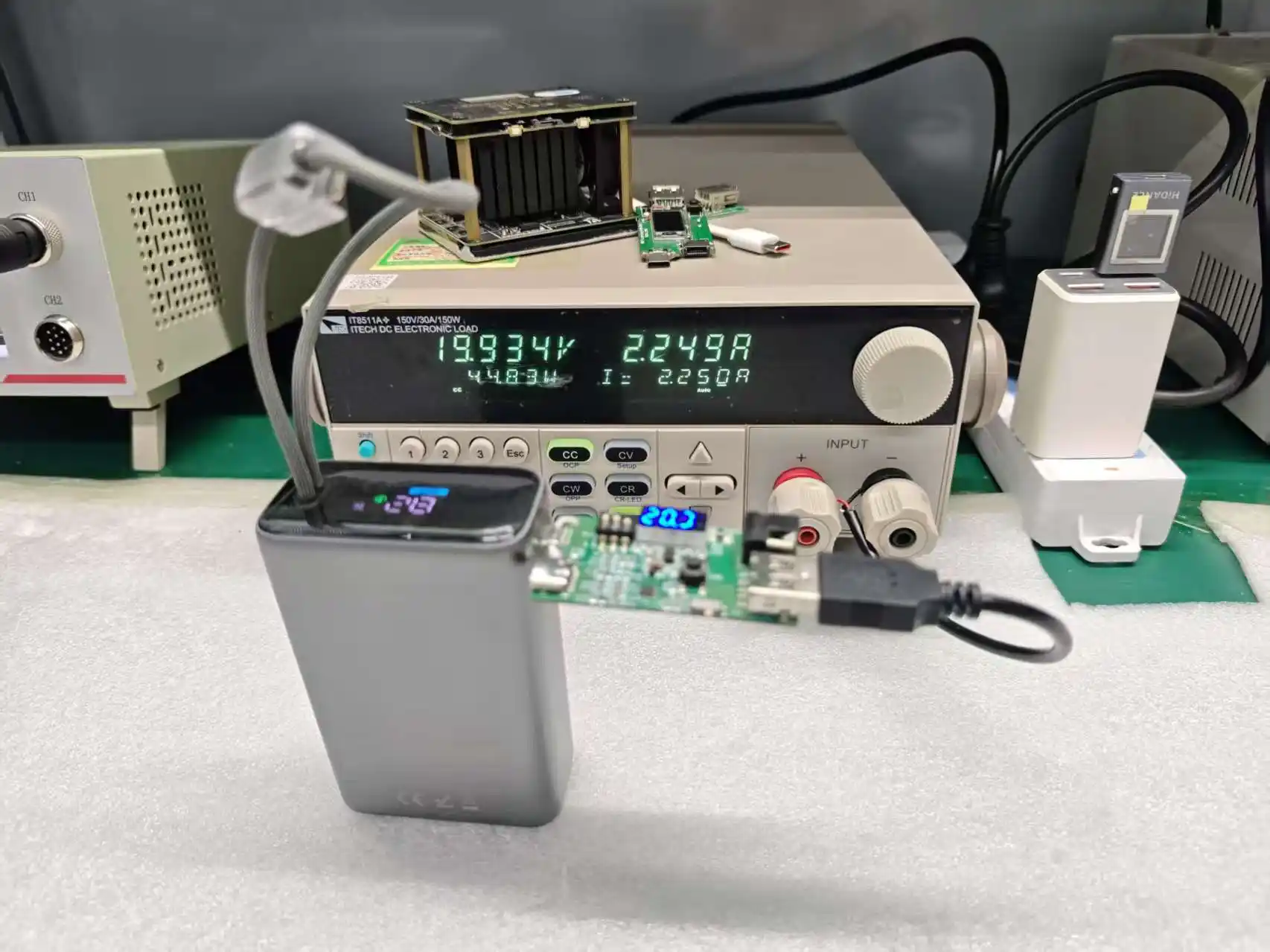
Built-in cable voltage testing: GaN chargers maintain stable output with integrated cable designs due to lower thermal stress, silicon chargers with built-in cables show 3-5% voltage drop under sustained load due to internal heat buildup
| Wattage | GaN Size (approx.) | Silicon Size (approx.) | Size Reduction |
|---|---|---|---|
| 30W | Thumb-sized (25-30 cm³) | Small apple charger (50-60 cm³) | ~50% |
| 65W | Credit card stack (40-55 cm³) | Palm brick (90-130 cm³) | ~50-60% |
| 100W | Deck of cards (70-90 cm³) | Large brick (180-250 cm³) | ~60-65% |
| 140W+ | Smartphone-sized (120-160 cm³) | Not practical in compact form | N/A (silicon impractical) |
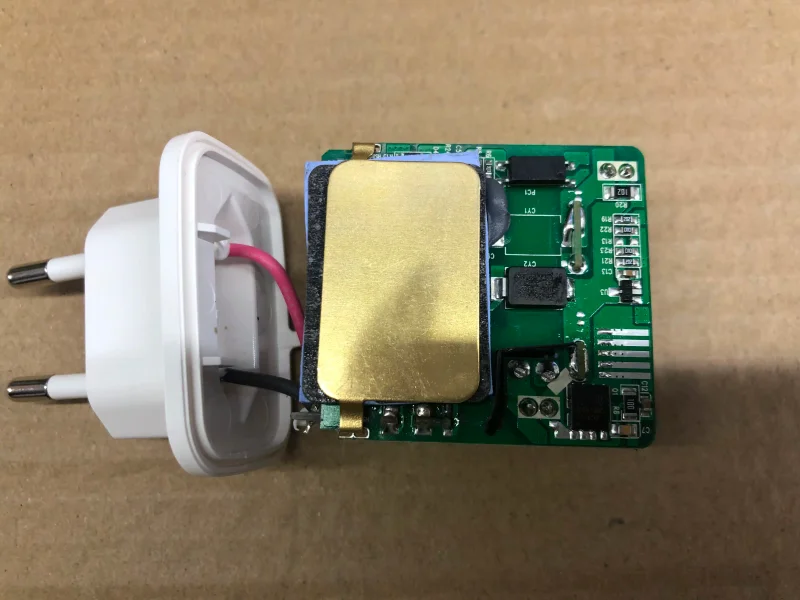
Side-by-side: a 65W GaN charger takes up roughly half the volume of an equivalent silicon charger
The size advantage compounds at higher wattages. At 100W and above, silicon chargers become impractical for portable use, they require large heat sinks that push dimensions well beyond pocket-friendly territory. GaN's thermal efficiency allows 100W+ chargers that still fit in a laptop bag's accessory pocket.
4. Efficiency & Heat: The Real-World Difference
Efficiency numbers on a spec sheet don't tell the full story. Here's what the numbers mean in practice.
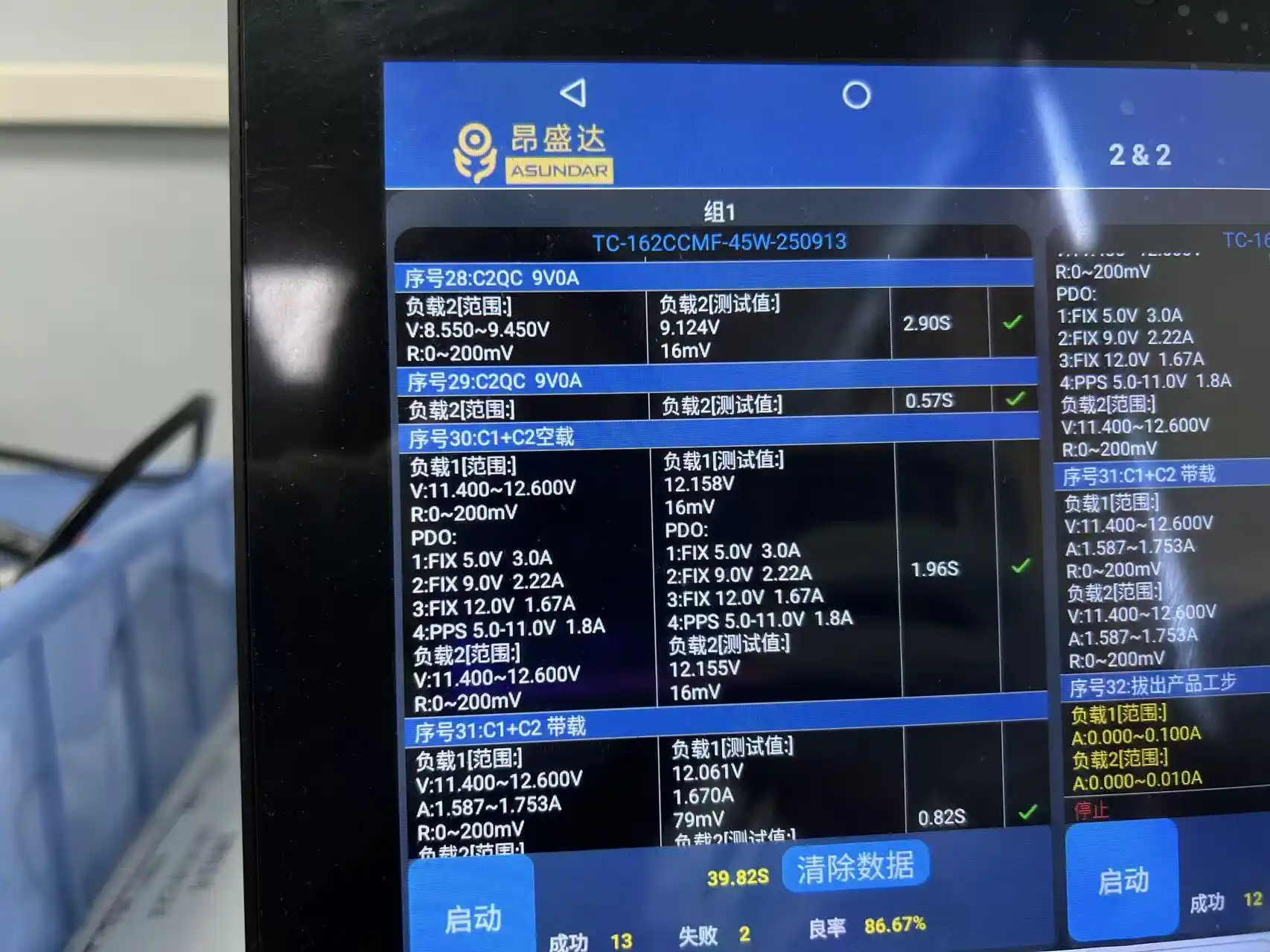
GaN V vs silicon efficiency testing at 65W full load: GaN maintains 94.3% with case temp 58.3C, silicon drops to 82.7% at 85.1C after 30 minutes continuous operation
That ~7W difference in waste heat
Heat Generation at 65W (Watts Lost)
97% efficiency at 65W = only 1.95W lost as heat. The charger stays warm to the touch, never hot.
85% efficiency at 65W = 9.75W lost as heat. That's enough to feel uncomfortably warm and trigger thermal throttling.
That ~7W difference in waste heat is why silicon chargers slow down after 15-20 minutes of full-power operation. When the internal temperature exceeds safe thresholds, the charger thermally throttles, reducing output to protect itself. A silicon charger rated at 65W may drop to 30-45W after extended use. A GaN charger maintains 65W continuously.
Why This Matters for Daily Use
If you charge a MacBook Air (49Wh battery) from 0%: a 65W GaN charger finishes in ~50 minutes at sustained full speed. A 65W silicon charger may start at 65W but throttle to 40W after 15 minutes, extending charge time to ~75 minutes, a 50% longer wait. For quick top-ups between meetings, this difference is significant.
WOWOHCOOL Factory Data: FLIR Thermal Imaging Comparison (65W Chargers, 30 min @ 100% Load)
Measurements: FLIR E8 thermal camera, 25°C ambient, 230V/50Hz input, 65W constant-current load on Chroma 63600. GaN unit: WOWOHCOOL 65W GaN V reference design (Infineon CoolGaN IGT60R070D1). Silicon unit: standard 65W silicon MOSFET charger (market sample).
MTBF Accelerated Aging Comparison: GaN units tested to 15,000+ hours equivalent (50,000+ hours projected at normal use). Silicon units: 6,500 hours equivalent (~20,000 hours projected). Test method: 85°C/85% RH accelerated environment per Arrhenius model, failure defined as output dropping below 90% rated wattage. Sample size: 50 units per technology. GaN field return rate: <0.3% vs silicon: ~3.2%.
5. OEM Decision: When GaN Wins for Your Product Line
Daily Carry & Travel
One compact GaN charger replaces 2-3 silicon bricks. A 100W 3-port GaN charger handles laptop + phone + earbuds from a single outlet, ideal for airport lounges, coffee shops, and hotel rooms with limited outlets.
Multi-Device Households
Families with multiple phones, tablets, and laptops benefit from multi-port GaN chargers that intelligently distribute power. A single 100W GaN desktop charger can replace 3-4 separate adapters, reducing cable clutter and outlet usage.
Laptop Charging (65W+)
Above 65W, silicon chargers become large, hot, and prone to throttling. GaN is the only practical choice for compact laptop charging at 65W-240W. If your charger needs to power a laptop, GaN is not optional, it's the correct engineering choice.
OEM & B2B Product Lines
For brands sourcing chargers, GaN enables premium positioning, lower shipping costs (smaller/lighter packaging), reduced return rates (less heat-related failure), and better retail margins. See our GaN V OEM Manufacturing Guide for B2B-specific analysis.
6. When Silicon Remains Cost-Competitive for OEM Budget SKUs
GaN is superior technology, but superior technology isn't always the right answer. Here's when silicon still makes sense:
Fixed Installations (Size Doesn't Matter)
Chargers permanently mounted behind furniture, inside cable management trays, or in fixed desk setups. If you never see or move the charger, its compactness adds zero value.
Single Low-Power Device (<20W)
Charging a single smartphone, earbuds case, or smartwatch. At these low wattages, GaN's thermal and size advantages are minimal. A basic 20W silicon charger does the job adequately and costs under $10.
Ultra-Budget Products
For markets where every cent of BOM cost matters and the retail price point is under $10, silicon's 40-50% component cost advantage is decisive. This applies to bundled chargers included with budget devices and entry-level accessories.
Legacy Product Lines
Existing products with established safety certifications. Re-certifying a silicon charger design for GaN involves testing costs ($5,000-15,000+ per model) that may not be justified for mature, low-volume products nearing end-of-life.
7. 3-Year TCO: The Real Cost of GaN vs Silicon
Unit price is the wrong number to compare. A $3-4 per-unit FOB premium on GaN hides roughly $11,600 in warranty savings on a 10,000-unit order over three years. Here is the full 3-year accounting an OEM buyer actually pays.
| Power Level | GaN Retail | Silicon Retail | GaN FOB Shenzhen (1,000 pcs) | Retail Price Gap |
|---|---|---|---|---|
| 30-45W | $20-30 | $10-18 | $3.50-5.50 | ~$5-12 retail |
| 65W | $25-40 | $15-25 | $6-9 | ~$10-15 retail |
| 100W | $45-70 | $30-45 | $10-16 | ~$15-25 retail |
| 140W+ | $70-120 | N/A (impractical) | $18-30 | GaN only |
All OEM/FOB prices at 1,000-unit volume, MOQ 500 per SKU. CE, FCC, RoHS certification included. Custom branding and packaging not included. Silicon charger FOB pricing: 30-45W $2-4, 65W $3-6, 100W $5-8. GaN BOM cost premium is offset by lower shipping costs (40-50% smaller/ilighter) and lower return rates (~0.5% vs ~3% for silicon at 65W+).
| 3-Year TCO Line (10,000 units, 65W) | GaN | Silicon | 3-Year Delta |
|---|---|---|---|
| FOB unit cost (1,000 pcs) | $6-9 | $3-6 | +$3-4 GaN premium |
| Field return rate (3 yr) | 0.3% (~30 units) | 3.2% (~320 units) | ~290 fewer returns |
| Warranty replacement (@$40/unit) | ~$1,200 | ~$12,800 | -$11,600 GaN saves |
| Freight & warehousing | Baseline | +$0.50-1.50/unit | -$0.50-1.50/unit |
| Energy waste (efficiency) | ~4.55W | ~9.75W | -$3.50/unit/yr |
Break-even: GaN's $3-4 per-unit FOB premium is recovered within 12-18 months through lower returns, freight, and energy alone. For any order above ~3,000 units per year, the 3-year TCO favors GaN before you even count the 40-60% higher retail margin it commands.
Cost Trend: GaN IC Prices Dropping 8-12% Annually
GaN power IC costs have been declining 8-12% per year as manufacturing scales and competition increases. Innoscience's 2024 mass-production of 8-inch GaN-on-Si wafers reduced device costs 30-40% vs. 6-inch baselines. Industry analysts project GaN chargers will reach cost parity with silicon in the 30-65W range by 2028-2029. For OEM buyers, the question is shifting from "can we afford GaN?" to "can we afford not to offer GaN?"
8. OEM Sourcing Decision: GaN or Silicon for Your Brand?
| Your Situation | Recommendation | Why |
|---|---|---|
| Travel retail & portable accessory brands | GaN | One compact multi-port adapter replaces 2-3 chargers. 40% smaller packaging reduces freight cost per unit. |
| Multi-device consumer market (65W dual-port) | GaN | Multi-port GaN handles laptop + phone from one outlet without throttling. Highest-volume OEM tier at 65W FOB $6-9/unit. |
| Premium workstation & gaming accessory brands | GaN | Silicon is not practical above 100W in portable form. GaN V + PD 3.1 EPR at 140-240W is the only viable OEM platform for workstation-grade charging. |
| Fixed installation & bundled accessories | Either | Size is not a differentiator. Choose based on wattage needs and BOM cost. Silicon is acceptable for cost-sensitive SKUs. |
| Entry-level single-device charger SKUs | Silicon OK | A basic 20-30W silicon charger is adequate for single-port entry SKUs. FOB $2-4/unit at volume. |
| OEM brand sourcing chargers for retail & Amazon | GaN | Premium positioning, lower return rates (0.3% vs 3.2%), higher margins, EU USB-C mandate compliance. Explore our OEM GaN chargers → |
| Maximum budget constraint | Silicon | If every dollar counts and performance is secondary, silicon remains the cheapest option. |
What Is the Bottom Line for Your Product Line?
Leaves the house — GaN. Fixed installation, single device — silicon is still fine. Laptop or multi-device — GaN regardless.
The bottom line: If a charger leaves your house, go GaN. If it stays plugged into the same outlet for a year and you never see it, silicon is still perfectly fine. For any charger handling a laptop or multiple devices, GaN is the correct engineering choice regardless of location.
EXPERT INSIGHT
"We are seeing brands move from 'should we use GaN?' to 'which GaN generation should we standardize on?' That shift happened in just 18 months. The combination of regulatory pressure from the EU, consumer expectations set by flagship products, and the narrowing cost gap has made GaN the default choice for new charger development above 30W."
, Snowy May, Marketing Manager & Founder at WOWOHCOOL, with 10+ years in charger market analysis
Frequently Asked Questions
How much smaller is a GaN charger vs silicon at the same wattage?
A 65W GaN charger is 40-50% smaller by volume than an equivalent silicon charger. At 100W+, the size gap widens dramatically because silicon requires proportionally larger heat sinks. For OEM brands: smaller packaging means 20-25% lower per-unit shipping costs (more units per container), reduced retail shelf space, and lower packaging material costs. A 65W GaN charger weighs approximately 75-85g; silicon equivalents exceed 110g. In B2B logistics, weight equals freight cost.
GaN vs silicon BOM cost, what is the real difference at OEM volume in 2026?
GaN commands a 15-25% BOM premium over silicon at equivalent wattage, down from 40-50% in 2023 and falling 8-12% annually. At 65W, FOB Shenzhen pricing at 1,000 units: GaN $5.50-8.00/unit vs silicon $3.00-5.00/unit. This premium is typically recovered through 40% smaller packaging (lower freight), 0.3% vs 3.2% field return rates, and 40-60% higher retail margins.
At what wattage should OEM brands switch from silicon to GaN?
Below 20W single-port: silicon remains cost-competitive. 20-30W: the transition zone, GaN starts to win on size. 30-65W: GaN is the recommended default for new OEM designs, the BOM premium is recovered through smaller packaging and lower return rates. 65W+: GaN is effectively mandatory for any charger targeting retail above $19.99 MSRP. Above 100W: GaN IV/V is required, silicon designs exceed practical size and thermal limits.
Does EU Ecodesign regulation effectively mandate GaN for chargers above 30W?
EU Ecodesign 2025/2052 sets efficiency and no-load power thresholds extremely difficult to meet with silicon above 30W: minimum 88% average efficiency at 4 load points, ≤0.1W standby. GaN naturally achieves 93-95% across all load points; silicon typically hits 85% and fails the 25% and 75% load efficiency thresholds. Non-compliance = EU border rejection. For OEM brands targeting the EU market, GaN above 30W is a compliance requirement, not a premium option.
How do OEM buyers decide, GaN or silicon for their next charger product line?
Decision framework: (1) Check your wattage, above 30W, GaN is the only future-proof choice. Below 20W, silicon is still viable for ultra-budget SKUs. (2) Check your target market, EU-bound chargers above 30W need GaN for Ecodesign compliance. (3) Check your margin strategy, GaN commands 40-60% higher retail margins that more than offset the 15-25% BOM premium. GaN V chargers stabilize at 58.3°C under 100% load vs 82.7°C for silicon, better thermal performance means lower warranty costs. The ROI case for GaN above 30W is now closed.
Marketing Manager & Founder · Wireless Charging & Market Analysis
10+ years experience in wireless charging and power bank market analysis. Marketing Manager & Founder at WOWOHCOOL tracking global trends in GaN, Qi2, and battery technology.
Factory Footprint
ISO 9001 Facility
Shenzhen, China
Export Countries
Engineers In-House
Ready to Source GaN Chargers for Your Brand?
WOWOHCOOL offers factory-direct OEM/ODM GaN chargers from 20W to 240W. MOQ from 500 units, full CE/FCC/UL certification included.
Sources & References
- Efficient Power Conversion (EPC), GaN Technology Whitepapers
- Infineon (GaN Systems), GaN HEMT Power Transistor Technology
- Yole Group, Power GaN Market Report 2026
- Counterpoint Research, GaN Charger Market Analysis
- USB-IF, USB Power Delivery Specification
- European Commission, ESPR Ecodesign Regulation