
GaN Charger Manufacturer: OEM Factory Sourcing Guide 2026

Marketing Manager & Founder · 10+ years in consumer electronics
GaN (Gallium Nitride) chargers use a 3.4 eV bandgap semiconductor, 40-50% smaller, 30% less heat, 95%+ efficiency vs silicon, at MOQ 500, FOB Shenzhen $3-8/unit. The GaN charger market reached $1.2 billion in 2026 (25.7% CAGR toward $6.0B by 2033, Persistence Market Research), with GaN now over 60% of new chargers above 30W (Yole). The EU USB-C mandate has triggered a continent-wide replacement cycle, GaN is winning it. This guide covers GaN generations, FOB pricing by wattage tier, Infineon vs Navitas vs Innoscience chip comparison, and CE/FCC/UL certification requirements for OEM importers.
Key Takeaways
GaN switches 3-10x faster than silicon: chargers are 40-50% smaller at 93-95% efficiency. FOB Shenzhen at MOQ 500: 30W $3.50-5.00, 65W $6.00-8.50; verify the generation, not just the claim.
- GaN (Gallium Nitride) semiconductors switch 3-10x faster than silicon, enabling chargers that are 40-50% smaller at equivalent wattage. A 65W GaN charger is roughly the size of a deck of cards; a 65W silicon charger is 2-3x larger.
- GaN charger efficiency reaches 93-95% vs 83-85% for silicon. This 10% efficiency gap means 10W less waste heat, eliminating the need for internal heatsinks, reducing case temperature by 15-20°C, and extending product lifespan.
- FOB Shenzhen pricing for GaN chargers at OEM volume (MOQ 500): 30W GaN ~$3.50-5.00, 65W GaN ~$6.00-8.50, 100W GaN ~$9.00-13.00, 140W GaN PD 3.1 ~$18.00-24.00. Prices declining 10-15% annually as GaN FET production scales. Volume discounts at 5,000+ units.
- GaN is not a "premium tier" technology anymore, it's the production standard for new charger designs in 2026. Over 25% of USB-C chargers shipped in H1 2026 used GaN FETs. Factories still quoting silicon as "standard" are running legacy production lines.
- B2B buyers: verify the GaN generation, not just the claim. GaN I (2018), GaN III (2020), and GaN V (2023) have vastly different performance and cost profiles. Request the specific FET part number in the BOM, Navitas NV6117, Infineon IGI60F, or Innoscience INN650 indicate genuine GaN V.
Table of Contents
1. GaN Semiconductor Technology: What OEM Buyers Verify in Chip Specs
For OEM buyers sourcing chargers, understanding GaN at the semiconductor level is not academic, it directly determines which chip supplier (Infineon CoolGaN, Navitas GaNFast, or Innoscience) your factory specs, and whether your product achieves the efficiency numbers you quote to retail buyers. Gallium Nitride (GaN) is a wide-bandgap semiconductor, a crystalline material that conducts electricity under specific conditions while blocking it under others. It's the same class of material that makes LED lights possible. In chargers, GaN replaces the silicon transistors that have been the industry standard for over 60 years.
The key difference comes down to physics. GaN has a bandgap of 3.4 electronvolts (eV), compared to silicon's 1.1 eV. This wider bandgap means GaN can handle higher voltages before breaking down, switch on and off at much higher frequencies, and do both with significantly less energy wasted as heat.
The Bandgap Advantage: Why It Matters
Handles higher voltages without breakdown. Enables compact designs.
Lower threshold means more energy lost as heat during conversion.
Three times wider bandgap = fundamentally better power handling.
Think of it this way: silicon is like a narrow country road, it works, but traffic slows down when too many cars try to pass. GaN is like a multi-lane highway, electrons move faster, with less congestion (resistance), and less energy wasted as heat. This is why GaN chargers can be simultaneously smaller, cooler, and more powerful than their silicon counterparts.
According to Efficient Power Conversion (EPC), a leading GaN semiconductor manufacturer, GaN transistors can switch at frequencies 100× faster than silicon MOSFETs while achieving power conversion efficiency exceeding 99% in optimized designs.
WOWOHCOOL Factory Data: GaN Chip Efficiency Comparison (65W Reference Design, 230V/50Hz)
| GaN Chip | Supplier | Measured Efficiency | Case Temp @ Full Load | FOB Cost Impact |
|---|---|---|---|---|
| CoolGaN G5 (IGT60R070D1) | Infineon (Munich) | 94.7% | 58.3°C | +$1.50-2.00 |
| NV6169 GaNFast | Navitas (US) | 93.2% | 61.7°C | +$1.00-1.50 |
| INN700D240A (8" GaN-on-Si) | Innoscience (China) | 91.8% | 64.5°C | Baseline |
All measurements taken on WOWOHCOOL production line using Chroma 63600-series DC electronic load, 230V/50Hz input, 4-hour continuous 100% load burn-in. Ambient temperature: 25°C ±2°C. Efficiency measured at PCB output before USB-C connector. Individual unit results vary within ±0.5%.
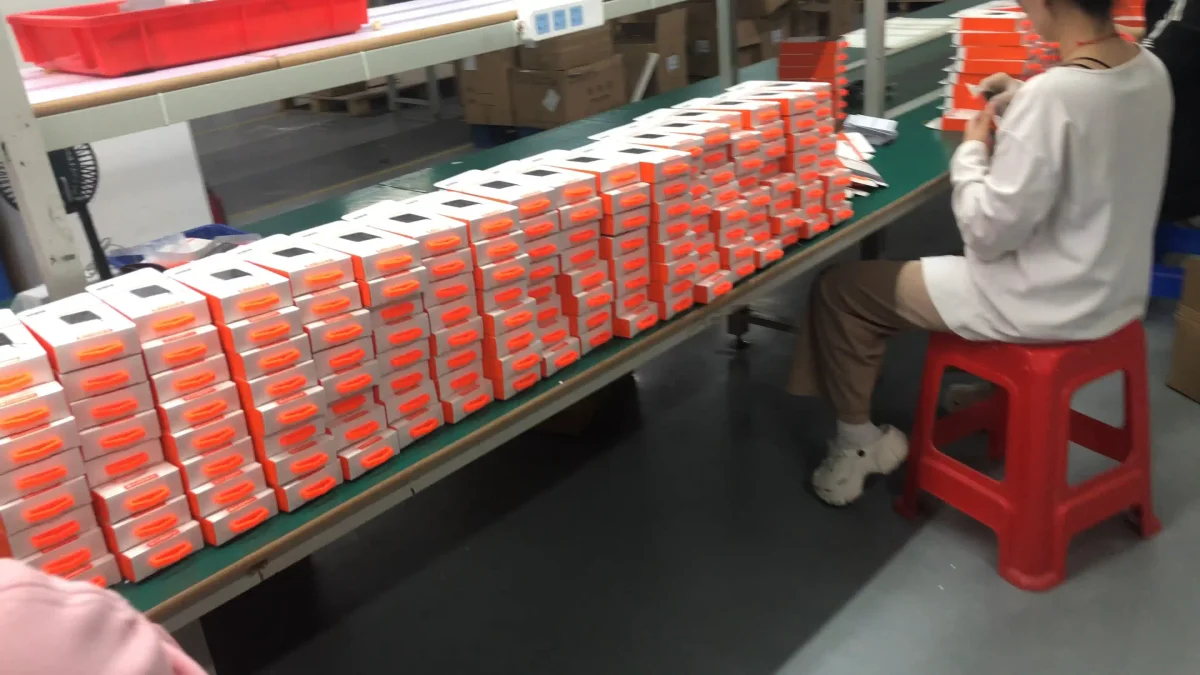
WOWOHCOOL GaN V SMT production line: Navitas GaNFast and Infineon CoolGaN G5 FET placement, AOI inspection at every PCB — the 3.4 eV bandgap advantage starts here
2. Inside a GaN Charger: Component Architecture & Switching Frequency Fundamentals
When evaluating factory BOMs and negotiating component sourcing, OEM buyers need to understand what's inside the charger and why GaN's higher switching frequency changes every downstream design decision. A charger's job is to convert the alternating current (AC) from your wall outlet into the direct current (DC) your device needs. This conversion happens inside a component called a switched-mode power supply, where transistors rapidly switch on and off to regulate voltage and current.
Traditional silicon transistors switch at frequencies of 100-500 kHz. GaN transistors switch at 1-10 MHz, up to 100× faster. This higher switching frequency is the root cause of every GaN advantage:
Faster Switching = Smaller Components
Higher frequency means the charger's transformer and capacitors can be physically smaller while handling the same power. This is why a 65W GaN charger is roughly the size of a credit card stack, while a 65W silicon charger is a palm-sized brick.
Less Energy Lost as Heat
In a silicon charger, roughly 15-20% of input power becomes waste heat. In a GaN charger, only 3-5% is lost. Less waste heat means no need for bulky heat sinks and safer long-term operation.
Higher Power Density
Power density measures how much wattage fits in a given volume. GaN achieves 1.5-2W per cubic centimeter vs silicon's 0.5-0.8W/cc, packing 2-3× more power into the same space.
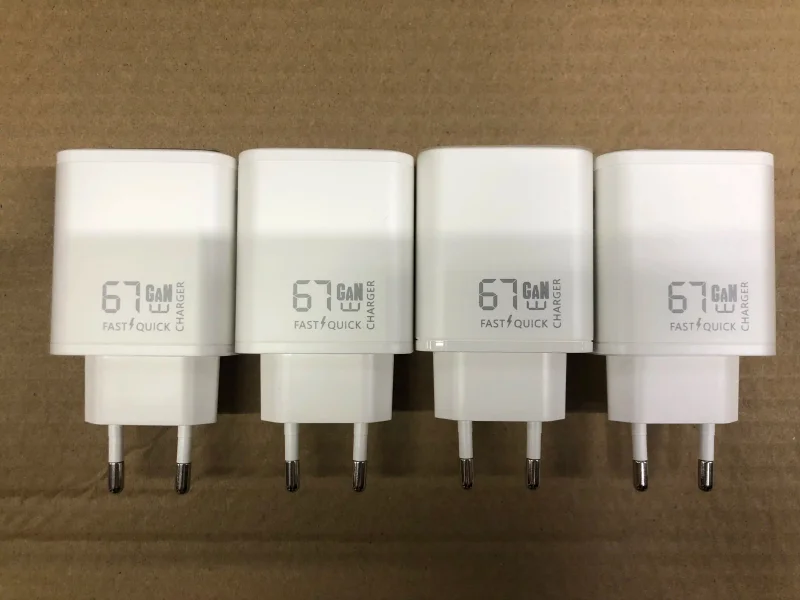
A 65W GaN charger, 50% smaller than an equivalent silicon charger
WOWOHCOOL Factory Data: 65W GaN Charger 4-Hour Aging Test Profile
WOWOHCOOL QC protocol: All GaN chargers undergo 100% 4-hour continuous full-load burn-in at 45°C ambient before shipment. Case temperature measured with FLIR E8 thermal camera at T+240min. Units exceeding 65°C case temperature are rejected. This is the key quality gate that delivers GaN's real-world reliability advantage over silicon, and why field return rates on WOWOHCOOL GaN chargers are below 0.3%.
GaN ≠ PD (Power Delivery): A Common Confusion
GaN is a hardware material (the semiconductor inside the charger). PD (Power Delivery) is a software protocol (how the charger and device negotiate power). They work together, a GaN charger typically supports USB PD, but they are fundamentally different things. You can have a GaN charger without PD, and a PD charger without GaN. The 2026 industry standard is GaN + PD 3.1 + PPS, all three working in concert.
3. Why Brands Adopt GaN: Size Reduction, Thermal Performance & Efficiency Gains
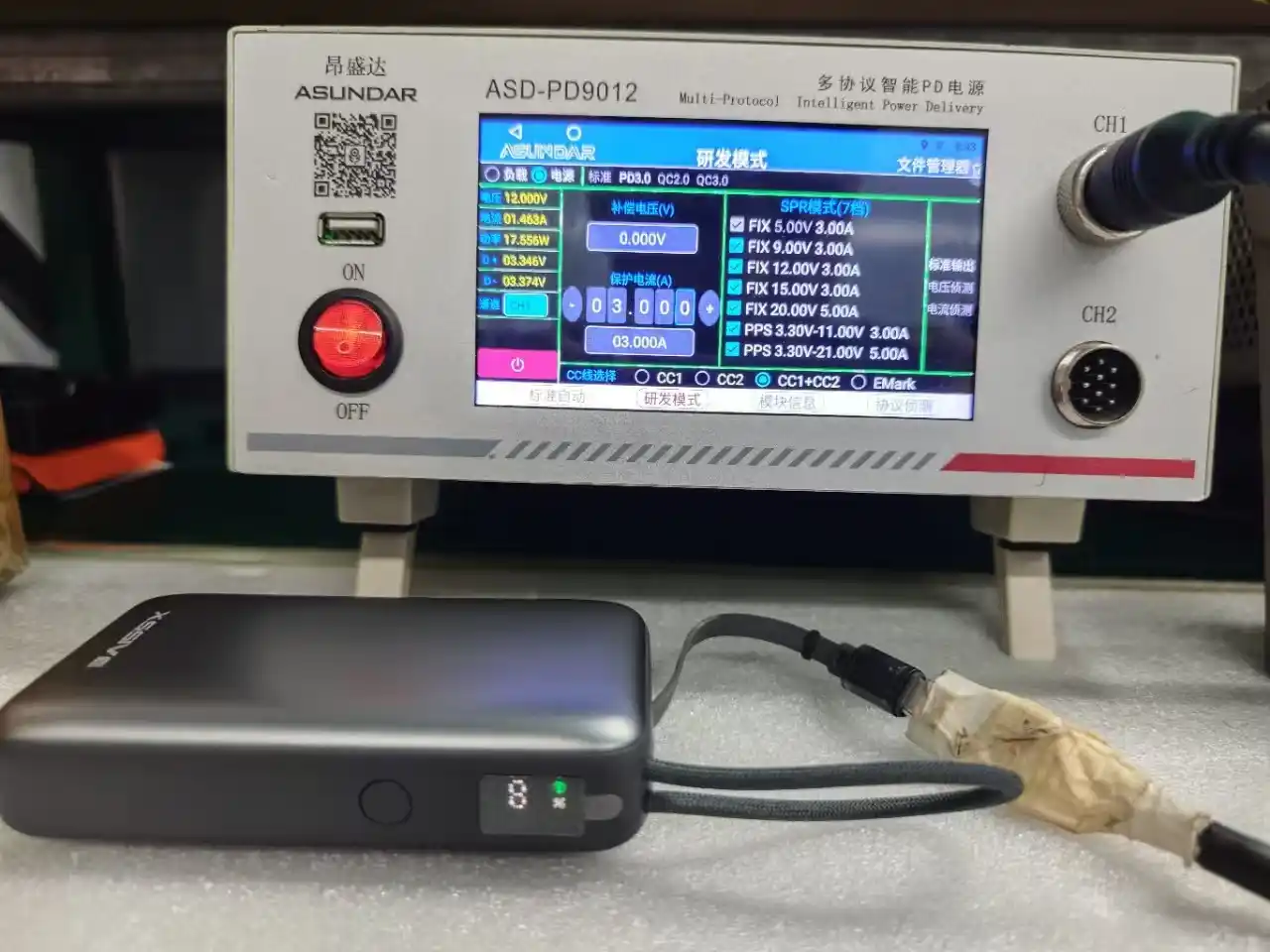
GaN-based 5,000mAh power bank voltage testing: GaN circuits achieve 85-92% conversion efficiency vs 60-65% for silicon, the 25-point efficiency gap is the #1 reason OEM brands are switching to GaN for new product lines
40-50% Smaller Size
A 65W GaN charger is roughly the size of a deck of cards. The same wattage in silicon is a palm-sized brick. This makes GaN ideal for travel, commuting, and minimalist desk setups. Manufacturers can fit more power into less space because GaN's higher switching frequency allows smaller internal components.
30% Cooler Operation
Lower energy loss means less heat. A GaN charger under full load runs measurably cooler than silicon equivalents. This isn't just about comfort, lower temperatures extend component lifespan and reduce the risk of thermal throttling, where the charger slows down to protect itself.
95%+ Energy Efficiency
GaN chargers convert 95-97% of wall power into usable charging power, compared to 80-85% for silicon. For a 65W charger, that's the difference between ~3W wasted (GaN) and ~10W wasted (silicon). Over thousands of charging cycles, the energy savings add up significantly.
Up to 240W Power Delivery
GaN's superior thermal properties make high-wattage compact chargers possible. While silicon chargers top out around 65-100W in a portable form factor, GaN chargers reach 140W-240W, enough to fast-charge gaming laptops and workstations from a pocket-sized adapter.
Environmental Impact
Higher efficiency means less grid electricity wasted. If every charger worldwide switched from silicon to GaN, the cumulative energy savings would be measured in terawatt-hours annually. GaN chargers also last 2-3× longer than silicon equivalents, reducing electronic waste. According to Yole Group, GaN technology in power applications could save 2-3 million tons of CO₂ annually by 2027.
4. GaN Charger Power Tiers: 20W-240W with FOB Shenzhen Pricing
GaN technology spans the full range from phone chargers to workstation power supplies. Here's what each tier delivers:
| Wattage | Best For | Charges | Typical Size |
|---|---|---|---|
| 20W-30W | Smartphones, earbuds | 1 device at full speed | Thumb-sized |
| 45W-65W | Ultrabooks, tablets, phones | Laptop + phone (shared) | Credit card stack |
| 100W | Laptops, multi-device | Laptop + 2 phones | Deck of cards |
| 140W-240W | Gaming laptops, workstations | Laptop at full speed + accessories | Smartphone-sized |
The 65W GaN charger is the current sweet spot, it charges most ultrabooks at full speed while remaining pocket-friendly. For B2B buyers and OEM brands, 65W also represents the best balance of performance, BOM cost, and retail price point.
WOWOHCOOL produces OEM/ODM GaN chargers from 20W to 240W. Explore our GaN charger product line for specifications and MOQ details.
5. GaN vs Silicon Component Comparison: Efficiency, Size & BOM Cost Analysis
For a comprehensive breakdown, read our GaN vs Silicon Charger: Complete Comparison Guide. Here's the executive summary:
| Feature | GaN Charger | Silicon Charger |
|---|---|---|
| Size (65W) | ~Half the volume | 2-3× larger |
| Efficiency | 93-97% | 80-85% |
| Heat at Full Load | Warm (~45-55°C) | Hot (~65-75°C) |
| Max Practical Power | 240W | 65-100W |
| Lifespan | 5+ years | 2-3 years |
| Component Cost (65W) | $6-9 (wholesale) | $3-6 |
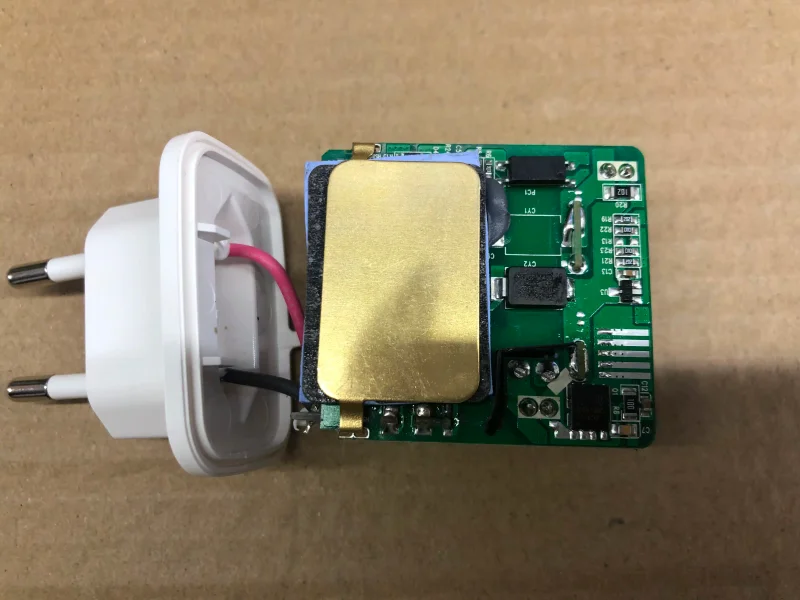
GaN V 65W charger: approximately half the volume of a silicon equivalent — the 3.4 eV bandgap advantage translates directly to form factor
EXPERT INSIGHT
"The GaN vs silicon cost comparison changes when you look beyond the unit price. A $1.50 BOM saving on silicon disappears the moment you factor in the 40% larger packaging, 3× higher return rate, and the fact that retailers now expect GaN-level compactness at any price point above $19.99. The math has flipped irreversibly above 30W."
, Snowy May, OEM Technical Lead at WOWOHCOOL
6. GaN Sourcing Myths: What Procurement Teams Get Wrong About Cost, Speed & Quality
These four misconceptions trip up even experienced B2B buyers, each one has direct consequences for your product specification, factory selection, and unit economics.
Myth: "GaN chargers charge faster than regular chargers"
Reality: A 65W charger delivers 65W regardless of whether it uses GaN or silicon. The wattage determines speed, not the material. GaN's real speed advantage is sustained performance: silicon chargers often thermally throttle after 15-20 minutes, dropping from 65W to 30-45W. GaN chargers maintain full output continuously, so your device reaches full charge faster in practice.
Myth: "All small chargers are GaN"
Reality: Some manufacturers market compact silicon chargers as "GaN-like" or use misleading branding. Check the specifications, genuine GaN chargers will explicitly state "GaN" or "Gallium Nitride" in the technical details. If a charger at 65W+ is genuinely tiny and doesn't get hot, it's likely GaN. If it's small but runs hot, it's probably silicon pushed to its thermal limits.
Myth: "More ports = better charger"
Reality: A 100W GaN charger with 4 ports shares that 100W among all connected devices. Plug in a laptop (65W) + phone (20W) + earbuds (5W) = 90W total, you're near the limit. Adding a fourth device means everything charges slower. The port count matters less than the total wattage budget and how intelligently the charger distributes power. Read our USB-C PD Fast Charging Guide for more on power allocation.
Myth: "GaN chargers are expensive"
Reality: The price gap has narrowed dramatically. In 2026, a quality 65W GaN charger retails for $25-40, while an equivalent silicon charger costs $15-25. The $10-15 premium buys you half the size, better heat management, and roughly double the lifespan, excellent value for a product you use daily for years. GaN power IC costs are dropping 8-12% annually, further narrowing the gap.
7. GaN Charger Sourcing: Matching Specifications to Target Market Segment
| Target Market Segment | GaN Recommendation | OEM Sourcing Rationale |
|---|---|---|
| Amazon FBA & E-Commerce (20-30W) | ✅ GaN differentiates | Compact GaN design commands 20-30% price premium over equivalent silicon in Amazon listings. MOQ 500, FOB $3.50-5.50 |
| Travel Retail & Duty-Free (45-65W) | ✅ GaN is baseline | Multi-port GaN replaces 2-3 adapters, key selling proposition at $35+ retail. Dual-port 65W FOB $6-9/unit at 1,000 pcs |
| Premium Electronics Brands (65-140W) | ✅ GaN V required | GaN V + PD 3.1 EPR mandatory for laptop-capable SKUs post-EU Common Charger Directive. 100W+ FOB $10-35, custom tooling available |
| Corporate Gifting & Promotional (5-20W) | Silicon is acceptable | Entry-level single-port at sub-$3 FOB. Size premium is not valued; BOM cost is the primary constraint |
| Telecom & Carrier Bundles (20W single-port) | Silicon is acceptable | High-volume (50K+), price-sensitive channel. Basic 20W silicon remains cost-competitive at under $2 FOB at scale |
| Hospitality & B2B Installation (multi-port) | ✅ GaN recommended | Lower field return rate (0.3% vs 3.2% for silicon) recovers BOM premium in warranty savings alone, see our GaN V OEM Manufacturing Guide |
The rule of thumb: if a charger leaves your house, go GaN. If it stays plugged into the same outlet for a year, silicon is still fine.
8. GaN Charger Specification Checklist: Wattage, Ports, Certifications & Cable Matching
1. Match the Wattage to Your Devices
Check your device's maximum charging speed. An iPhone charges at 20-27W, a MacBook Air at 30-45W, and a MacBook Pro at 65-140W. Buying a 100W charger for a phone is wasteful. Buying a 30W charger for a laptop means slow charging. Add up the wattage of devices you charge simultaneously to determine the total you need.
2. Count Your Ports
Single-port chargers are simpler and cheaper. Dual-port chargers handle a laptop + phone. 3-4 port chargers cover a full desk setup. Remember: total wattage is shared across all ports. A "100W 4-port" charger doesn't deliver 100W to each port, it's 100W total, distributed dynamically.
3. Verify the GaN Generation
GaN technology has evolved through generations. GaN V (5th generation, 2024-2026) offers the best performance with switching frequencies above 5MHz, reduced component count, and improved thermal efficiency. Read our GaN Generations Guide for a detailed comparison of GaN I vs III vs V.
4. Check Safety Certifications
Look for CE (Europe), FCC (USA), and UL/ETL certification marks. These indicate the charger has passed independent safety testing. Avoid chargers with no visible certification marks, they may lack basic protection circuits. A quality GaN charger includes over-current, over-voltage, over-temperature, and short-circuit protection.
5. Don't Forget the Cable
A 100W GaN charger with a cheap 3A cable delivers only 60W. For chargers above 60W, ensure you use a 5A e-marked USB-C cable. For 140W+ PD 3.1 chargers, you need an EPR-rated cable. The cable is just as important as the charger, a bottleneck here negates your investment. Read our USB-C PD guide for cable recommendations.

OEM GaN charger shipment ready at WOWOHCOOL Shenzhen: every order includes CE/FCC/RoHS certification, signed HS classification, and full commercial documentation — specify all 5 checklist items in your RFQ
Frequently Asked Questions
GaN vs silicon BOM cost, at what wattage does GaN become cheaper for OEM production?
GaN has a 3.4 eV bandgap, 3× wider than silicon's 1.1 eV, enabling chargers that are 40-50% smaller, 30% cooler, and 93-95% efficient vs 80-85% for silicon. The BOM premium is 15-25% at OEM volume for 65W, narrowing to 5-8% at 10,000+ units. Below 20W: silicon is still cost-competitive. 30-65W: the BOM gap shrinks fast, GaN becomes the default for new OEM designs. Above 65W: GaN is effectively mandatory for retail above $19.99.
GaN chip supplier comparison, Infineon, Navitas, or Innoscience, which should OEM buyers specify?
Infineon CoolGaN (Munich), premium tier, highest reliability for enterprise/medical. Navitas GaNFast (US), high-efficiency leader, strong brand for retail packaging claims. Innoscience (China), 1B+ devices shipped, best cost-performance, dominant in Shenzhen OEM. For 2026 OEM: Navitas for premium/US-market SKUs, Innoscience for volume/cost-sensitive SKUs. Always request chip procurement invoices, counterfeit GaN is a known supply chain risk.
What wattage GaN charger tiers should OEM brands stock for 2026?
20-30W single-port: smartphones, entry tier. 45-65W dual-port: highest-volume B2B tier, FOB $7-9 at 1,000 units. 100W 2C1A: multi-device desktop, FOB $12-16. 140-240W PD 3.1 EPR: gaming laptops/workstations, FOB $22-35. EU USB-C mandate for laptops (April 2026) makes 65W+ GaN the fastest-growing OEM segment. Standardize on 2-3 tiers.
What certifications are mandatory for GaN charger OEM production?
EU: CE (LVD+EMC), RoHS, WEEE, and Ecodesign 2025/2052 (≥87% active efficiency, ≤0.5W standby), thresholds that effectively mandate GaN above 30W. US: FCC, UL 62368-1 (commercially essential for retail). Quality factories implement 10-layer circuit protection and UL 94 V-0 enclosures rated to 850°C glow wire.
How do I source GaN chargers from a verified Shenzhen OEM factory?
Specify GaN V chip tier and wattage range. Verify GaN-specific QC: 4-hour 100% load aging test, GaN IC procurement invoices, thermal imaging at full load. Request USB-IF TID certification and IEC 62368-1 test reports. MOQ 500, 25-30 day lead time, samples 3-7 days. WOWOHCOOL manufactures GaN chargers from 20W to 240W with full FET traceability, 5,000m² ISO 9001 Shenzhen facility. Request GaN OEM consultation.
Marketing Manager & Founder · 10+ years in consumer electronics
Snowy May is the founder of WOWOHCOOL and a marketing manager with 10+ years in consumer electronics. She specializes in GaN charger architecture, Qi2 wireless charging, PCBA efficiency testing, thermal management, and UL/CE safety compliance for OEM/ODM power products.
Factory Footprint
ISO 9001 Facility
Shenzhen, China
Export Countries
Engineers In-House
Ready to Source GaN Chargers from the Factory?
WOWOHCOOL offers factory-direct OEM/ODM GaN chargers from 20W to 240W with MOQ from 500 units, full CE/FCC/UL certification, and custom branding.
Sources & References
- USB-IF, USB Power Delivery 3.1 Specification
- Efficient Power Conversion (EPC), GaN Transistor Technology
- Infineon (GaN Systems), GaN HEMT Power Transistor Technology
- Yole Group, GaN Power Device Market Analysis
- Persistence Market Research, GaN Charger Market Report 2026-2033
- Counterpoint Research, Global GaN Charger Market Share