
Wireless Charger OEM Manufacturers: China Factory Sourcing Guide

Marketing Manager & Founder · 10+ years in consumer electronics
"Both quotes said Qi2. Only one of them could name its authorization IC."
A German accessory brand shortlisted two Shenzhen factories for a 15W magnetic pad in early 2026. The quotes landed within 8% of each other at MOQ 500. The first supplier returned a coil inductance of 10.0 µH booked against the chip vendor's reference design. The second returned no measurement at all, only a datasheet PDF, and its sample reached 41°C above room temperature after one hour at full load. The brand ordered from the first. The second factory is still quoting.
That gap is the whole sourcing problem in one story. China holds the dense end of the world's wireless charging supply chain, and the pad on your desk and the pad that fails at month eight come out of factories that look identical on a directory listing. Per Grand View Research, the global wireless charging market continues to expand at a double-digit rate, and per WPC industry-recognized standards, magnetic alignment is now the baseline expectation rather than a premium feature. This guide profiles the manufacturers that matter for 2026 and, more usefully, hands you the five coil measurements and one thermal test that separate them.
KEY TAKEAWAYS
Wireless charger sourcing in China splits into two supplier classes: factories that hold a WPC membership and publish measured coil data, and factories that print "Qi2 compatible" on a catalog. Only the first class can give you a Qi-ID that resolves in the public registry. The five numbers below, plus one thermal load test you run yourself, separate them in under a week.
- MOQ follows design ownership, not order size. In-stock ODM with laser logo starts at 500 units, a platform redesign at 1,000-2,000 units, and a full OEM build with a new mold at 3,000+. Asking for "your MOQ" without specifying who owns the drawing gets you a number that will change later.
- The Qi2 certification adder is 1.20-2.00 USD per unit — a WPC-authorized authentication IC at 0.80-1.50 USD plus the per-unit royalty. A quote that undercuts the market by 3 USD is not "Qi2 certified"; it is Qi2-compatible hardware that cannot legally carry the trademark.
- Five measurements catch a weak coil before tooling: Tx inductance 10.0 µH ±5% at 100 kHz, Q-factor above 80, DCR 95 mΩ ±8%, ferrite μi around 2,300, and FOD response under 180 ms.
- FOB Shenzhen at 500 units: Qi2 15W magnetic pad 6.50-9.00 USD, 3-in-1 foldable station 12.00-16.00 USD, magnetic car mount 8.00-12.00 USD, desktop stand 7.00-10.00 USD. Prices fall 40-45% at 5,000 units.
- Shenzhen, Dongguan and Guangzhou are not interchangeable. Shenzhen gives you coil and IC sourcing density plus fast NPI, Dongguan gives you mid-volume cost balance, Guangzhou gives you the lowest unit cost at high volume with the longest engineering queue.
Tx Coil Inductance
Case Rise at 15W / 1h
System Efficiency at 15W
FOD Response Time
Table of Contents
Need a quick pick? If you want MOQ 500 on in-stock Qi2 models with a coil measurement report attached to every quotation, browse WOWOHCOOL's Qi2 wireless charger line →
1. How Were These Wireless Charger Manufacturers Selected?
Only factories that can evidence WPC certification, measured coil performance and in-house SMT were shortlisted. Wireless charging has no battery to hide behind: a pad that underperforms shows up as heat, not as a quietly degraded capacity figure.
Wireless charging is a smaller supply base than power banks or wall chargers, and it behaves differently. A power bank factory can buy cells on the open market and still ship a defensible product. A wireless charger factory either controls its coil geometry, ferrite sheet and FOD tuning, or it buys a finished module and puts a shell around it. Those two businesses look similar from a directory page and completely different on a test bench.
We screened on five criteria, in this order:
- WPC membership and per-SKU Qi-ID. Membership alone is table stakes; the test is whether each quoted model carries an ID you can resolve in the WPC product registry. Factory-wide membership with no per-model registration is a marketing position, not a compliance position.
- Measured coil data. Inductance, Q-factor, DCR and ferrite permeability are the four parameters that determine whether a 15W pad runs cool or throttles. We require a batch-referenced measurement report naming the instrument.
- In-house SMT and coil winding. Outsourced coil winding is the single most common source of unit-to-unit variance. If the factory cannot show you the winding line on a video call, assume the coils arrive in boxes.
- Certification support included in the quotation. CE, RoHS and FCC ID should be quoted as line items, not referred to a third party. This matters most for FCC, where the wireless transmitter needs its own ID rather than a general SDoC.
- Verifiable client references. At least two, in markets you actually sell into, that you can contact without the factory sitting in the call.
The screening deliberately weights engineering evidence over capacity claims. A 30,000 m² plant that outsources coils will produce a worse magnetic pad than a 5,000 m² plant that winds its own, and the difference only appears after the first container lands.
EXPERT INSIGHT
"The failure mode we see most often is not a bad chip, it is a coil that was wound to the wrong tolerance and never measured. Buyers spend weeks negotiating price and never ask for a single inductance reading. Ask for the number, name the instrument, and half your supplier list disappears."
— Snowy May, Marketing Manager & Founder, WOWOHCOOL
2. Top Wireless Charger Factories in China
The list below groups factories by what they are actually good at rather than by size. A brand launching a 500-unit test run and a retailer replacing 40,000 units of bedside furniture are not shopping for the same supplier.
WOWOHCOOL (Dong Yi Technology)
Shenzhen, Guangdong | Founded 2013
Builds Qi2 magnetic pads, 3-in-1 foldable stations, magnetic car mounts and desktop stands on shared SMT lines with in-house coil winding. ISO 9001 certified, 5,000 m², 1M+ units monthly, 50+ R&D engineers. MOQ 500 on in-stock models.
Distinguishing evidence: the factory publishes batch-referenced QC measurements rather than catalog specifications. On a 50-unit sample from batch #QC-2026-Q2-W93, Tx coil inductance measured 10.0 µH ±5% at 100 kHz on a Keysight E4980A, Q-factor exceeded 80 at 1 Vrms, DCR measured 95 mΩ ±8% by four-wire Kelvin, ferrite μi was 2,300 on an MnZn sheet equivalent to TDK PC95, and foreign object detection responded in under 180 ms.
Belkin / Foxconn Wireless Division
Belkin's BoostCharge Pro line is contract-manufactured at scale by large Taiwanese-owned EMS plants in Shenzhen and Vietnam. These lines run Apple MFM and Qi2 MPP builds side by side and hold deep magnetic-alignment process knowledge.
Certifications: Qi2, MFM (where applicable), CE, FCC, UL. Quality systems are automotive-grade. The trade-off is a supplier relationship built around forecast commitments rather than flexible runs, and engineering access sits behind a program manager.
Anker Innovations (OEM Division)
Anker's MagGo line established the consumer benchmark for Qi2 magnetic power banks and 3-in-1 stands. The OEM arm takes selective programs and brings strong thermal design and FOD tuning to the table.
Certifications: Qi2, UL, FCC, CE, RoHS. High-volume SMT with rigorous incoming inspection. Custom branding flexibility is limited because the platform catalog is tuned for Anker's own retail roadmap.
Shenzhen Coil and Module Specialists
A cluster of Shenzhen and Dongguan suppliers build only the transmit coil, ferrite sheet and PCBA module rather than a finished pad. They are the upstream source for many "wireless charger factories" that assemble rather than wind.
Certifications: varies. WPC membership is uncommon at this tier because the module is not a finished certified product. These suppliers are the right partner if you already have enclosure design capability and want to control the magnetic stack directly, and the wrong partner if you need a finished, certified retail SKU.
Dongguan Multi-Category Accessory Plants
Large accessory manufacturers that run wireless chargers alongside cables, wall chargers and phone cases on the same floor. Their advantage is one purchase order for a mixed container and consistent packaging across categories.
Certifications: CE, FCC, RoHS, UN38.3 where batteries are involved. Qi2 depth varies considerably between plants, so per-SKU Qi-ID validation matters more here than anywhere else on this list. Cost per unit is typically 8-15% below equivalent Shenzhen quotes at volumes above 5,000.
Furniture and Hospitality Embed Specialists
Factories that build charging surfaces into furniture, hotel bedside units and office desks. The coil sits under a 2-6 mm non-metallic surface, which changes the coupling calculation entirely and requires a different tuning approach than a bare pad.
Certifications: CE, FCC, RoHS, plus fire-rating documentation (UL 94 V-0 on housings) for hospitality procurement. Engagement is usually ODM from the factory's platform with a custom surface treatment rather than a clean-sheet design.
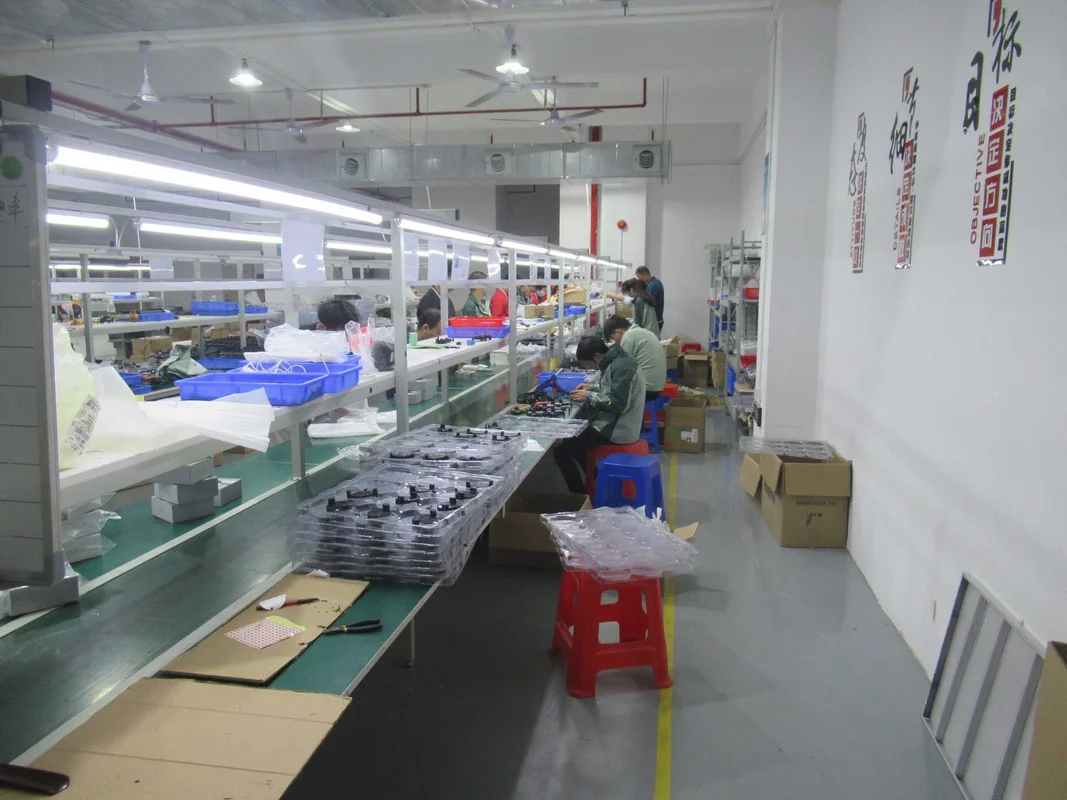
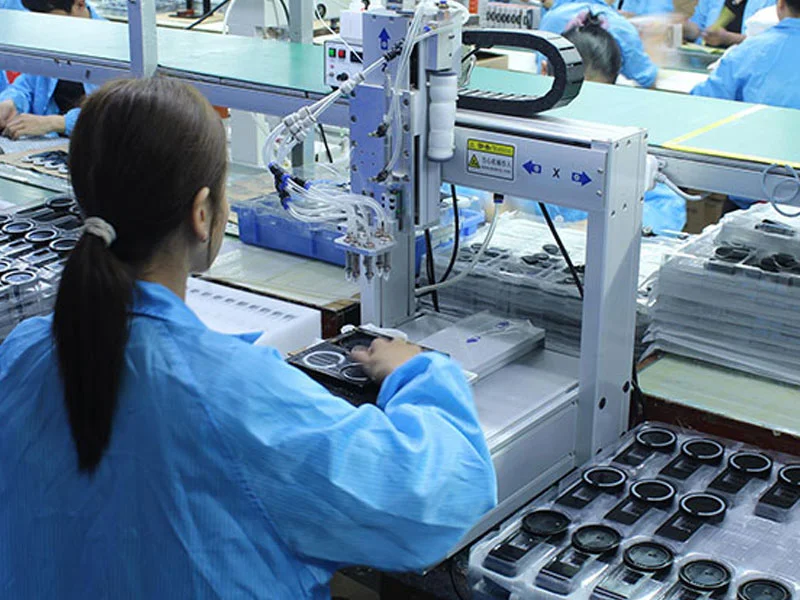
Automated assembly line at a Qi2 wireless charger factory in Shenzhen
3. Quick Comparison
The table compares MOQ against the highest power tier each supplier class typically supports, because that ceiling is what determines whether you can sell into the laptop and tablet accessory market.
| Manufacturer | MOQ | WPC / Qi-ID | Best For |
|---|---|---|---|
| WOWOHCOOL | 500 | Qi2 per SKU | QI2 MPP pads and 3-in-1 stations, published coil data, flexible MOQ |
| Belkin / EMS Division | 20,000+ | Qi2 + MFM | Retail programs, magnetic alignment at scale |
| Anker OEM Division | 10,000+ | Qi2 | High-volume retail, mature thermal design |
| Dongguan Multi-Category | 5,000+ | Varies by plant | Mixed-category containers, 8-15% lower unit cost |
| Coil / Module Specialists | 2,000+ | Rarely certified | Brands with enclosure design capability |
| Furniture Embed Specialists | 1,000+ | Qi2 with custom tune | Hotels, office furniture, surface-integrated charging |
*MOQ tiers reflect in-stock ODM platform models with laser branding. Structural changes and new tooling move a project to a higher tier regardless of the supplier.
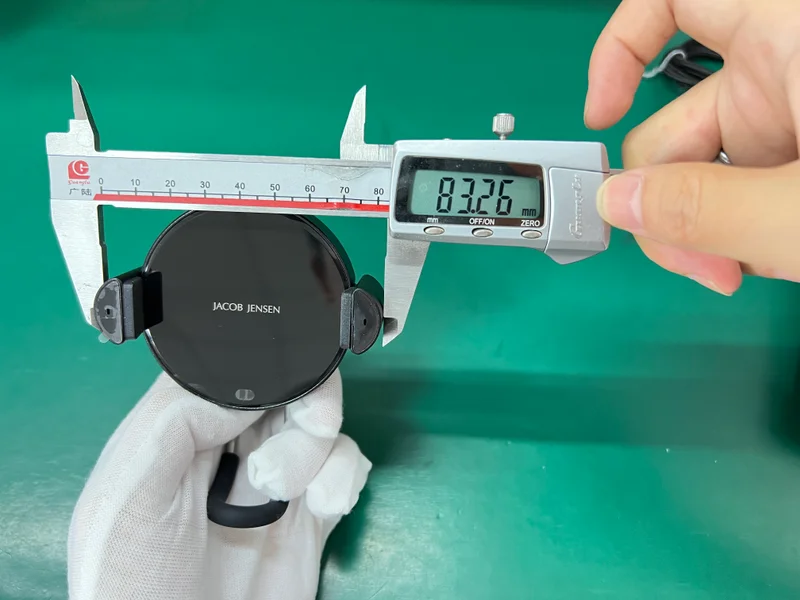
Coil and PCBA inspection during the in-process QC stage
Comparison tables compress a decision that has three separate axes. Price is the axis buyers negotiate hardest and the one that matters least once the coil spec is confirmed, because a 3 USD gap per unit is roughly the cost of a Qi2 certification and royalty you have to pay either way.
4. How to Choose the Right Wireless Charger Supplier?
Confirm the coil spec first, the MOQ tier second and the price last. Inverting that order is why brands end up renegotiating in week six.
1. Fix the magnetic standard before you fix the form factor
Decide whether you are shipping Qi2 MPP at 15W or moving to the Qi2.2 25W extended profile. The two carry different certification work and different coil tuning, and the decision changes what your supplier has to quote. A pad designed for 15W does not become a 25W pad with a firmware flag; the magnetic array and thermal path change with it. If your roadmap includes 25W, tell the factory on the first call rather than after the enclosure is tooled. Our Qi2 magnetic alignment explanation covers the coupling physics if you need the background before that call.
2. Ask who owns the design, then ask for MOQ
MOQ is a consequence of design ownership, not a knob the sales team turns. If the factory's platform design stays as-is and you add a laser-engraved logo, you are in the 500-unit tier with 3-7 day samples. If you want custom packaging, the tier moves to 2,000 units. If you bring your own drawing that needs a new injection mold, the tier is 3,000 units plus two to three months of tooling. Getting this wrong is the most expensive mistake in the process: a brand that plans a 500-unit test run against a custom-enclosure design will discover the mismatch after tooling has been quoted, not before.
3. Do the Qi2 cost math so a cheap quote cannot fool you
An officially certified Qi2 product carries a WPC-authorized authentication IC costing 0.80-1.50 USD plus a per-unit royalty. Total certification adder lands at 1.20-2.00 USD per unit against a non-certified Qi-compatible build. That number is your sanity check: if a quote undercuts a certified competitor by more than about 2 USD at the same power and form factor, the supplier is almost certainly shipping non-certified hardware that cannot display the Qi2 mark. Non-certified pads are 1.00-1.50 USD cheaper and are legal to sell, but they cannot use the trademark, and retail platforms increasingly filter on it. Our full WPC certification process and cost breakdown walks through the registry checks.
4. Run one thermal test yourself before releasing tooling
Order 3-5 units from the top two candidates and run each at 15W continuous for one hour in a 25 °C room. Log the case temperature rise. A well-tuned pad settles near 17.5 °C above ambient; a pad that climbs past 30 °C is losing energy in the coil or the ferrite rather than the silicon, and it will throttle on the customer's nightstand during the second year of the warranty. System efficiency at 15W should land between 82% and 85% DC-in to DC-out, with output ripple under 25 mVpp on the 5V rail. If a supplier cannot reproduce those numbers on demand, the specification was never real.
"Marcus, an Austrian furniture brand, approved a 4,000-unit bedside charger based on a catalog spec sheet. The first container ran 34 °C above ambient at 15W and throttled to 7.5W within 40 minutes. The retune cost three weeks and a new ferrite supplier. The coil had never been measured against the ferrite it was paired with."
5. Lock the QC regime into the purchase contract
Specify the inspection standard rather than accepting "strict QC". A defensible regime is four-stage inspection covering incoming components, in-process assembly, final function and outgoing packaging, with AQL 0.65 on normal and 0.25 on tightened inspection, and a 100% four-hour aging test on every unit rather than batch sampling. Ask what the factory's production yield and defect rate are and compare against the industry's 95-97% yield and 2-5% defect norm. Third-party inspection runs 300-800 USD per visit and is worth scheduling for the first production order, not the third.
5. Qi2 Certification: Evidence Buyers Must Verify
Five coil measurements and one WPC registry lookup verify more about a wireless charger supplier than any certificate pack. Ask for all six before you release tooling.
Certificates are easy to forward and hard to fake convincingly only if you check the registry. The five parameters below come from an actual production QC run of 50 units, not from a reference board, which is exactly why they are worth asking for. Any factory that cannot produce an equivalent batch report is telling you it does not measure its own output.
| Parameter | Target Value | How It Is Measured |
|---|---|---|
| Tx Coil Inductance (Ls) | 10.0 µH ±5% @ 100 kHz | LCR meter, e.g. Keysight E4980A |
| Coil Q-Factor | > 80 @ 100 kHz, 1 Vrms | Same LCR meter, Q mode |
| DC Resistance (DCR) | 95 mΩ ±8% | Four-wire Kelvin measurement |
| Ferrite Shield μi | 2,300 (MnZn, PC95 class) | IEC 62044-2 test method |
| FOD Response Time | < 180 ms | Q-factor deviation method, WPC PT 1450 |
| Thermal, 15W continuous 1h | +17.5 °C over 25 °C ambient | Thermal camera, e.g. FLIR E8 |
| System Efficiency @ 15W | 82-85% DC-in to DC-out | Electronic DC load plus oscilloscope |
| Output Ripple (5V rail) | < 25 mVpp @ 15W load | Oscilloscope, 20 MHz bandwidth limit |
*Values are mean averages from a 50-unit production sample. Any supplier quoting these parameters must also name the instrument and the batch.
Certification cost and timing sit alongside the measurements, and both are repeatedly underestimated. WPC lab testing runs 3,000-5,000 USD per SKU over 4-8 weeks, and WPC membership runs 5,000-25,000 USD per year depending on tier. The FCC ID for a wireless transmitter is a separate 2,000-5,000 USD and 3-6 weeks from the general SDoC that covers a wired charger. Budget the certification line before you negotiate unit price, because it is a fixed cost that does not scale down with volume.
Finally, verify rather than trust. Every Qi2 product carries a Qi-ID that resolves in the WPC product registry. Look up the ID for the exact model you are buying, not the model family, and confirm the manufacturer name on the registry entry matches the company issuing your quotation. A trading company quoting a factory's certification is the most common mismatch, and it is a five-minute check. For the wider picture on detecting forged documents, see how to verify FCC, UL and CE certificates.
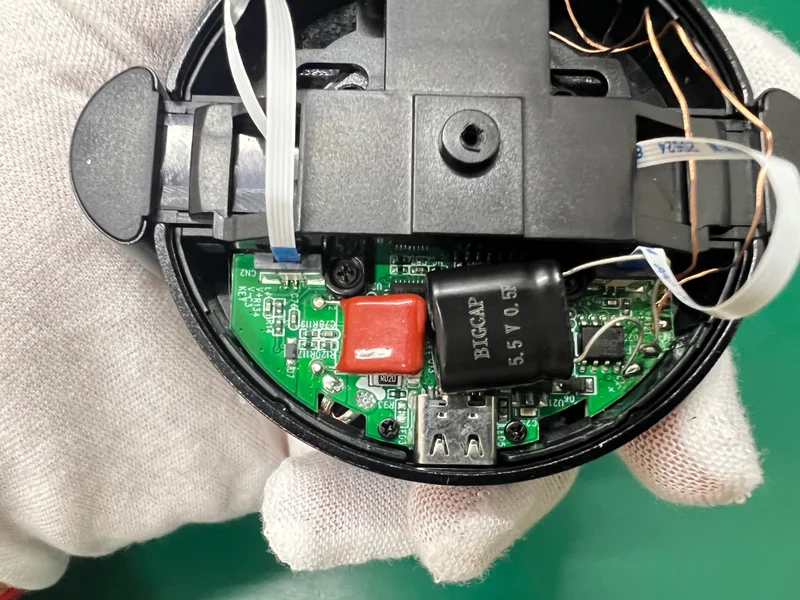
The image above shows the stack that the five measurements describe: transmit coil, MnZn ferrite shield and the PCBA carrying the foreign object detection circuit. FOD is the safety gate that stops a pad from cooking a set of car keys, and it is the one parameter where a cheap design fails visibly. Per WPC industry-recognized standards, response time under 180 ms is the working target; pads that take longer are typically running a simplified detection routine with a narrower thermal window.
6. Which Manufacturing Hub Is Best for Wireless Chargers?
Shenzhen for magnetic and IC depth, Dongguan for mid-volume cost balance, Guangzhou for the lowest unit cost at high volume. The right answer depends on your order profile, not on a ranking.
Wireless charging is less geographically distributed than battery assembly. The magnetic stack depends on ferrite sheet suppliers, coil winding houses and Qi2 authentication IC distribution, and those three sit within a short radius of each other in the Pearl River Delta. That concentration is the reason a Shenzhen factory can quote a coil change in days while a factory two provinces away quotes it in weeks.
| Hub | Strength | Trade-off |
|---|---|---|
| Shenzhen | Coil, ferrite and Qi2 IC sourcing density; fastest NPI and engineering response | Highest labour and overhead cost; quotes run above Dongguan |
| Dongguan | Balanced cost and quality; strong mid-volume accessory capacity | Qi2 engineering depth varies plant by plant; validate per SKU |
| Guangzhou | Lowest unit cost at high volume; large multi-category plants | Longest engineering queue; weaker fit for small or frequent runs |
| Foshan / Zhongshan | Furniture and appliance integration; legacy lighting and hardware supply chain | Few standalone charger factories; usually a sub-supplier relationship |
A practical pattern many brands settle into: keep the design and first production run with a Shenzhen partner that can iterate on coil tuning quickly, then move repeat orders of a frozen SKU to a Dongguan line for the cost delta. That works because the SKU is fixed by then, but it only works if the receiving factory can reproduce the same measurement report. Write the coil parameters into the transfer package before the second supplier is onboarded, otherwise the second run will drift and you will not know why.
Worth stating plainly: a factory's location predicts its cost structure and its engineering queue, not its quality. The five measurements in section 5 are location-independent, and a Dongguan plant that can produce them is a better partner than a Shenzhen plant that cannot.
Once the supply base is settled, the commercial model question follows. If you are still deciding between using the factory's platform design and bringing your own, the trade-offs are covered in our OEM vs ODM decision guide. If you want to benchmark wireless charging against a category with a longer production history and more mature supplier scrutiny, see our power bank factory comparison, which profiles the same supplier landscape from the battery side.
Wireless Charger Buyer Specification Sheet
Certifications
- WPC Qi2 per SKU with resolvable Qi-ID
- CE (LVD + EMC) and RoHS
- FCC ID for the wireless transmitter
- IEC 62368-1 safety test reports
Manufacturing & MOQ
- MOQ: 500 units (in-stock ODM, laser logo)
- Sample lead time: 3-7 days
- Mass production: 25-35 days
- Platform redesign: 1,000-2,000 units
- Full OEM with new mold: 3,000+ units
Quality Standards
- AQL 0.65 Major / 0.25 tightened
- 100% 4-hour aging test on every unit
- 4-stage QC: IQC / IPQC / FQC / OQC
- Coil measurement report per batch
Frequently Asked Questions
What is the MOQ for OEM wireless charger manufacturing in China?
It depends on who owns the design. In-stock ODM with laser-engraved logo starts at 500 units. A platform redesign that keeps stock packaging starts at 1,000 units, and custom branded packaging or structural changes start at 2,000. A full OEM project using your own drawing with a new injection mold starts at 3,000 units and adds 2-3 months for tooling before mass production begins.
What is the FOB Shenzhen price for Qi2 wireless chargers?
At 500 units, a Qi2 15W magnetic pad runs 6.50-9.00 USD, a 3-in-1 foldable station 12.00-16.00 USD, a magnetic car mount 8.00-12.00 USD, and a desktop stand 7.00-10.00 USD. At 5,000 units those bands fall to 3.50-5.00, 7.00-11.00, 5.00-7.50 and 4.00-6.00 USD. All prices include the Qi2 authorization IC and WPC per-unit royalty and exclude freight, duty and certification fees.
Which certifications must a wireless charger supplier provide?
Five documents matter for a Qi2 pad: WPC Qi certification with a Qi-ID that resolves in the public product registry, CE marking covering LVD and EMC, RoHS, FCC ID for the wireless transmitter rather than a generic SDoC, and IEC 62368-1 safety test reports. Expect 3,000-5,000 USD and 4-8 weeks for the WPC lab work per SKU, and 2,000-5,000 USD for the FCC ID. A supplier who sends only PDF certificates without database references has not been verified.
How do I verify a wireless charger factory's Qi2 coil quality?
Ask for five measured parameters from a named batch: Tx coil inductance of 10.0 uH plus or minus 5 percent at 100 kHz, Q-factor above 80, DC resistance of 95 mOhm plus or minus 8 percent, ferrite initial permeability near 2,300 on an MnZn sheet, and foreign object detection response under 180 ms. Then run your own one-hour 15W load test. A pad whose case temperature rises more than 17.5 degrees C above a 25 degree room is losing efficiency in the coil rather than the silicon.
How long does OEM wireless charger production take from sample to shipment?
For an in-stock ODM model, samples ship in 3-7 days and mass production takes 25-35 days. A platform redesign adds 25-45 days of engineering before production, and mass production then runs 35-50 days. A full OEM build with a new mold needs 7-14 days for samples, 30-60 days of production, plus 2-3 months of tooling. Add 4-5 weeks of sea freight to Europe or North America if you ship by water.
Sourcing Wireless Chargers Without the Guesswork
The wireless charger supply base in China is smaller and more technically gated than the battery category, which is good news for buyers who do the work. Two suppliers quoting the same MOQ and the same wattage are not quoting the same product. The difference is a coil that measures 10.0 µH on a named instrument and one that does not, and it takes one measurement report and one thermal test to tell them apart.
Work in this order: fix the magnetic standard, confirm who owns the design so the MOQ tier is real, do the Qi2 cost math so a suspicious quote is obvious, run the one-hour load test yourself, and write the QC regime into the contract. Any supplier that resists any step of that sequence is giving you information.
Marketing Manager & Founder · 10+ years in consumer electronics
Snowy May is the founder of WOWOHCOOL and a marketing manager with 10+ years in consumer electronics. She specializes in GaN charger architecture, Qi2 wireless charging, PCBA efficiency testing, thermal management, and UL/CE safety compliance for OEM/ODM power products.
Factory Footprint
ISO 9001 Facility
Shenzhen, China
Export Countries
Engineers In-House
Need a Qi2 Wireless Charger Supplier at MOQ 500?
Send us your target wattage and form factor. We reply with an FOB price, the coil measurement report for the matching SKU, and sample availability within 24 hours.