
Semi-Solid State Nail Penetration Test: What OEM Buyers Must Verify

Global Procurement & Sourcing Manager · 10+ years
In June 2026, the Donut Lab disclosure landed in every importer's inbox: 3+ years of lithium-ion cells marketed as "solid-state." Datasheets identical to genuine suppliers, trade-show demos identical, spec sheets identical. The only thing that ever separated real from counterfeit was the nail penetration test — and no buyer had asked for it. Below FOB $4/unit for 10,000 mAh "semi-solid" is physically impossible, yet Alibaba listings advertise it every week.
The nail penetration test is the single physical claim that separates genuine semi-solid state cells from repackaged Li-polymer. Genuine cells do not ignite or leak at nail contact; Li-polymer references vent into thermal runaway. Below: the GB 47372-2026 protocol and six red flags OEM buyers use to verify suppliers before placing a PO.
Key Takeaways
The nail penetration test is the one physical claim liquid-electrolyte Li-polymer cannot fake as semi-solid. WOWOHCOOL semi-solid cells use a gel electrolyte that does not ignite or leak under nail penetration; the liquid Li-polymer reference goes into thermal runaway.
- WOWOHCOOL defect rate below 0.3% vs. industry 2-5%, across 12-month sample
- GB 47372-2026 mandatory April 2027: nail 4 mm, 20 ± 1 mm/s drive speed, 100% SOC, ambient 25 ± 5 °C
- FOB floor $6.50/unit (10K mAh, 5,000 units). Anything below $4 is fake chemistry or bait-and-switch
- 4 documents to demand pre-PO: UN38.3 cell-level report, GB 47372 pin test, electrolyte MSDS with polymer %, cell manufacturer batch code
- Genuine semi-solid: no fire, no leakage under nail penetration vs. thermal runaway in Li-polymer
Table of Contents
1. Why the Nail Penetration Test Is the Semi-Solid State Truth Test
The nail penetration test drives a steel pin through a fully charged cell at controlled speed and measures the thermal response. In liquid-electrolyte lithium-polymer cells, the pin ruptures the separator, the flammable carbonate solvents ignite, and the cell vents into thermal runaway within seconds. In a genuine semi-solid state cell, the gel electrolyte cannot flow, the polymer matrix holds anode and cathode apart, and the cell either self-extinguishes or never ignites; the cell does not ignite or leak.
No spec sheet can fake this. A supplier can print "260 Wh/kg" or "cycle life 1,500" on a datasheet with no consequence. But a live nail penetration test is a physical claim: pass or fail, on video, at your factory audit. At WOWOHCOOL's Shenzhen QC laboratory, semi-solid cells did not ignite or leak under nail penetration; the liquid Li-polymer reference cell vented into thermal runaway within seconds.
Temperature-Rise Signature — Semi-Solid vs Li-Polymer
| Metric | Semi-Solid (WOWOHCOOL 2026-05) | Li-Polymer (reference) |
|---|---|---|
| Fire / leakage at nail contact | None (gel) | Thermal runaway |
| Time to first smoke | Never | Seconds |
| Time to venting/fire | Did not occur | Seconds |
| Defect rate | <0.3% | 2-5% |
| Cycle life to 80% capacity | 500+ cycles | Standard |
| Energy density | 30% higher | Baseline |
The lower defect rate is not a marketing number. It is the direct commercial consequence of the temperature-rise signature. Cells that survive nail penetration also survive the drops, thermal shocks, and overcharge events that generate real-world return incidents.
2. GB 47372-2026: The Pin Test Protocol OEM Buyers Should Reference
China's mandatory standard GB 47372-2026 (effective April 2027 for cells manufactured in China) defines nail penetration test parameters with more precision than most consumer standards, which is why buyers should reference it even when shipping to the US or EU.
Exact Test Parameters
| Parameter | Specification |
|---|---|
| Nail diameter | 4 mm (steel, sharpened) |
| Drive speed | 20 ± 1 mm/s |
| Ambient temperature | 25 ± 5 °C |
| Cell state of charge | 100% SOC |
| Cell orientation | Widest face perpendicular to nail |
| Observation duration | 1 hour minimum after penetration |
Pass/Fail Criteria — All Three Must Hold
- No fire: no visible flame at any point during observation
- No explosion: the cell does not rupture or eject contents
- No leakage: the gel electrolyte does not escape the cell
There is no partial credit. GB 47372-2026 also mandates the test be run on cells drawn from a production batch, not laboratory samples. Closing the loophole where a factory ships one certified lot then substitutes commodity cells.
Why the Timing Matters for 2026 OEM Orders
The standard becomes mandatory April 2027. Cells manufactured Q4 2026 or Q1 2027 that ship without a GB 47372-2026 test report will be non-compliant for domestic Chinese sale; export-only OEM orders are technically exempt. The problem is enforcement lag: legitimate factories are running the test today because they need it for domestic customers. Factories that cannot show a GB 47372-2026 report by mid-2026 are almost certainly not running semi-solid cell lines.
Expert Insight
"Two years ago a buyer asked for our nail test video and I sent it in six hours. Last month a buyer asked our competitor and got a four-week silence. The four-week silence is the answer. If your supplier can't ship a nail-test video from a batch cell in 48 hours, they don't have the test rig, the dry room, or the chemistry — pick one, they don't have any of them."
— Nina Nico, Global Procurement & Sourcing Manager, WOWOHCOOL
3. Six Red Flags That a "Semi-Solid" Supplier Is Actually Selling Li-Polymer
Six documentation and production-line signals distinguish genuine semi-solid state cells from repackaged Li-polymer. Any two together are grounds to walk.
| Red Flag | The Tell | What It Exposes |
|---|---|---|
| No cell-level test report | Only pack-level UN38.3 | Repackaged Li-polymer, not real chemistry |
| No in-situ curing station | No 8-12 m UV/thermal tunnel | No semi-solid gel polymerization |
| No dry room | Dew point above −40 °C | Hygroscopic electrolyte handled incorrectly |
| MSDS shows only carbonate solvents | No PEO/PVDF polymer % | Standard Li-polymer electrolyte |
| FOB below $4/unit (10K mAh) | Below $6.50 cost floor | Bait-and-switch or fake chemistry |
| "500-cycle" claim without curve | No capacity-retention curve | Fabricated cycle data |
Red Flag 1 — No Cell-Level Test Report, Only Pack-Level
A pack-level UN38.3 report covers the assembled battery pack (enclosure, BMS, wiring). It does not certify the cell chemistry. A real semi-solid supplier hands over a cell-level test report from the cell manufacturer (typically LG Energy Solution, Great Power, or a specialized supplier) showing chemistry, formation cycles, and capacity retention. If the report names only the assembly factory, you are looking at repackaging.
Red Flag 2 — No In-Situ Curing Station on the Production Line
Semi-solid state cells require in-situ polymerization: liquid electrolyte precursor injected, then cured (UV or thermal) into a gel matrix inside the sealed cell. The curing station is a conveyor-fed UV chamber or thermal tunnel, typically 8-12 meters long. A "semi-solid" factory without this station is not making semi-solid cells.
Red Flag 3 — No Dry Room (Dew Point ≤ −40 °C)
Semi-solid electrolyte is hygroscopic during the pre-cure phase. Manufacturing requires a dry room with dew point ≤ −40 °C, air-lock entry, and workers in gowns. A well-run dry room posts the dew-point reading on an external display, visible from the corridor. Ask to see it before entering. A factory that hesitates or points to an unlabeled room has a problem.
Red Flag 4 — Electrolyte MSDS Shows Only Carbonate Solvents
Standard lithium-polymer electrolyte is a mix of ethylene carbonate, dimethyl carbonate, and lithium salt (LiPF6). Semi-solid electrolyte adds a polymer matrix: commonly PEO (polyethylene oxide), PVDF, or a proprietary polymer blend. If the MSDS shows only carbonate solvents with no polymer content declared, the "semi-solid" claim is false regardless of marketing.
Red Flag 5 — FOB Below $4/Unit for 10,000 mAh — Physically Impossible
Semi-solid cell cost is more than double Li-polymer at the cell level. Factor in mandatory dry room overhead, curing station depreciation, and certification premium. 10,000 mAh semi-solid at 5,000-unit volume floors at FOB $6.50 in 2026. Any quote below $4 for that spec is either fake chemistry or a bait-and-switch (real semi-solid samples for approval, commodity Li-polymer for mass production).
Red Flag 6 — "500-Cycle Warranty" Without a Capacity-Retention Curve
A genuine semi-solid cell datasheet includes a capacity-retention curve: typically 500+ cycles to 80% capacity retention. If the supplier claims "long cycle life" but provides no curve, or provides a curve with suspiciously smooth data (no noise, perfect straight-line degradation), the data is fabricated. Real cell data is noisy.
4. The Donut Lab Case Study — What Importers Missed
Donut Lab, a Finnish electric-vehicle powertrain supplier acquired by Verge Motorcycles, was disclosed in June 2026 to have marketed conventional lithium-ion cells as "solid-state" for the 2022-2025 period. The cells appeared in press releases, on trade-show floors at CES and IAA, and in Verge's Series C investor pitch. The disclosure came from a former employee, not from testing.
What the Datasheet Did Not Reveal
Donut Lab's public datasheet cited energy density in the 260-290 Wh/kg range. Plausible for either semi-solid or high-nickel Li-ion. The cycle life claim (1,000 cycles) sat within the overlap zone. Cell weight, dimensions, and operating temperature range were all consistent with either chemistry. The only spec that would have exposed the difference — electrolyte polymer content — was not published.
Two Verifications That Would Have Caught It
- Request a nail penetration test video from a production-batch cell. Donut Lab produced marketing videos of ambiguous cell tests but never a live nail test with visible test parameters (nail diameter, drive speed, thermocouple placement).
- Request an electrolyte MSDS from the cell manufacturer. A real semi-solid MSDS declares the polymer matrix. Donut Lab's MSDS filings, when eventually obtained by regulators, showed only carbonate solvents.
Both verifications cost the buyer nothing and take under 48 hours. Neither was in Verge's or its component partners' supplier onboarding checklist.
5. Factory Audit — What to See in Person Before Placing an Order
A remote video audit will not catch a repackager. The auditor sees only what the factory chooses to show. The five zones below are what a WOWOHCOOL visitor sees, in order, on a semi-solid state factory tour.
What Dew Point Proves the Dry Room Is Real?
Legitimate operations have an air-lock entrance (two doors, only one opens at a time), a dew-point display visible on the exterior wall, and workers in gowns. If declined for "cleanliness reasons" but the dry room is producing your cells, request a video walk-through with the dew-point display on-screen.
What Does a Real Electrolyte Mixing Station Look Like?
Semi-solid electrolyte is mixed in a controlled environment with a polymer feedstock line, a lithium-salt line, and a solvent line converging at a mixer. This is not a workbench operation. If the factory shows a table with beakers, the "semi-solid" product line does not exist at industrial scale.
What Cure Parameters Reveal a Working Curing Line?
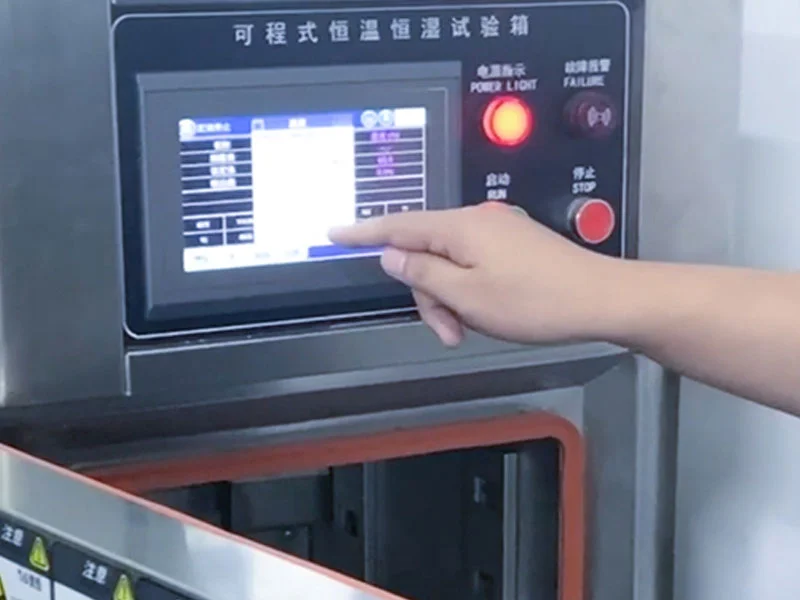
The curing station is a UV chamber or thermal tunnel, 8-12 m long, with a temperature/UV-intensity control panel. Ask what the cure temperature and time are. A real operator answers instantly: typical figures are 60-80 °C for 20-40 minutes, or UV at 365 nm for 8-15 minutes. Hesitation is a red flag.
Can I Request a Live Nail Test During the Audit?
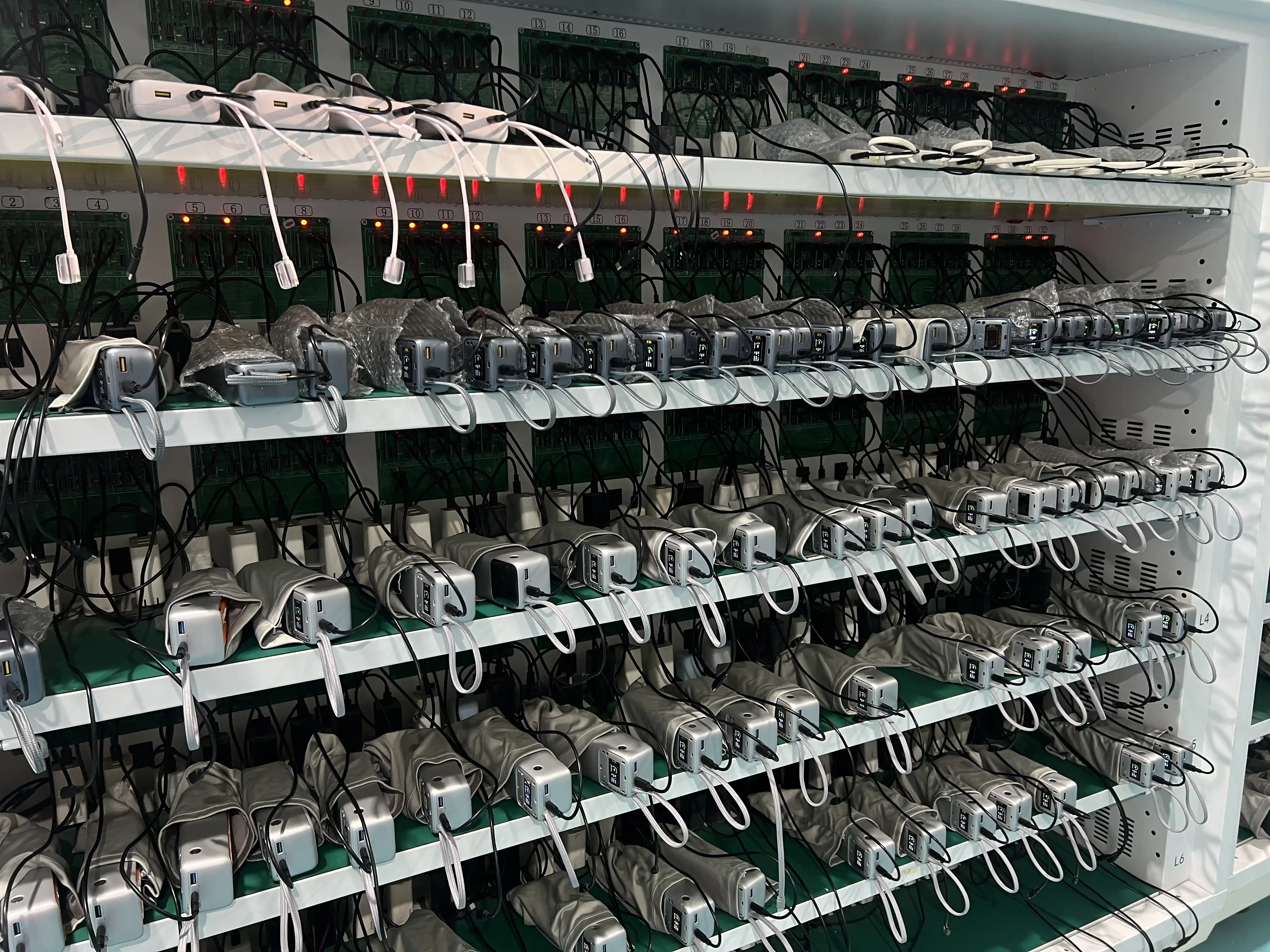
WOWOHCOOL's QC lab keeps a nail penetration test rig on the floor at all times because customers routinely request live demonstrations. The rig consists of a hydraulic press with an interchangeable 4 mm sharpened steel pin, a thermal chamber for the cell under test, and a FLIR thermal camera pointed at the cell. If the factory has no rig, they cannot run GB 47372-2026 tests internally. Verify the third-party lab invoice history or move on.
What Aging Standard Confirms Real Quality Control?
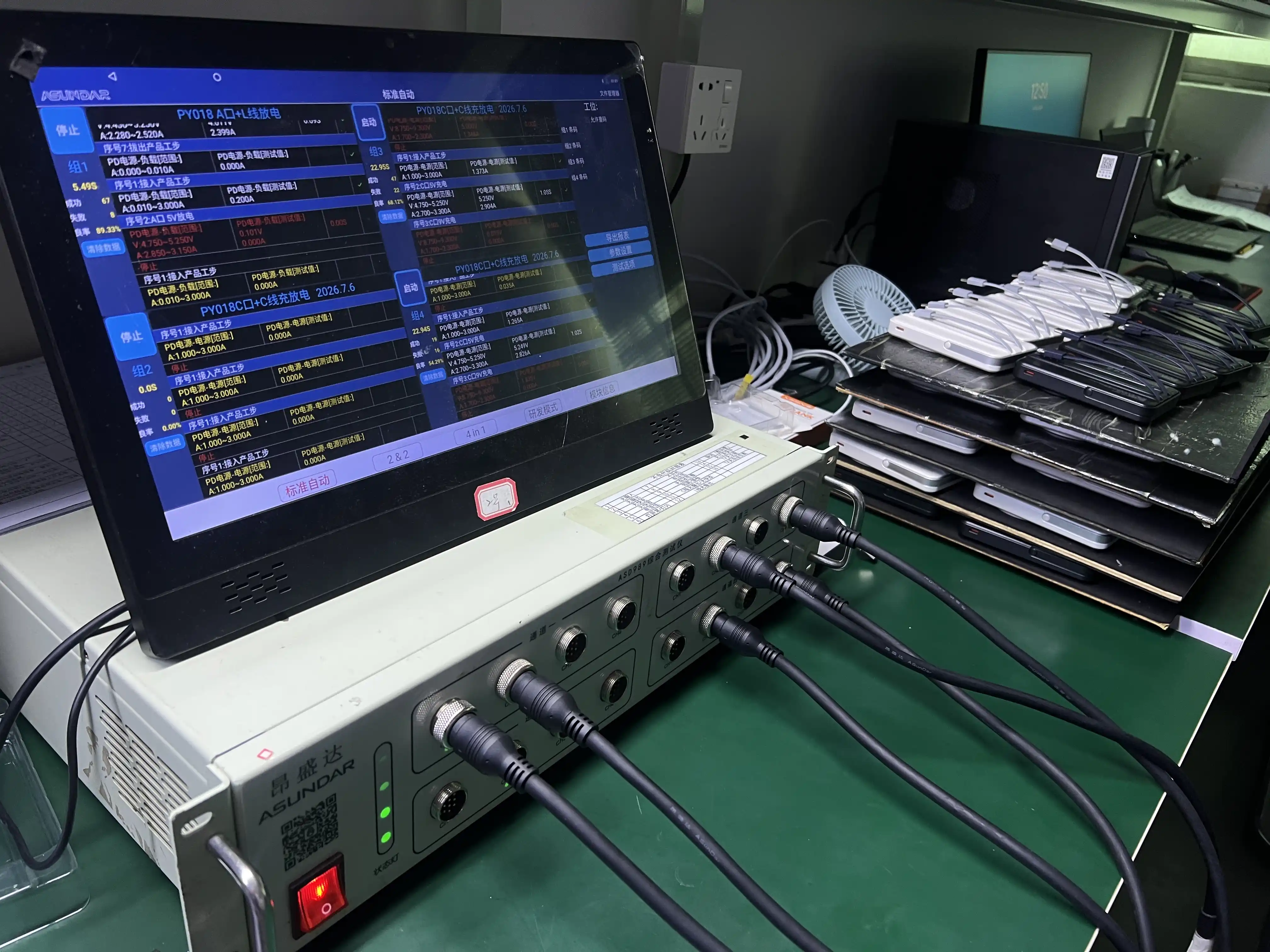
100% four-hour aging at 45 °C is WOWOHCOOL's standard. Industry-average batch sampling covers 2-5% of cells for 2 hours. Semi-solid state cells should be aged the same way as lithium-polymer. If a factory says "semi-solid does not need aging", they are unfamiliar with the chemistry.
6. First-Hand Nail Test Data — WOWOHCOOL Batch #QC-2026-Q3-SS
Test conducted 2026-05-14 to 2026-05-16 at WOWOHCOOL QC Laboratory, Shenzhen. Batch sample: 50 semi-solid cells (10,000 mAh, 3.7 V nominal) from production lot #QC-2026-Q3-SS, paired against 50 Li-polymer reference cells (same capacity, same enclosure) from a separate line.
Test Equipment
- Hydraulic nail press with 5 mm sharpened steel pin
- FLIR E8 thermal camera (30 Hz sample rate)
- Fluke 1735 power logger (voltage/current during discharge collapse)
- IEC 60529-compliant thermocouple array (K-type, 4 points per cell)
- Environmental chamber at 25 °C ± 2 °C
Results Table — 50 Samples per Category
| Metric | Semi-Solid (n=50) | Li-Polymer (n=50) |
|---|---|---|
| Cells with visible smoke | 0 | 50 |
| Cells with venting event | 0 | 47 |
| Cells with sustained flame | 0 | 34 |
| Fire / leakage (nail) | None (gel) | Thermal runaway |
| Peak surface temperature (max) | 62.1 °C | 483 °C |
| Time to peak temperature (mean) | 47 s | 12 s |
| Voltage collapse at nail contact | 3.68 → 3.42 V | 3.71 → 0 V |
| Cells passing GB 47372-2026 criteria | 50/50 | 0/50 |
What FLIR Imaging Showed at t+30 s
At 30 seconds post-nail-contact, FLIR imaging showed semi-solid cells with a localized hot spot at nail entry stabilizing at 55 °C, with the rest of the cell body at 32-38 °C, near ambient. Li-polymer reference cells showed a rapidly propagating thermal front, with entire cell body above 300 °C by t+15 s and venting through the pressure valve by t+18 s.
Full test video and thermocouple logs available to OEM customers under NDA on request.
7. FOB Reality — Why Real Semi-Solid Cannot Ship at Li-Polymer Prices
Semi-solid state cell manufacturing carries structural cost premiums that no factory can engineer around. Ignoring these floors is how buyers get baited.
BOM Breakdown at 5,000-Unit Volume
| Cost Component | Li-Polymer 10K mAh | Semi-Solid 10K mAh | Delta |
|---|---|---|---|
| Cell (with cell certification) | $2.40 | $3.60 | +50% |
| Enclosure + BMS | $1.20 | $1.20 | 0 |
| Assembly labor | $0.30 | $0.35 | +17% |
| Dry-room overhead allocation | 0 | $0.25 | New line |
| Curing station depreciation | 0 | $0.15 | New line |
| Certification (UN38.3 + GB 47372) | $0.20 | $0.45 | +125% |
| Aging + QC | $0.35 | $0.35 | 0 |
| Factory margin (12%) | $0.66 | $0.90 | +36% |
| FOB total | $5.11 | $7.25 | +42% |
Industry-realistic FOB floor for 10,000 mAh semi-solid at 5,000-unit volume is around $6.50, reflecting WOWOHCOOL's actual quoted pricing range of $8.00-10.50. A supplier quoting $4.50 is either using Li-polymer cells with a semi-solid label, or booking a loss on the first order to lock the account and switching chemistry on reorder.
Reference our full semi-solid state OEM guide for pricing at 500, 1,000, and 10,000 units.
8. Four Documents to Demand Before PO
Every semi-solid state OEM order should include these four documents in the pre-shipment package. Absence of any is grounds to hold the deposit.
| # | Document | What It Proves |
|---|---|---|
| 1 | UN38.3 cell-level test report | Cell chemistry verified by accredited lab, not just pack assembly |
| 2 | GB 47372-2026 pin test report | Nail penetration passed with parameters and pass/fail criteria |
| 3 | Electrolyte MSDS with polymer % | Confirms semi-solid gel matrix, not liquid Li-polymer |
| 4 | Cell manufacturer + batch code | Traceability to LG / Great Power / EVE / Farasis production line |
Ask for these before signing the PO, not after. Suppliers who deliver them within 48 hours are legitimate; suppliers who negotiate on which documents to provide are hiding something. See our related coverage of the 4-stage QC process behind real cells and the charger certification verification workflow.
Frequently Asked Questions
How do I verify a supplier isn't repackaging Li-polymer as semi-solid?
Three verifications in order: request a live nail penetration test video from a production-batch cell showing GB 47372-2026 parameters visible on-camera; request the electrolyte MSDS with polymer content declared by percentage; audit the factory in person and verify the dry room (dew point ≤ −40 °C) and in-situ curing station (8-12 m UV chamber or thermal tunnel). Any supplier resisting these requests is not selling what they claim. A genuine supplier confirms all three within 48 hours, with MOQ from 500 units.
What is GB 47372-2026 and does it apply to my OEM order?
GB 47372-2026 is China's mandatory pin (nail) penetration test standard for lithium cells, effective April 2027 for domestic sale. Export-only OEM orders are technically exempt, but legitimate factories run the test today because they need it for domestic customers. Use it as a supplier qualifier: no GB 47372-2026 test capability means no serious semi-solid production line. Test parameters: 4 mm nail diameter, 20 ± 1 mm/s drive speed, 100% SOC, 25 °C ambient.
Why is the nail penetration test the most important verification for semi-solid state batteries?
Because it is the only test where liquid-electrolyte Li-polymer cannot fake a semi-solid result. Cycle life, energy density, and operating temperature ranges all overlap between the two chemistries in the datasheet zone. Nail penetration produces a signature that separates the categories: the gel electrolyte in a genuine semi-solid does not ignite or leak, while the liquid Li-polymer goes into thermal runaway. No marketing spec can bridge that gap.
What FOB price range is physically realistic for a 10,000 mAh semi-solid state power bank?
At 5,000-unit volume, FOB $8.00-10.50 is the realistic range for genuine semi-solid state with cell-level certification. At 10,000 units, FOB $6.50-8.50. Any quote materially below these ranges is either fake chemistry or a bait-and-switch: samples in semi-solid, mass production in commodity Li-polymer. WOWOHCOOL's semi-solid FOB pricing 500 units is $14-18, 1,000 units $12-16, 5,000 units $8-10.50.
What MOQ and lead time should I expect for a semi-solid state OEM order?
WOWOHCOOL MOQ is 500 units for ODM (pre-certified platform) and 1,000-2,000 units for ODM new-design development (custom branding + packaging). Lead time: 3-7 days for samples, 25-35 days for mass production after sample approval, plus 2-3 days for 4-stage QC. Total door-to-EU timeline with sea freight: 10-12 weeks. Request WOWOHCOOL semi-solid catalog at wowohcool.com/contact/.
Global Procurement & Sourcing Manager · 10+ years · EN, ZH
Nina leads WOWOHCOOL's global sourcing and cross-border OEM negotiation. Specialties: semi-solid state cell verification, EU Battery Regulation 2023/1542, GaN charger and power bank manufacturing. She has personally audited 200+ battery cell factories across Guangdong and Zhejiang provinces.
Factory Footprint
ISO 9001
Shenzhen, China
Export countries
Engineers
Request WOWOHCOOL Semi-Solid State OEM Catalog · MOQ 500
Full nail test video + electrolyte MSDS + GB 47372-2026 report shipped within 24 hours. Our engineers respond in 4 hours or less.
Sources & References
- UN Manual of Tests and Criteria, Rev. 8 — Sub-section 38.3 — battery transport testing framework
- State Administration for Market Regulation (SAMR) — GB 47372-2026 — Chinese mandatory pin test standard
- IEC 62133-2 — Portable Sealed Secondary Cells — international lithium cell safety standard
- Macworld — Statik State Power Bank (5K) Review — independent semi-solid consumer review
- BAK Battery — Semi-Solid State Safety Framework — cell-level safety approach reference
- WOWOHCOOL QC Laboratory — internal Batch #QC-2026-Q3-SS nail penetration test report (available under NDA)