
EU Battery Regulation 2023/1542: OEM Import Compliance Guide

Global Procurement & Sourcing Manager · 10+ years in 3C procurement & sourcing
Since August 18, 2025, the EU Battery Regulation 2023/1542 has been in full force, rewriting the rulebook for every OEM importer shipping power banks into Europe's €18.2 billion portable battery market. Generic CE marking no longer cuts it: the regulation now mandates full lifecycle traceability, carbon footprint declarations, country-by-country EPR registration, a physical EU-based authorized representative, and digital product passports. Customs authorities across all 27 member states are enforcing these requirements at the border. An importer who ships non-compliant product faces detention, destruction, and fines of up to 4% of annual turnover.
This guide covers every requirement from the importer's perspective: what documentation you need, how much EPR registration costs per EU country, what the Omnibus VIII package of June 2026 changed, and how an OEM manufacturer like WOWOHCOOL simplifies the entire process, with authorized representative service, included certifications, and complete compliance support for your brand's EU market entry.
Key Takeaways
To import power banks into the EU under Regulation 2023/1542, OEM importers need: EPR registration in each EU member state where products are sold (€200-600/year per country via approved PRO schemes), an EU-based authorized representative (mandatory under GPSR 2023/988), and complete technical documentation with CE marking. Non-compliance can cost up to 4% of annual turnover. WOWOHCOOL includes CE + UN38.3 + RoHS documentation at no extra cost with OEM orders.
- EPR registration is country-by-country: No single EU-wide registration exists. Selling in 5 countries means 5 separate registrations (€1,000-3,000/year total). Common PROs: Stiftung EAR (DE), Ecopilas/ERP (ES), EcoOrganisme (FR).
- Authorized representative mandatory: Under GPSR 2023/988, every non-EU manufacturer must appoint a physical EU-based representative. Name and address must appear on the product label.
- Triple EPR stream for power banks: Batteries (Reg 2023/1542) + WEEE (Directive 2012/19/EU) + Packaging (PPWR 2025/40, mandatory from August 12, 2026). Missing any one stream triggers enforcement.
- Omnibus VIII (June 2026): Formal SVHC definition, expanded "producer" definition covering online marketplaces. Due diligence postponed to August 2027 for operators with ≥€150M turnover.
- Certifications included with OEM: CE + UN38.3 + RoHS at no extra charge. Estimated savings: $2,500-4,500 USD per model (standard CE/FCC/RoHS package).
Key Figures: EU Battery Regulation 2023/1542
In This Article
1. What Is the EU Battery Regulation 2023/1542?
The EU Battery Regulation 2023/1542 is the most ambitious battery legislation ever enacted. Published in the EU Official Journal on July 28, 2023, it replaces the outdated Batteries Directive 2006/66/EC with a comprehensive regulatory framework covering every battery type sold in the European Union, from portable power banks and smartphone batteries to EV traction batteries and industrial storage systems.
The regulation introduces requirements far beyond the previous directive. Generic CE marking plus a declaration of conformity is no longer sufficient. The new framework demands full lifecycle traceability, from raw material extraction through production, use, and end-of-life recycling. This includes mandatory carbon footprint declarations, minimum recycled content thresholds, durability and performance specifications, and a digital product passport accessible via QR code (mandatory from February 2027).
The regulation applies to all batteries regardless of shape, size, chemical composition, or application. If your product contains a battery, power banks, portable chargers, wireless earbuds cases, Bluetooth speakers, the regulation applies. For OEM importers sourcing from China, this represents a fundamental shift in documentation, labeling, and compliance responsibility. The importer, not the factory, is the legally accountable entity before EU authorities.
2. Key Deadlines: When Each Requirement Takes Effect
The Battery Regulation uses a phased implementation approach, different requirements activate on different dates. OEM importers must track these deadlines because shipping non-compliant product after the applicable date means customs rejection.
| Date | Requirement | Impact on Power Bank Importers |
|---|---|---|
| August 2023 | Regulation enters into force | Transition period begins |
| August 18, 2025 | Core requirements apply: battery categories, labeling, CE conformity, restricted substances | Already in force. All imports must comply |
| August 2026 | Carbon footprint declaration mandatory for portable batteries | Prepare carbon accounting with your factory now |
| February 2027 | Digital product passport (QR code) mandatory for portable batteries | QR code must link to live product data online |
| August 2027 | Mandatory recycled content labeling + due diligence for large operators (≥€150M) | Label must state % recycled cobalt, lithium, nickel |
| August 2028 | Portable battery collection target: 63% | Higher PRO fees likely as targets ramp |
What Did Omnibus VIII Change for OEM Importers?
Approved June 24, 2026, it adds SVHC labeling, expands the “producer” definition to online marketplaces, and postpones due diligence to August 2027.
Update: Omnibus VIII, June 2026
On June 24, 2026, the EU Council approved the Omnibus VIII package with three changes critical for OEM power bank importers:
- SVHC definition: Formal definition of "substances of very high concern" per REACH Article 57 criteria. Batteries must label SVHCs present at concentrations ≥0.1% by weight.
- Expanded "producer" definition: Explicitly covers manufacturers, importers, and distributors selling batteries into any member state from another member state or third country, regardless of sales technique, including online marketplaces (Amazon, eBay, AliExpress).
- Due diligence timeline: Postponed to August 2027 for operators with ≥€150M turnover (introduced by Regulation (EU) 2025/1561 in July 2025, independent of Omnibus VIII). Smaller companies have 2 additional years to build cobalt, graphite, lithium, and nickel traceability systems.
What Is Already in Force Since August 2025?
Core requirements apply to every battery-containing product placed on the EU market — compliance is checked at customs today.
Since August 2025, all battery-containing products placed on the EU market must meet the regulation's core requirements. If you are importing power banks from China today, verify your manufacturer has already updated processes and documentation, or risk customs detention at the port of entry.
3. EPR Registration for Importers: Country-by-Country Obligation
Extended Producer Responsibility (EPR) is the most operationally complex requirement of the new regulation, and the one most frequently missed by first-time importers. EPR means the producer (importer, manufacturer, or distributor) bears financial and operational responsibility for the end-of-life management of batteries they place on the market. In practice, this means:
What Are the Four EPR Obligations for Importers?
Register in every selling country through its PRO, report volumes periodically, pay the fees, and display your EPR number on labeling.
- Register as a producer in every EU country where your products are sold. There is no single EU-wide EPR registry, each member state operates its own system through designated Producer Responsibility Organizations (PROs).
- In Germany, register through Stiftung EAR (Stiftung Elektro-Altgeräte Register). In France, through an approved EcoOrganisme. In Spain, through Ecopilas or ERP. Each PRO administers collection, treatment, and recycling on behalf of registered producers.
- Report periodically the volume of batteries placed on the market and pay the corresponding fees to fund waste management operations.
- Display your EPR registration number on product labeling and commercial documentation for each country of sale.
How Much Does EPR Registration Cost?
€200-600 per country per year for 500-2,000 units — budget €1,000-3,000/year across 5 EU markets.
Registration costs vary by PRO and volume. For a small-to-medium importer placing 500-2,000 units annually per country, expect €200-600 per country per year. An importer active in 5 EU markets should budget €1,000-3,000/year in total EPR fees, roughly 10-15% of the total per-SKU landed cost for a typical OEM power bank import. (See our OEM import cost guide for a full landed-cost breakdown including tariffs, freight, and customs.) This is a modest line item compared to the risk of non-compliance, customs authorities in Germany, France, and the Netherlands are actively checking EPR registration at the border.
WOWOHCOOL Fact
WOWOHCOOL has been compliant with EU Battery Regulation 2023/1542 since its effective date. We provide our OEM clients with authorized representative service in the EU, complete CE documentation, and EPR registration guidance for each target market. Over 200 global brands rely on our compliance infrastructure to access the European market without regulatory friction.
5. Technical Documentation and CE Marking Under 2023/1542
The Battery Regulation strengthens technical documentation requirements significantly. A generic Declaration of Conformity is no longer adequate. The regulation now requires a complete technical file including:
| Document | Mandatory | Retention | Issued By |
|---|---|---|---|
| EU Declaration of Conformity | Yes | 10 years | Manufacturer + Notified Body |
| Risk Analysis | Yes | 10 years | Manufacturer |
| Test Reports (LVD, EMC, UN38.3) | Yes | 10 years | Accredited Lab (TÜV, SGS, Intertek) |
| Chemical Composition Data | Yes | 10 years | Manufacturer (with lab verification) |
| Batch Traceability Records | Yes | 10 years | Manufacturer |
| Recyclability Information | Yes | 10 years | Manufacturer + PRO |
The CE mark remains mandatory, but must now be accompanied by the notified body's registration number where the conformity assessment procedure requires their involvement. For power banks, the CE mark must be visible on the product, packaging, and accompanying documentation.
Real Certification Costs for Power Banks (USD per Model)
| Certification | Cost (USD) | Timeline | Mandatory |
|---|---|---|---|
| CE (LVD + EMC) | $1,500-3,500 | 2-4 wks | Yes |
| UN38.3 (transport) | $1,000-2,500 | 2-4 wks | Yes |
| RoHS | $500-1,000 | 1-2 wks | Yes |
| REACH | $1,000-2,000 | 2-3 wks | Yes |
| EPR Registration (per country) | €200-600/yr | 2-3 wks | Yes |
| Authorized Representative | €500-2,000/yr | 1-2 wks | Yes (GPSR) |
Data from WOWOHCOOL factory data panel. With OEM orders, WOWOHCOOL includes CE + UN38.3 + RoHS in the certification package at no additional cost (estimated savings: $2,500-4,500 USD per model, the price of a standard CE/FCC/RoHS package). Authorized representative service and EPR guidance available as complementary services. See our full US & EU certification guide for complete cost and timeline comparison.
6. Power Bank Labeling: OEM Importer Obligations & Checklist
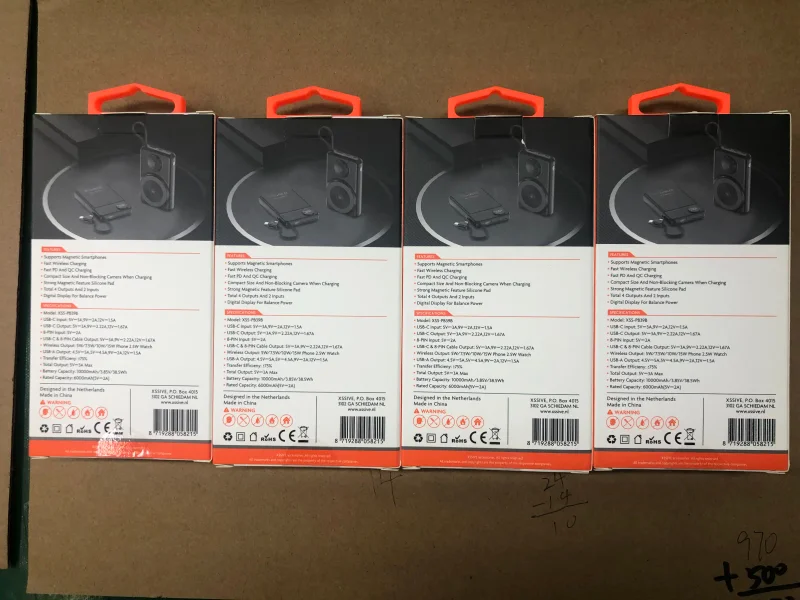
The new regulation introduces significantly more detailed labeling requirements. Each power bank must carry the following information, visible, legible, and indelible:
- CE mark, mandatory, with notified body number where applicable.
- EPR registration number(s), one per EU country where the product is marketed.
- Manufacturer name and address plus authorized representative details in the EU.
- Unique model identifier and batch or serial number for traceability.
- Nominal capacity in mAh or Ah, both total and minimum guaranteed capacity.
- Nominal voltage in volts (V).
- Chemical composition of the battery (e.g., Li-ion, LiFePO4, Semi-Solid-State).
- Separate collection symbol (crossed-out wheeled bin), mandatory.
- Heavy metal content declarations if exceeding regulatory thresholds.
- Maximum charging power in watts (W) for output ports.
- QR code linking to the digital product passport and Declaration of Conformity (mandatory from February 2027).
This level of labeling detail requires close coordination with your manufacturer. It is not a matter of printing an extra sticker, the information must be integrated into the product and packaging design from the development phase. An experienced OEM factory like WOWOHCOOL already has these requirements baked into standard production lines.
7. Recycling Targets and Waste Management Fees
The regulation sets ambitious collection and recycling targets for waste batteries. For portable batteries, which includes power banks, the targets are:
- 2025: 63% collection rate for portable battery waste.
- 2028: 73% collection rate.
- 2031: 83% collection rate.
- Minimum recycling efficiency: 65% of the average weight of portable batteries must be effectively recycled.
- Critical material recovery targets: lithium 70% by 2030, cobalt 95%, nickel 95%, copper 95%.
As an importer, your responsibility is not to physically recycle batteries but to finance the collection and recycling system through your PRO membership. The fees you pay are calculated based on the weight and chemistry of batteries you place on the market. These fees cover collection logistics, treatment, and material recovery operations across the EU.
Critical: The Triple EPR Obligation, Batteries + WEEE + Packaging
A single power bank triggers three simultaneous EPR streams in the EU, not just one:
| EPR Stream | Regulation | What It Covers | Key Deadline |
|---|---|---|---|
| Batteries | Regulation (EU) 2023/1542 | Internal lithium cells | In force (Aug 2025) |
| WEEE | Directive 2012/19/EU | Electronic circuitry (PCB, ports, controller) | In force |
| Packaging | PPWR Regulation (EU) 2025/40 | Commercial packaging (box, inserts) | Aug 12, 2026 |
From August 12, 2026, PPWR requires a packaging authorized representative and online marketplaces (Amazon, etc.) will verify packaging EPR registration. Many importers register only the battery stream and face enforcement for missing WEEE and packaging obligations. Verify all three registrations before your next shipment.
8. How the Regulation Impacts OEM Power Bank Importers
The EU Battery Regulation 2023/1542 impacts OEM power bank importers across four operational dimensions: factory selection (not all Chinese suppliers are prepared), additional costs (€1,000-3,000/year in EPR + documentation), lead time impact (+1-2 weeks for documentation preparation), and competitive advantage (compliant importers differentiate in a European portable power bank market growing at 6-8% annually).
| Impact Area | What Changes | Cost / Timeline | Recommended Action |
|---|---|---|---|
| Factory Selection | Not all Chinese suppliers are prepared for the new regulation | , | Verify technical documentation and lab testing capability before placing the order |
| Additional Costs | EPR registration + technical documentation + authorized representative | €1,000-3,000/year | Budget before first shipment; WOWOHCOOL includes base certifications with OEM |
| Lead Time | Documentation preparation adds time to the import process | +1-2 weeks | Request documentation from the factory before confirming the order |
| Competitive Advantage | Compliant importers stand out; EU power bank market grows at 6-8% annually | 6-8% CAGR | Use compliance as a selling point with European distributors and retail buyers |
9. How WOWOHCOOL Ensures 2023/1542 Compliance
WOWOHCOOL has manufactured power banks and chargers for the European market for over 10 years. The EU Battery Regulation 2023/1542 is not a surprise, it is a framework we have been preparing for since its publication. Here is what we have implemented:
- Updated technical documentation: All products ship with a complete technical file compliant with the new regulation, including a model-specific Declaration of Conformity, risk analysis, and accredited lab test reports.
- EU authorized representative: We provide this service to all OEM clients, with a physical EU address that appears on product labeling at no additional charge.
- Compliant labeling: Our production lines integrate full labeling per the new regulation, including QR codes with live access to digital product documentation (ready for the February 2027 mandate).
- EPR support: We guide OEM clients through EPR registration in Germany, France, Spain, and other EU markets, providing the technical documentation required for PRO registration.
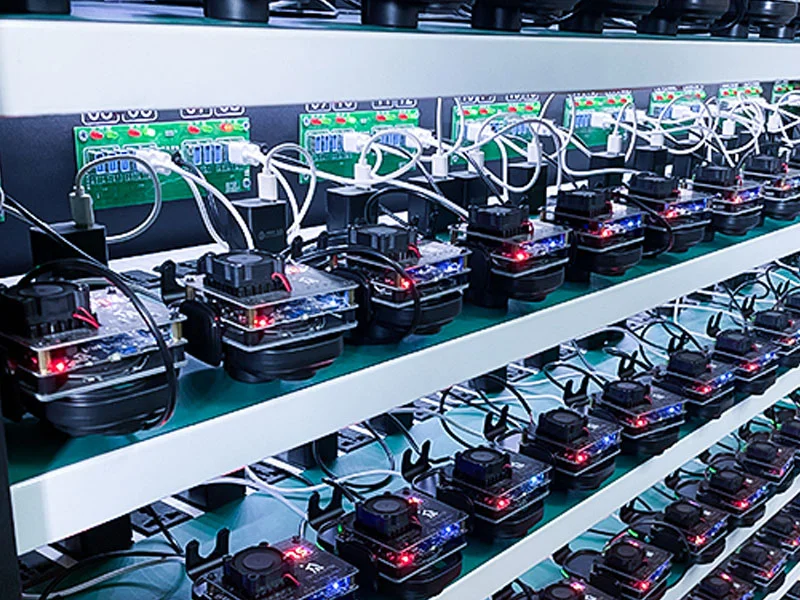
- Complete traceability: Batch-level traceability system enabling identification of every component's origin for each unit produced, from cell supplier to final assembly date. This system underpins our 4-stage QC process (IQC → IPQC → FQC → OQC), with 100% of units passing a 4-hour aging test before shipment.
10. Consequences of Non-Compliance
The consequences of failing to comply with EU Battery Regulation 2023/1542 are severe. Market surveillance across the EU, coordinated through the RAPEX rapid alert system and ICSMS information platform, has intensified significantly since August 2025. Customs authorities can and do:
What Can Customs Authorities Do to Non-Compliant Shipments?
Detain at the port, order destruction or re-export at your cost, and impose fines up to €600,000 or 4% of annual turnover.
- Detain shipments at the port of entry until complete documentation is presented. Temporary storage fees at the warehouse accrue to the importer, these can reach hundreds of euros per day for a full container.
- Order destruction or re-export of non-compliant products, with all costs borne by the importer. This includes freight, handling, and disposal fees.
- Impose financial penalties reaching €600,000 or more in serious cases, depending on the member state's transposition legislation. Under the regulation's upper threshold, fines can reach 4% of the operator's annual turnover.
- Order product withdrawal from the market for goods already in distribution, with the associated reputational and financial damage.
What Does a Market Withdrawal Cost Your Brand?
Beyond fines, a regulatory withdrawal destroys distributor and consumer trust — the Commission holds every economic operator liable.
The reputational consequences can be equally devastating. A product withdrawn from the market for regulatory non-compliance loses distributor and consumer trust instantly. In consumer electronics, where trust is a critical purchasing factor, the damage can be lasting, retailers may delist your entire brand, not just the non-compliant SKU.
According to the European Commission, the Battery Regulation holds all economic operators, manufacturers, importers, and distributors, responsible for the compliance of batteries they place on the EU market. Penalties are determined by member states but must be "effective, proportionate, and dissuasive."
Expert Opinion
"The EU Battery Regulation 2023/1542 is the most ambitious battery legislation in the world. For OEM power bank importers, compliance is not optional, it is the key to the European market. At WOWOHCOOL, we see this as a competitive advantage: those who comply first, sell first. All our products ship with complete CE documentation, EPR support, and authorized representative service from day one."
— Nina Nico, Global Procurement & Sourcing Manager at WOWOHCOOL, specialist in EU regulatory compliance for consumer electronics OEM importers
Frequently Asked Questions
The most common questions from OEM importers about EU Battery Regulation 2023/1542, answered with practical compliance criteria for power banks and portable batteries imported from China:
What is the EU Battery Regulation 2023/1542?
The EU Battery Regulation 2023/1542 is the new European regulatory framework for batteries, effective August 2025. It replaces Directive 2006/66/EC and imposes stricter sustainability, safety, labeling, and traceability requirements on all batteries sold in the EU, including power banks. OEM importers must comply to access a 27-country market of over 448 million consumers.
Do I need an authorized representative in the EU to import power banks?
Yes. Under GPSR 2023/988, any non-EU manufacturer must appoint an authorized representative physically established in the EU at a cost of €500-2,000/year for standalone service. The representative must appear on product labeling with full postal address. WOWOHCOOL includes authorized representative service at no additional cost with OEM orders (MOQ 500), saving importers €500-2,000/year per EU market entry.
What is EPR registration and how does it work across the EU?
EPR (Extended Producer Responsibility) is mandatory registration in every EU country where battery-containing products are sold. The importer or manufacturer is responsible for financing waste collection and recycling. Registration is done through a national PRO (Producer Responsibility Organization): Stiftung EAR in Germany, Ecopilas or ERP in Spain, EcoOrganisme in France. Costs range from €200-600/year per country for small-to-medium import volumes.
Can I use a single EPR registration for the entire EU?
No. EPR registration is national, not EU-wide. An importer selling in 5 EU countries needs 5 separate EPR registrations, with an estimated total cost of €1,000-3,000/year. Some PROs like ERP operate across multiple countries, simplifying the process. WOWOHCOOL advises OEM clients on which PRO to choose in each target market.
Does the regulation also apply to chargers without batteries?
Chargers without internal batteries are exempt from the Battery Regulation but still require compliance with the Low Voltage Directive (2014/35/EU), EMC Directive (2014/30/EU), and GPSR. For OEM importers sourcing GaN chargers, budget $2,500-4,500 USD in initial certifications per model (CE LVD+EMC, RoHS, REACH). The EU Common Charger Directive (2022/2380) also mandates USB-C for all new chargers. Unlike power banks, chargers incur no battery EPR or UN38.3 costs, reducing per-SKU compliance overhead by approximately $1,500-3,500 USD. See our charger import cost guide for full compliance details.
Global Procurement & Sourcing Manager · 10+ years in 3C procurement & sourcing
Nina Nico is WOWOHCOOL's Global Procurement & Sourcing Manager with 10+ years in 3C procurement. She specializes in B2B hardware sourcing, OEM/ODM power bank manufacturing, factory audits, supply chain quality assurance, and international trade compliance.
Factory Footprint
ISO 9001 Facility
Shenzhen, China
Export Countries
Engineers In-House
EU Compliance Without the Headache
CE/UN38.3/RoHS certifications included with OEM orders · Authorized EU representative · MOQ from 500 units · DDP to your warehouse
Sources & References
- Regulation (EU) 2023/1542 of the European Parliament and of the Council, Batteries and waste batteries
- Regulation (EU) 2023/988, General Product Safety Regulation (GPSR)
- Regulation (EU) 2025/40, Packaging and Packaging Waste (PPWR)
- ERP, European Recycling Platform, multi-country PRO for batteries and electronics
- European Commission, Battery Regulation Implementation