
Qi2 Magnetic Power Bank OEM: Design, Testing, and Sourcing Checklist

Global Procurement & Sourcing Manager · 10+ years in 3C procurement & sourcing
A Qi2 magnetic power bank OEM program succeeds or fails on four subsystems: the magnet interface, the coil and shield, thermal control, and the battery pack. Get those four right, and the rest becomes project management. Get them wrong, and a 25 W label will not save the product.
This guide is for the buyer who has already picked the category. You've got a product brief, a target price, and a launch date. Now you need to qualify a factory, freeze a specification, and sign off a build that behaves the same in unit 1 and unit 10,000.
We've been making these products in Shenzhen. Our QC lab measures coil inductance, Q-factor, DC resistance, foreign object detection time, case temperature, and system efficiency on every Qi2 batch. This article shares the values we measure and the test evidence we hand to OEM buyers.
Key Takeaways
A Qi2 magnetic power bank OEM program stands on four measurable gates: magnet grade, coil tolerances, thermal derating, and battery safety. Ask for the batch data behind each gate before you approve tooling.
- A Qi2 magnetic power bank has four qualification gates: magnet grade and polarity, coil and shield tolerances, thermal derating, and battery safety. A Qi2 logo covers only the first interface, not the other three.
- Ask for measured values, not catalog claims. Our Qi2 batch data shows coil inductance of 10.0 µH ±5%, Q-factor above 80, DCR of 95 mΩ ±8%, and FOD response under 180 ms.
- At 15 W continuous, our test unit runs 17.5 °C above ambient after 1 hour. At 25 W, heat rises faster, so the derating curve matters more than the peak wattage on the box.
- MOQ tiers are 500 units for ODM stock, 1,000-2,000 for ODM design work, and 3,000+ for full OEM. Sample lead time is 3-7 days for stock models.
- Qi2 adds $1.20-2.00 per unit in authentication IC and WPC royalty. WPC lab testing runs $3,000-5,000 per SKU and 4-8 weeks, and the brand owner usually holds the membership.
Table of Contents
1. What a Qi2 Magnetic Power Bank OEM Program Actually Requires
Direct answer: A Qi2 magnetic power bank OEM program needs four specifications signed off before tooling: the magnetic interface, the coil and shield stack, the thermal budget, and the battery/BMS design. Each one has its own test evidence. A factory that can quote a price but can't show that evidence isn't ready for an OEM order.
Qi2 is the second generation of the Qi standard from the Wireless Power Consortium. It adds the Magnetic Power Profile, or MPP, which uses a magnet array in both the transmitter and the receiver to align the coils. Qi2 v2.0 launched in April 2023 at 15 W. Qi2 v2.2.1, often sold as Qi2 25W or Qi2.2, raised the ceiling to 25 W in 2025.
That history matters because the marketing label isn't the specification. Two factories can both claim "Qi2 25W" and ship very different products. One may deliver 25 W for 4 minutes before dropping to 12 W. The other may hold 22 W for 40 minutes. The difference sits in the coil, the shield, the firmware, and the thermal path.
What does the Qi2 logo actually cover?
The Qi2 mark covers the magnetic interface and the wireless charging profile. It doesn't cover coil tolerances, thermal derating, battery safety, or production consistency. Those are the four items the specification sheet below asks you to freeze.
Here's the specification sheet we ask buyers to complete before a quote.
| Subsystem | What to agree | Evidence to request |
|---|---|---|
| Magnetic interface | Magnet grade, polarity, ring geometry, holding force, case compatibility | Magnet grade certificate, polarity drawing, pull-force sample data |
| Coil and shield | Inductance, Q-factor, DCR, ferrite grade, coil centering tolerance | LCR and Q-meter report, coil centering measurement, SPC chart |
| Thermal | Continuous output, case temperature limit, derating curve, NTC placement | Power-vs-time and temperature-vs-time logs at two ambient temperatures |
| Battery and BMS | Cell grade, capacity, cycle life, protection thresholds, UN38.3 file | Cell datasheet, IEC 62133-2 report, UN38.3 test summary, aging record |
| Certification | Qi2/Qi2.2, FCC, CE, RoHS, UKCA, PSE/KC as needed | Certificate holder, model list, test report, label artwork |
| Production | MOQ, sample date, mass-production date, AQL, warranty | Signed schedule, golden sample, QC plan, warranty terms |
Elena runs product for a consumer brand in Rotterdam. She approved a 10,000-unit program after seeing a sample hit 25 W on a bench. Four months later, returns climbed because the bank throttled after 6 minutes inside a thick leather case.
The factory had tested the bare phone on a desk at 22 °C. Nobody had tested the product in the condition Elena's customers actually used. That's the gap this checklist closes. Test the product the way it will be used, and put the result in the purchase order.
Want to see the current Qi2 magnetic line? The Qi2 magnetic power bank catalog lists 11 models from 5,000 mAh to 20,000 mAh, with 15 W and 25 W wireless options.
2. The Magnetic Interface: N52H, Polarity, and Holding Force
The magnet interface decides whether the phone lands in the right place every time. Qi2 MPP uses a magnet array to align the transmitter and receiver coils. The standard sets the magnetic behavior, but it doesn't pick the magnet grade for you. That's a factory decision, and it changes with heat.
N52H is a neodymium grade with 52 MGOe energy and a maximum working temperature near 120 °C. A standard N52 magnet is rated closer to 60 °C. Wireless charging creates heat at the coil, and a thin power bank has little room to spread it. A magnet that loses strength at 60 °C may still pass a room-temperature pull test and fail after 30 minutes of charging.
We use N52H in the Qi2 magnetic line because the case sits against the phone and the coil heat has nowhere to go. The H suffix isn't a marketing upgrade. It's a heat specification.
Why does polarity fail a Qi2 magnet ring?
Qi2 magnet arrays have a defined polarity. If the ring is inverted during assembly, the bank will repel the phone instead of holding it. The unit may still charge on a bench when you place it by hand. It will fail the moment a customer tries to snap it on one-handed.
Ask the factory for the polarity drawing and a production test that checks magnet orientation, not just pull force. A pull-force gauge can read a good number on a reversed ring because the phone still sticks to the strongest nearby magnet. The phone just sits off-center.
How do you test the magnetic interface?
Run a three-part test before you approve the sample:
- 1. Bare phone, vertical hold. Attach the bank to the phone and hold it vertically for 60 seconds. Measure the gap between the bank and the phone case at the top and bottom.
- 2. Case matrix. Repeat with a 1 mm case, a 3 mm case, and a MagSafe-compatible case with a metal ring. Qi2 products commonly support cases up to 4 mm, but the alignment quality drops before the charging stops.
- 3. Shear and drop. Slide the phone sideways while the bank is attached, then repeat after a 1 m drop onto a hard floor. A bank that loses alignment after a drop has a mechanical problem, not a charging problem.
Record the results by unit, not by "sample passed." Magnet strength varies by batch, and a 10-unit check catches a weak lot before 10,000 units ship.
3. Coil and Shielding: The Tolerances That Decide Efficiency
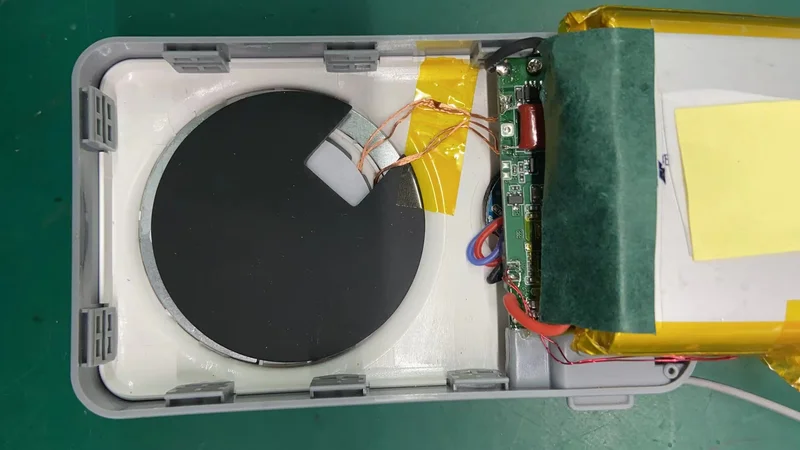
Coil quality sets how much of the input power reaches the phone. The three numbers to request are inductance, Q-factor, and DC resistance. They are easy to measure, hard to fake, and they expose a cheap coil quickly.
Our QC lab tests 50 units from each production batch. The May 2026 Qi2 batch, sample QC-2026-Q2-W93, produced the values below. These are mean averages, not best-case lab samples.
| Parameter | Measured value | Test equipment |
|---|---|---|
| Tx coil inductance (Ls) | 10.0 µH ±5% at 100 kHz | Keysight E4980A LCR meter |
| Coil Q-factor | Above 80 at 100 kHz, 1 Vrms | Keysight E4980A |
| DC resistance (DCR) | 95 mΩ ±8% | Four-wire Kelvin measurement |
| Ferrite shield permeability (µi) | 2,300, MnZn, TDK PC95 equivalent | IEC 62044-2 |
| FOD response time | Under 180 ms, Q-factor deviation method | WPC PT 1450, 1,000-unit batch |
| Output ripple, 5 V rail | Under 25 mVpp at 15 W | Tektronix MDO3024, 20 MHz bandwidth |
| System efficiency at 15 W | 82-85%, DC input to DC output | Chroma 63600 load, Tektronix MSO |
A coil with low Q or high DCR turns more input power into heat. That heat raises the case temperature, which triggers the firmware to cut power. The customer sees a slow charge and blames the phone. The root cause is a coil that cost $0.15 less.
How does the mechanical stack-up affect efficiency?
Coil centering, magnet ring placement, housing flatness, adhesive thickness, and fixture repeatability all move the electrical result. A coil that sits 0.4 mm off-center on one line and 0.1 mm on another produces two different products from the same drawing.
Ask for the control plan, not just the drawing. The control plan should name the measurement fixture, the sampling frequency, and the reaction plan when a unit drifts outside the limit. If the factory can't name the fixture, it can't control the dimension.
Our line checks coil centering with a dedicated alignment fixture and tracks the result as an SPC item. We also measure housing flatness before assembly, because a warped housing tilts the coil and changes the gap even when the coil is perfectly placed.
What should a coil test report contain?
A useful report includes the measurement conditions, not just a pass stamp. Look for the test frequency, the voltage, the temperature, the sample size, and the instrument model. A report that says "inductance: OK" tells you nothing.
For a Qi2 program, ask for:
- Ls, Q, and DCR at 100 kHz, with the sample size and the min/max spread.
- Ferrite grade and supplier, plus the permeability test method.
- Coil centering measurement with the fixture ID and the tolerance.
- FOD response time from a batch test, not a single golden unit.
- A photo or drawing of the coil and shield stack, with the adhesive callout.
If the factory can't supply these before the purchase order, budget for a third-party lab check. A $300-800 inspection is cheaper than a container of units that throttle.
4. Thermal Design: Why 15 W and 25 W Behave Differently
Heat is the main reason a magnetic power bank disappoints. At 15 W, our measured system efficiency is 82-85%. That means roughly 3 W of the input power becomes heat. At 25 W, the same efficiency range turns roughly 5 W into heat.
The higher number sounds better on the box and demands a better thermal path. Our 15 W continuous test, run for 1 hour at 25 °C room temperature, measured a case rise of 17.5 °C above ambient. That puts the case near 42.5 °C.
Hold that in your hand and it feels warm, not hot. Move to a 35 °C ambient, add a thick case, and the same product can cross 50 °C and start derating.
Qi2.2 adds a 25 W profile and tighter thermal expectations. The exact surface limit and test method belong to the current WPC specification and the test lab's reading of it. Don't accept a verbal "it stays cool." Ask for the log.
What should a thermal log record?
A thermal log is only useful if it records the conditions. Ask for a table with these four columns:
| Column | What it should show |
|---|---|
| Time | Samples at 1-minute intervals for at least 30 minutes, ideally 60 |
| Delivered power | Wireless output in watts, measured at the receiver, not the input |
| Case temperature | °C at the coil, the battery, and the outer surface |
| State of charge | Phone battery percentage at the start and the change during the test |
Run the test at two state-of-charge windows: one around 20-40% and one above 70%. A phone accepts more power at low state of charge and tapers near full. A test that starts at 90% will look cool because the phone is already limiting the current.
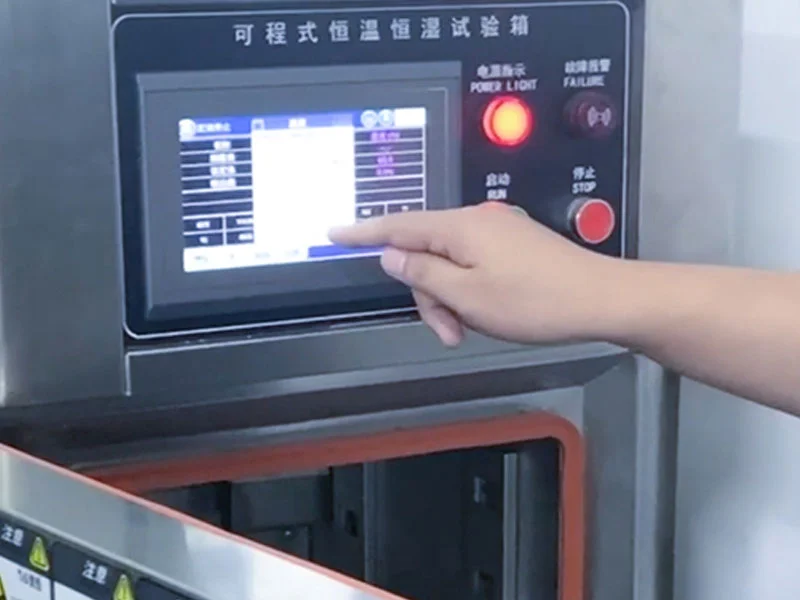
Run it at 25 °C and 35 °C ambient. Run it with no case and with the thickest case you plan to support. That's 8 test runs per phone model. If the factory pushes back, ask which run they propose to skip and why.
How does firmware affect thermal derating?
The derating curve is a firmware decision. A well-tuned product reduces power in small steps as temperature rises, then recovers when the case cools. A poorly tuned product cuts from 25 W to 10 W in one step, and the customer sees the charge time jump.
Ask for the NTC placement, the threshold temperatures, the hysteresis, and the recovery condition. A good answer sounds like "we reduce 2 W per 2 °C above 42 °C, with a 5 °C recovery band." A bad answer sounds like "the chip handles it."
5. FOD and Battery Safety: The Tests That Prevent Recalls
Foreign object detection, or FOD, stops the coil from heating a coin, a key, or a paper clip that lands on the charging surface. Qi2 requires FOD, and the test method matters as much as the result.
We use the Q-factor deviation method defined in WPC PT 1450. Our production test targets a response under 180 ms across a 1,000-unit batch. The test checks that the transmitter stops or reduces power when a metal object changes the coil's Q-factor.
Ask the factory how it tests FOD in production, not just in the certification lab. A one-time pass on a golden sample doesn't prove that every unit detects a foreign object. The production test should be automated and logged.
What belongs in the battery safety file?
A Qi2 power bank contains a lithium battery, so the safety file goes beyond the wireless interface. The core documents are:
- UN38.3 for transport. Power banks ship as UN3480, lithium batteries alone, which is the stricter dangerous goods classification.
- IEC 62133-2 for portable lithium cells and batteries.
- UL 2056 for power bank safety, often requested by US retailers.
- IEC/EN 62368-1 where the product's input and output bring it into scope; confirm the applicable standard with the lab.
- MSDS for shipping.
Capacity math is simple and worth putting on the spec sheet. A 10,000 mAh bank at 3.7 V holds about 37 Wh, and a 20,000 mAh bank holds about 74 Wh. Both sit below the common 100 Wh carry-on threshold, which is one reason the category travels well.
The 27,000 mAh class reaches about 100 Wh and needs a closer look at airline rules.
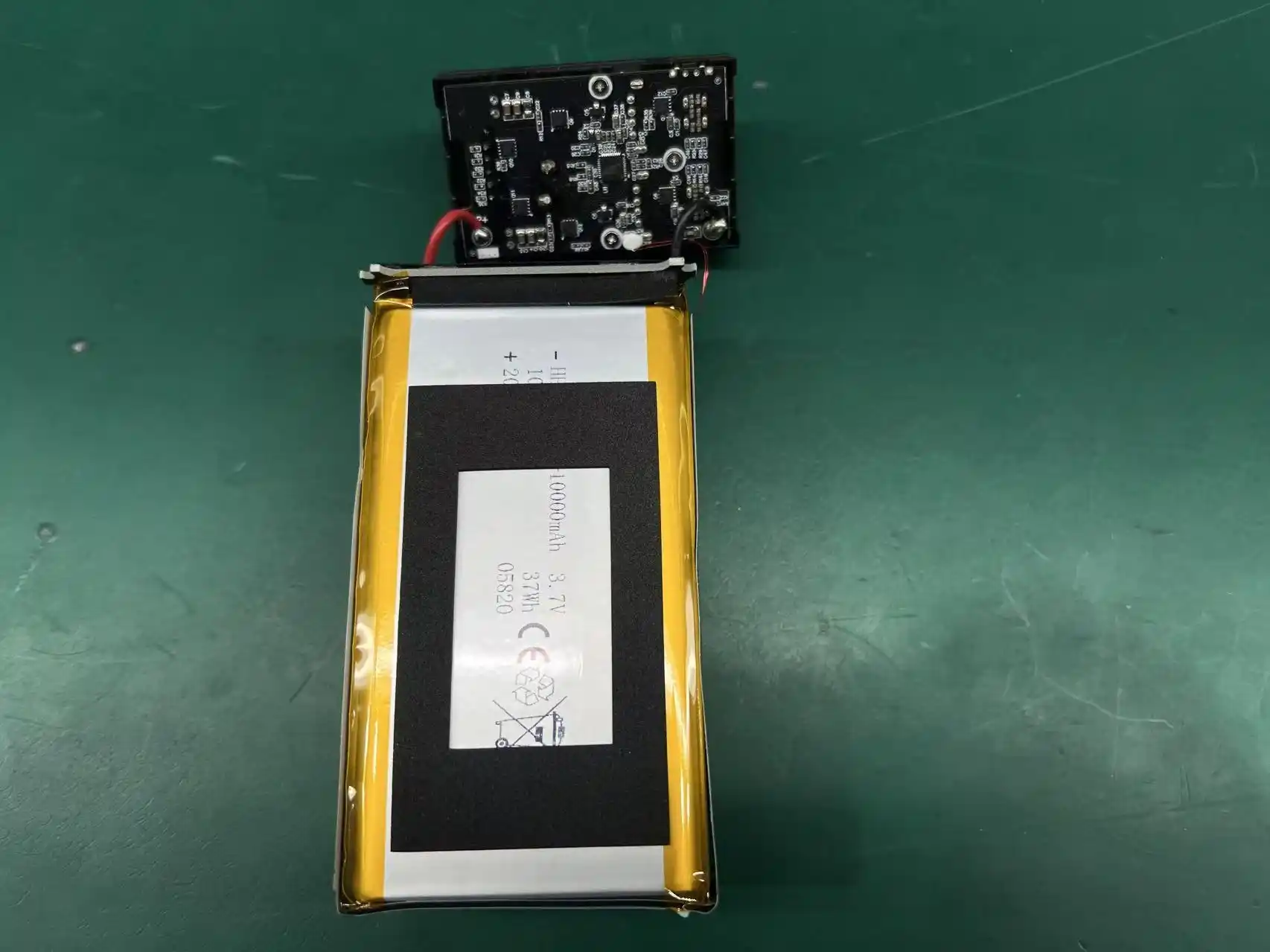
Our line runs a 100% 4-hour aging test on every unit before shipping. The batch acceptance uses AQL 0.65 normal and 0.25 tightened. Our production yield runs above 98%, with a defect rate below 0.3% and on-time delivery above 97%. Those numbers are the output of the process, not a claim about a single sample.
What warning belongs in the manual?
A magnetic power bank should carry a plain warning about medical implants and magnetic stripe cards. The magnet array is strong enough to hold a phone through a case, and that same field can affect objects the customer carries. Put the warning in the manual and on the retail packaging. It doesn't cost anything and prevents a support ticket.
6. Certification: Who Owns What
Certification is where private-label brands get surprised. The factory can test the product, but the certificate usually belongs to the brand that sells it. If you're planning to sell under your own name, confirm who holds each document before you pay the deposit.
Here's the map we use for a Qi2 magnetic power bank.
| Regime | What it covers | Who usually holds it | Typical cost | Typical time |
|---|---|---|---|---|
| Qi2 / Qi2.2 (WPC) | Wireless charging interoperability and the Qi logo | Brand owner, or factory for its own brand | $3,000-5,000 per SKU plus membership | 4-8 weeks |
| FCC Part 18 | Wireless power transfer in the US | US responsible party or importer | $500-5,000 depending on path | 1-6 weeks |
| FCC Part 15 | Bluetooth, Wi-Fi, or other data radio | US responsible party or importer | $2,000-5,000 for certification | 3-6 weeks |
| CE (EMC, RoHS, Battery Regulation) | EU market access | EU importer or authorized representative | $1,500-3,500 for CE plus RoHS | 2-4 weeks |
| UN38.3 | Lithium battery transport | Battery or product manufacturer | $1,000-2,500 | 2-4 weeks |
| UKCA | UK market access | UK importer | $800-1,500 | 2-3 weeks |
| PSE / KC | Japan / Korea market access | Importer or local representative | $1,000-3,000 each | 3-5 weeks |
A combined CE/FCC/RoHS package with UN38.3 typically runs $2,500-4,500 and takes 4-6 weeks. That package covers the basics for a US/EU launch. It doesn't include the WPC membership or the Qi2 lab test, which are separate line items. For the EU battery file itself, the EU Battery Regulation 2023/1542 guide covers the importer duties that sit alongside CE.
Who holds the WPC membership?
Qi2 certification attaches to a WPC member. The membership tiers run from about $5,000 to $25,000 per year. If you're a private-label brand, you'll generally need your own membership or a documented arrangement with the factory that holds the certification. A factory certificate doesn't automatically let you print the Qi2 logo on your own box.
Ask this question before the sample stage: "Whose WPC membership will the certificate sit under, and can my brand legally use the Qi2 mark on the retail packaging?" A vague answer here can delay a launch by 8 weeks or force a packaging reprint.
Does certification prove production quality?
A certificate doesn't prove anything beyond one sample passing a test at one lab on one date. It doesn't prove that the coil stays centered, the magnet stays strong, or the firmware keeps derating in production. Treat certification as the entry ticket and production control as the ongoing proof.
For the US path, our guide to FCC ID vs SDoC for wireless chargers explains when a wireless power product needs certification and when a supplier's declaration is enough. For the WPC process itself, the Qi certification guide walks through the lab and membership steps.
7. Mass-Production Control for a Qi2 Magnetic Power Bank OEM
A golden sample is a contract, not a souvenir. It should freeze the drawing, the material, the color, the firmware, and the test limits. If the sample and the production unit can differ, the sample proves nothing.
We use a four-stage QC process: incoming material check, in-process check, final product check, and outgoing check. The incoming stage verifies cells, ICs, PCBs, connectors, and housings. The in-process stage watches soldering, component placement, and wiring.
The final stage tests charging performance, port function, button feel, and display. The outgoing stage checks packaging, accessories, and labels.
Which SPC items matter for a Qi2 bank?
Put these on the control plan and review them at the pilot build:
- Coil centering, measured with the alignment fixture.
- Magnet ring position and polarity, checked on every unit.
- Housing flatness before assembly.
- Adhesive thickness and compression after cure.
- Screw torque and clip engagement.
- Unit weight, as a quick check for missing components.
- FOD response, sampled from the line.
- Aging test result, 100% of units.
A pilot build is where tolerance drift shows up. Consider a sourcing team that approved a 0.2 mm coil-centering tolerance on the drawing. The first pilot run measured a 0.45 mm spread on one fixture.
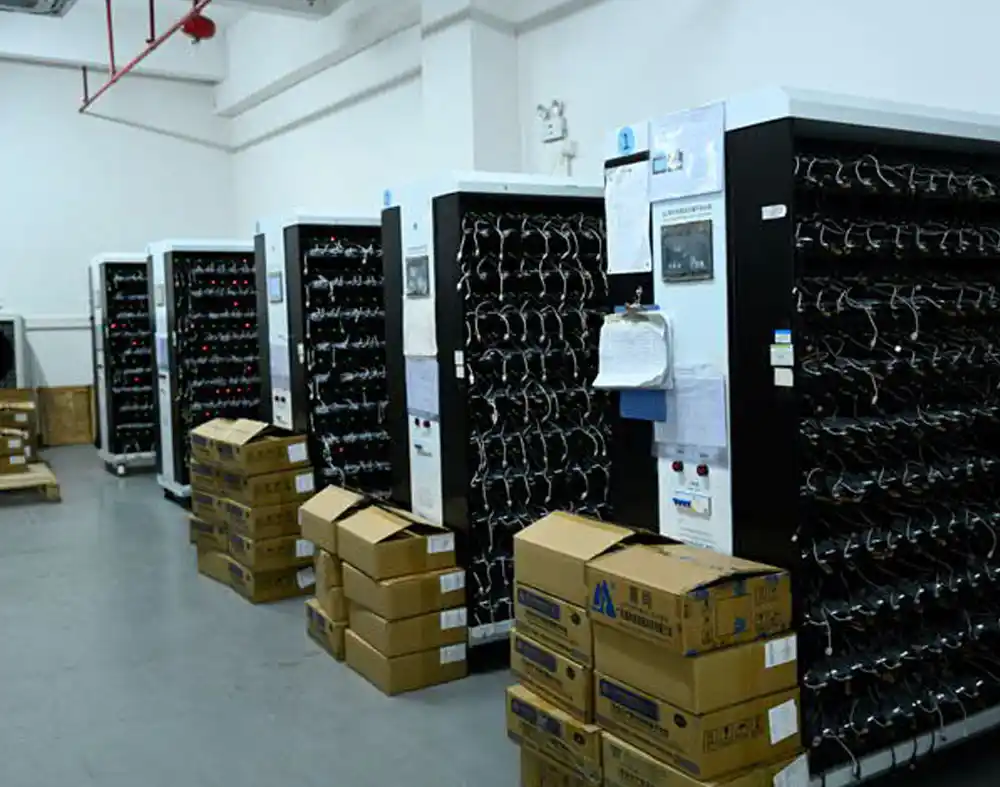
The units still charged, but the efficiency spread widened by 5 percentage points between the best and worst units. The worst units hit the thermal limit earlier, and the return rate for that lot ran 3 times the target.
The fix wasn't a new design. It was a fixture rebuild and a tighter adhesive callout. That's why the pilot build exists.
What should the QC report contain?
Ask for a report with the lot number, the sample size, the measurement results, the pass/fail limits, and the disposition of any failures. A report that lists only "pass" is a receipt, not a quality record.
For OEM buyers, we also provide the golden sample measurement sheet, the aging log, and the FOD batch result. If your team needs a deeper audit framework, the quality control guide covers the four-stage process and the AQL sampling plan. If you're still writing the capacity and port spec, the power bank specs guide explains how mAh, Wh, and PD ratings interact.
8. MOQ, Lead Time, and Cost Drivers for a Qi2 Magnetic Power Bank OEM
MOQ depends on who owns the design and whether the project needs a new mold. That rule matters more than the number itself. A 500-unit quote for a stock model is a different project from a 500-unit quote for a custom enclosure, even if both say "500" on the email.
Our tiers:
| Tier | MOQ | Sample time | Mass production |
|---|---|---|---|
| ODM stock, logo and color on an existing model | 500 | 3-7 days | 25-35 days |
| ODM design, no packaging change | 1,000 | 25-45 days | 25-35 days |
| ODM design, custom packaging | 2,000 | 25-45 days | 35-45 days |
| ODM design, structural or appearance change | 2,000 | 25-45 days | 35-50 days |
| Full OEM, customer drawing or sample | 3,000+ | 7-14 days | 30-60 days |
| Full OEM with new tooling | 3,000+ | 7-14 days | 30-60 days plus 2-3 months tooling |
A full OEM project with a new enclosure takes 2-4 months end to end. The tooling's the long pole. Enclosure tooling runs $5,000-30,000 depending on complexity and material.
PCB design and engineering NRE runs $2,000-5,000. Custom packaging setup runs $1,000-5,000. None of those costs scale with the first order quantity, which is why a small order carries a higher unit cost.
What does Qi2 certification add to the unit cost?
Qi2 certification adds $1.20-2.00 per unit. That covers the WPC-authorized authentication IC at $0.80-1.50 and the WPC per-unit royalty. A Qi-compatible product without the Qi2 mark can save $1.00-1.50 per unit, but it can't use the Qi2 trademark or claim the certified profile.
Don't compare a certified quote with a non-certified quote and call the difference a factory margin. The two products carry different bills of materials and different legal rights.
Other cost drivers include the magnet grade, the coil and ferrite, the cell grade, the display, the kickstand, the shell material, and the packaging. A TFT display, a zinc alloy kickstand, and a semi-solid-state cell each add cost. So does a custom color match.
Why can a 300-unit quote cost more?
Daniel sells on Amazon and asked three factories for 300 units. Two quoted a low unit price, and one quoted 40% higher. The low quotes assumed a stock model with a logo print and a stock box.
Daniel wanted a custom box, a Pantone color, and his own brand on the Qi2 certificate. The low quotes weren't lying. They were answering a different question.
The 40% quote included the packaging setup, the color matching, and the certification work. Once Daniel added those items to the low quotes, the gap closed to 6%.
Ask for a cost breakdown with the following lines: unit price, tooling, packaging setup, certification, sample fee, and freight. A quote without those lines isn't a budget.
9. The RFQ Checklist and Red Flags
What should the RFQ include?
Send these 10 questions with your RFQ. They'll tell you more than a catalog.
- 1. Which magnet grade do you use, and what is the maximum working temperature?
- 2. What are the coil Ls, Q-factor, and DCR targets, and what is the sample size for the batch test?
- 3. What is the coil-centering tolerance, and which fixture measures it?
- 4. What is the continuous wireless output at 25 °C and 35 °C ambient, and where does the unit derate?
- 5. Can you send a power-vs-time and temperature-vs-time log at two state-of-charge windows?
- 6. How do you test FOD in production, and what is the response-time limit?
- 7. Which WPC membership will the Qi2 certificate sit under, and can my brand use the mark?
- 8. What is the MOQ for my exact configuration, including packaging and color?
- 9. What is the sample date, the mass-production date, and the tooling date if a new mold is needed?
- 10. What does the golden sample approval package contain, and who signs it?
What are the red flags?
Six patterns should stop the conversation before you pay a deposit.
- The factory quotes a wattage without a derating curve.
- The factory can't name the magnet grade or the ferrite supplier.
- The factory says "Qi2 certified" but can't show the certificate holder or the model list.
- The factory tests only a bare phone on a desk at room temperature.
- The factory treats MOQ as a single number, regardless of design ownership.
- The factory can't explain what happens when a foreign object lands on the coil.
If two answers conflict, stop and ask for the document. A factory that's organized will send the file. A factory that's guessing will send a paragraph.
10. Next Steps: Build the Specification Before the Quote
A Qi2 magnetic power bank OEM project is a specification exercise before it's a price exercise. Freeze the magnet grade, the coil and shield stack, the thermal limit, the battery safety file, and the certification owner. Then compare quotes against the same scope.
What is the five-step qualification sequence?
Run the sequence in order, and don't release mass production until step five is signed.
- 1. Freeze the product specification. Agree capacity, wireless wattage, cell chemistry, enclosure, display, and packaging before you request a quote.
- 2. Request measured test evidence. Ask for coil Ls, Q-factor, DCR, FOD response, thermal logs, aging records, and the certificate holder for each market.
- 3. Approve the golden sample. Freeze the drawing, materials, firmware, and test limits in a signed golden sample package.
- 4. Run the pilot build. Measure coil centering, magnet polarity, housing flatness, and FOD on the pilot line, then compare the spread to the golden sample.
- 5. Lock certification and release mass production. Confirm the WPC membership, certificate holder, label artwork, and AQL plan before the purchase order.
Start with three documents: a product spec sheet, a test-evidence request, and a golden sample approval form. If the factory can fill those three, the project has a foundation. If it can't, the cheapest quote will be the most expensive decision.
Our Qi2 magnetic power bank line covers 5,000-20,000 mAh models with 15 W and 25 W wireless output, N52H magnets, and OEM branding from 500 units. For the wider category, the power bank product page covers semi-solid-state, laptop, and 2-in-1 models. For a custom program, the OEM/ODM service page explains the sample, tooling, certification, and production steps.
If you're still choosing between Qi2 and MagSafe, the Qi2 vs MagSafe comparison covers the certification and compatibility differences.
Frequently Asked Questions
What is the difference between Qi2 and Qi2.2 for a power bank?
Qi2 v2.0 delivers up to 15 W and introduced the Magnetic Power Profile. Qi2 v2.2.1, sold as Qi2 25W or Qi2.2, raises the wireless ceiling to 25 W and is backward compatible with Qi2 devices. A Qi2.2 bank can charge a Qi2 phone at 15 W, but it only reaches 25 W with a phone and profile that support the higher rate.
What MOQ should I expect for a Qi2 magnetic power bank?
Expect 500 units for an ODM stock model with logo and color changes. ODM design work starts at 1,000-2,000 units, and full OEM with a customer design starts at 3,000 units. Quotes below 500 usually exclude certification, custom packaging, or a new mold, so compare the scope before the price.
How do I verify magnet and coil quality before ordering?
Ask for the magnet grade certificate, the polarity drawing, and a pull-force test from the production batch. For the coil, request Ls, Q-factor, and DCR at 100 kHz with the sample size and spread. Our Qi2 batch target is 10.0 µH ±5%, Q above 80, and DCR of 95 mΩ ±8%.
Why does my magnetic power bank get hot or throttle?
Heat comes from coil losses, shield losses, the power stage, and the battery. At 15 W, our measured system efficiency is 82-85%, so about 3 W becomes heat. At 25 W, about 5 W becomes heat. A thick case, a misaligned coil, or a weak thermal path raises the case temperature and triggers the firmware to cut power.
Which certifications does a Qi2 magnetic power bank need?
A Qi2 product needs WPC certification for the Qi mark, plus the market certifications for each destination. For the US, that usually means FCC Part 18 for the wireless power transmitter and Part 15 if a data radio is present. For the EU, CE covers EMC, RoHS, and the Battery Regulation. UN38.3 is required for transport, and UL 2056 or IEC 62133-2 is often requested by retailers.
How do I start a Qi2 magnetic power bank OEM project?
Start with a product brief: capacity, wireless wattage, cell chemistry, enclosure material, display or kickstand, target market, and packaging. Send it with the RFQ questions above and ask for a sample date and a test-evidence package. You can request factory pricing or review the OEM/ODM process before the first call.
Global Procurement & Sourcing Manager · 10+ years in 3C procurement & sourcing
Nina Nico is WOWOHCOOL's Global Procurement & Sourcing Manager with 10+ years in 3C procurement. She specialises in B2B hardware sourcing, OEM/ODM programme management, and supplier verification for charging accessories.
Factory Footprint
ISO 9001 Facility
Shenzhen, China
Export Countries
Engineers In-House
Need a Qi2 Magnetic Power Bank Program?
Send your capacity, wireless wattage, target market, and packaging plan. Our engineers reply with a sample date, MOQ, and the test evidence you should expect.