
Top GaN Charger Manufacturers in China for OEM Buyers (2026)

Global Procurement & Sourcing Manager · 10+ years in 3C procurement & sourcing
The GaN charger manufacturers in China for OEM buyers most worth comparing are WOWOHCOOL, Huntkey, Aohai, Ricomm, Zonsan, Gopod, WECENT, and UGREEN's manufacturing arm. The right choice depends on order size, certification scope, and whether you need a 500-unit stock ODM or a 3,000-unit new tooling program.
GaN charger demand is growing at a 25.7% CAGR, and more factories are adding GaN lines without the certificate scope or thermal data to support them. This guide compares eight factories on the evidence an OEM buyer can verify.
Disclosure: WOWOHCOOL manufactures charging accessories through its OEM/ODM charging service. It is included in this list and disclosed as the publisher. The ranking is by order fit, not by an independent quality score. Verify every supplier, including this one.
Key Takeaways
Compare 8 GaN charger manufacturers in China on MOQ, FOB price, certifications, and thermal evidence. Verify each factory before you request a sample.
- In-stock ODM starts at 500 units at WOWOHCOOL; platform redesign runs 1,000–2,000 units; full OEM with a new mold starts at 3,000 units.
- A 65W multi-port GaN charger costs $6.00–8.50 FOB Shenzhen at 500 units and $4.20–6.00 at 10,000 units, before certification and freight.
- The certificate must name the exact model, wattage, and port configuration. A "series certificate" is not evidence for the SKU you are buying.
- Ask for thermal data at full load in the shipping enclosure. WOWOHCOOL's GaN V 65W unit measured 52.4°C after 30 minutes, against 76.8°C for a silicon reference.
- The right shortlist is two or three factories, not eight. Filter by order size, target market, and whether you need a stock platform or a new design.
Table of Contents
1. How Were These GaN Charger Manufacturers Selected?
The shortlist uses seven filters. A company had to pass at least five to appear, and every profile states what still needs verification.
- Real manufacturing, not trading. A business license, a factory address, and in-house SMT, assembly, and aging.
- GaN-specific evidence. A named GaN FET, efficiency data, full-load thermal data, a derating curve, and PD 3.1/PPS support.
- Certification scope. The report must cover the exact model, wattage, and port configuration.
- MOQ fit. The quote must state whether it is in-stock ODM, platform redesign, or full OEM with new tooling.
- Export and retail record. Prior shipments to the US, EU, UK, or Japan, and retailer audit experience where relevant.
- QC and traceability. Four inspection gates, 100% aging, an AQL plan, and batch records traceable from carton to component lot.
- Disclosure. The list is editorial, not paid placement. WOWOHCOOL is the publisher and is disclosed in the intro and in its profile.
The selection is deliberately narrow. A factory built for a 50,000-unit retail program may not want a 500-unit first order. A low-MOQ ODM may not have the thermal margin for a 140W flagship. The list is a starting point, not a league table.
Want the factory data behind this comparison? Explore the GaN charger line or send your target wattage and market through the quote form. We separate the platform, certification, and packaging so you can compare each line item.
2. Top GaN Charger Manufacturers in China
The profiles below are ordered by the most common starting point for an OEM buyer: a first order between 500 and 3,000 units. That is a fit order, not a quality ranking. A 50,000-unit retail program should start with a different conversation.
WOWOHCOOL (Dong Yi Technology)
Best for: 500–3,000 unit ODM programs that need low MOQ plus documented thermal and QC data.
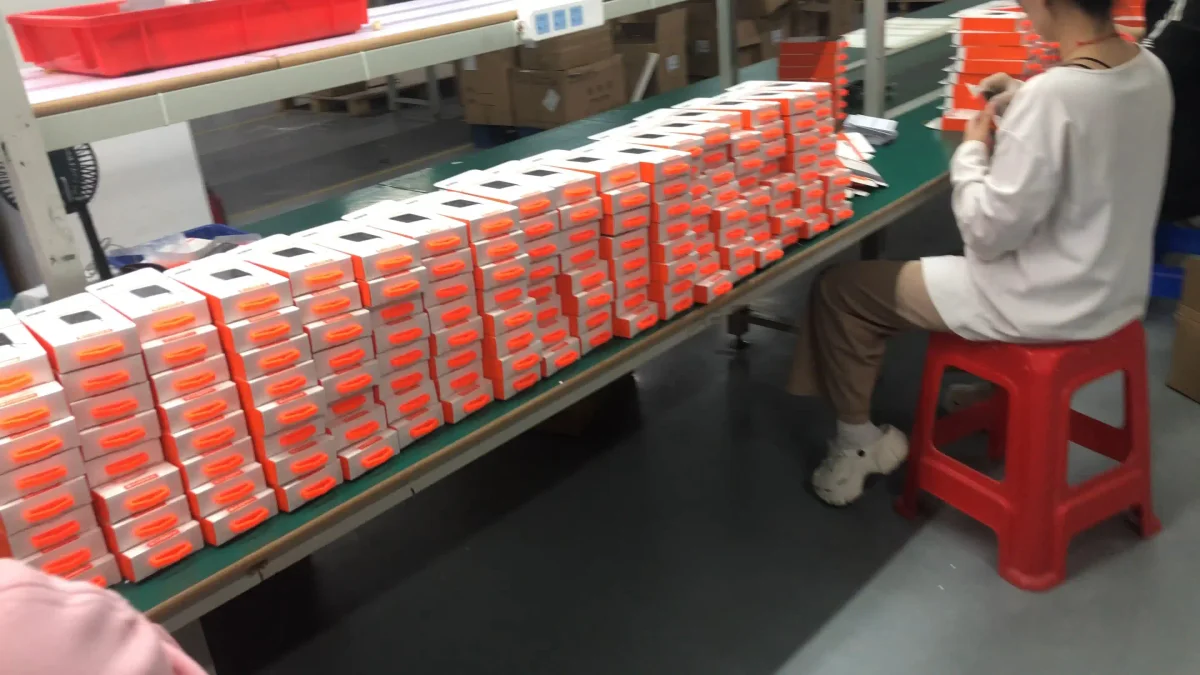
WOWOHCOOL has operated since 2013, with a Shenzhen office and a 5,000 m² factory in Dongguan. It reports 1M+ units per month, 50+ R&D engineers, and 200+ client brands across 50+ countries. Its GaN line covers 35W to 140W, with a 20W–240W customization range.
The differentiator is the MOQ tier. In-stock ODM with logo, color, and stock packaging starts at 500 units, below the 1,000+ many Chinese factories quote for the same work. Platform redesign runs 1,000–2,000 units, and full OEM with a new mold starts at 3,000.
The evidence standard is the stronger part. WOWOHCOOL publishes four-stage QC, 100% four-hour aging, AQL 0.65/0.25, a defect rate below 0.3%, and a GaN field return rate of about 0.5%. Its GaN V 65W unit measured 52.4°C after 30 minutes at full load, against 76.8°C for a silicon reference. A 2025 Bosch 65W GaN car charger program shipped 10,000 units with zero defects; that was an expedited project, so its 25-day run is not the standard OEM timeline.
Verify first: the mainland entity's business license and USCC, the ISO 9001 certificate, the exact GaN V model certificate, and the thermal report for the SKU you are buying.
Huntkey
Best for: laptop-grade OEM programs and larger volumes that need a mature power-supply supply chain.
Huntkey is a Shenzhen power-electronics manufacturer founded in 1995. Its public profile describes three industrial parks, in-house metal, injection molding, transformers, SMT, and OEM assembly, plus 440+ R&D engineers and 13 laboratories. Its GaN line includes 35W, 65W, and 100W models; Global Sources listings show MOQs around 500–1,000 with UL and FCC certification.
The appeal is depth. Decades of power-supply work for laptop and phone brands usually mean stronger documentation and component qualification than a small ODM. The trade-off: a 500-unit custom enclosure is not the program Huntkey is built for.
Verify first: which GaN models are actually in production, the exact certificate for your wattage, the minimum order for a custom enclosure, and whether the quoted factory is the Shenzhen site or a subcontractor.
Aohai Technology
Best for: high-volume brand programs that need a listed manufacturer with multiple production bases.
Aohai Technology (002993.SZ) is a Dongguan charger and power-adapter ODM listed on the Shenzhen Stock Exchange. Public reporting describes GaN fast chargers, PD adapters, and power banks, with plants in Dongguan, Jiangxi, Wuhan, Hainan, India, Indonesia, and Vietnam, and annual charger capacity above 180 million units.
Aohai fits forecasts in the hundreds of thousands, where the retail customer expects a listed supplier with audit files. It is not a low-MOQ channel; its public materials focus on program scale, not 500-unit trials.
Verify first: the minimum program size, the production site assigned to your SKU, the audit report your retailer will accept, and the GaN model certificate. Do not assume that a large ODM will put your 1,000-unit order on the same line as its flagship customer.
Ricomm
Best for: EU retail programs that need a factory with retail audit experience.
Ricomm (Dongguan Ricomm Electronics) was founded in 2008 in Shipai Town, Dongguan. It reports 500+ staff, a 20,000 m² base on one page and 10,000 m² on another, in-house molding and tooling, a 1,500 m² test lab, and GaN chargers from 20W to 140W plus desktop stations up to about 370W. Claimed certifications include GS, TUV, UL, ETL, SAA, ISO 9001, and BSCI/SEDEX.
Its retail client list is self-reported and includes Carrefour, Walmart, TESCO, Argos, Staples, DSGI, Disney, Office Depot, Woolworths, and Media Markt. Media Markt is the easiest to check; treat the rest as claims until you see purchase orders or audit files. The retail orientation suits a European chain, but a small custom run can wait behind a retail program.
Verify first: the factory area discrepancy, the exact certificate for your SKU, the client references you intend to rely on, and the production slot for a small custom order.
Zonsan
Best for: custom wattage and port configurations, especially 100W+ desktop chargers.
Zonsan (Shenzhen Zonsan Innovation Technology) was founded in 2009 and operates from Longgang, Shenzhen. Its GaN range runs from 20W to 65W wall chargers and 100W to 240W desktop chargers. The company says it has passed BSCI, GRS, ICS, ISO 9001, KC, and ETL audits, and lists CB, CE, RoHS, GS, UKCA, FCC, PSE, and CCC credentials.
The fit is customization: custom wattage and port layouts, including dual USB-C plus USB-A. It does not publish factory size, headcount, or MOQ, and third-party guides estimate 1,000+. Ask for the audit file and the MOQ in writing before you design around its platform.
Verify first: factory size and headcount, the MOQ for your port configuration, the certificate for the exact model, and whether the GaN FET is a named part or an unspecified equivalent.
Gopod
Best for: fast 30–65W standard launches using existing tooling.
Gopod is a Shenzhen charging-products ODM that third-party sourcing guides describe as strong on standard 30–65W GaN wall chargers, with white-label builds from existing tooling, MOQs around 500–1,000, and a $3–7 price band. Its own site was not accessible during this research, so those figures are third-party estimates, not confirmed factory data.
That means the first call should be a documentation request, not a price request. A standard-SKU ODM can be the fastest route to market when your design is close to its platform.
Verify first: the official factory profile, the exact SKU certificate, the MOQ in writing, and whether 100W+ or custom enclosures are in scope.
WECENT
Best for: 200–1,000 unit trials and cost-sensitive standard chargers.
WECENT is a Shenzhen Bao'an charger manufacturer that says it has operated since 2018. Its public site lists 20W–240W wall, desktop, and travel adapters, MOQ from 200 pieces per model, samples in 2–3 days, and CE, FCC, RoHS, PSE, and KC support, plus 200+ brand customers.
The low MOQ is the attraction. The trade-off is engineering depth: a 200-piece program tests a market; it does not develop a new thermal architecture. Independent inspection is cheap insurance at this tier.
Verify first: factory size and headcount, the production site, the exact model certificate, and the aging and AQL procedure. The company's public page does not disclose square footage, staff count, or line count.
UGREEN / Zhize
Best for: a brand-scale benchmark, not a general white-label channel.
UGREEN is a Shenzhen brand, not a general OEM factory. Its group manufacturing arm, Shenzhen Zhize Technology, is a public OEM/ODM manufacturer founded in 2010, with a 30,000 m² facility, 1,000+ staff, ISO 9001/14001/45001/13485, IATF 16949, and QC080000 credentials. Zhize produces hubs, docks, wireless chargers, GaN chargers, and cables.
UGREEN itself is selective about white-label work. If you want your brand on the product, the realistic route is a specialist ODM or the group's manufacturing arm, not the UGREEN retail catalog. Use UGREEN as a specification benchmark: if your factory matches its documentation depth, you are in a different tier from the average trader.
Verify first: whether the manufacturing arm accepts external white-label work, the minimum program size, the IP and tooling ownership terms, and the certificate for the exact model.
Other names buyers ask about fit narrower cases: Baseus for design-led brand work, Jialu for low-MOQ white-label, Dilithink for compact 30–65W designs, and Salcomp for large ODM programs above a first order.
3. Quick Comparison
| Manufacturer | Base | GaN range | MOQ | Certification support | Best for | Verify first |
|---|---|---|---|---|---|---|
| WOWOHCOOL | Shenzhen + Dongguan | 35–140W; 20–240W custom | 500 in-stock ODM | CE, FCC, UL project-based, RoHS | 500–3,000 unit ODM | License, ISO 9001, SKU certificate, thermal report |
| Huntkey | Shenzhen | 35–100W public line | ~500–1,000 | UL, FCC, CE | Laptop-grade OEM | Exact model certificate, factory site |
| Aohai | Dongguan | GaN fast chargers, PD adapters | Project-based | UL, FCC, CE, KC | High-volume brand programs | Minimum program size, audit file |
| Ricomm | Dongguan | 20–140W; desktop to ~370W | Project-based | GS, TUV, UL, ETL, SAA | EU retail programs | Factory area, SKU certificate, references |
| Zonsan | Shenzhen | 20–240W | Not published; third-party 1,000+ | CB, CE, GS, UKCA, FCC, PSE, KC | Custom wattage/ports | Factory size, MOQ, FET part number |
| Gopod | Shenzhen | 30–65W | Third-party 500–1,000 | CE, FCC, UKCA on some SKUs | Fast standard launches | Official profile, SKU certificate |
| WECENT | Shenzhen | 20–240W | 200 | CE, FCC, RoHS, PSE, KC | 200–1,000 unit trials | Factory size, aging/AQL procedure |
| UGREEN / Zhize | Shenzhen | GaN chargers | Selective OEM | ISO 9001/14001/45001/13485, IATF 16949 | Brand-scale benchmark | White-label acceptance, IP terms |
The table is a shortlist tool, not a scorecard. Two factories can both be "CE certified" and still be months apart in documentation quality. The next section explains why the brand name on the catalog is not the same as the factory that will make your order.
4. Factory or Brand? What OEM Buyers Get Wrong
A brand is not a factory. A factory is not a brand. The confusion costs buyers time and money.
UGREEN, Baseus, and Anker are brand-led companies. They design, specify, and sell finished products, and may own part of the manufacturing chain through a group company. They are benchmarks for industrial design, certification depth, and retail packaging. They are not general white-label channels for a 500-unit order.
A contract manufacturer is set up to put your brand on a product. It quotes MOQ by program type, holds the certification in the factory's name or supports yours, and can share the line audit. The trade-off is a less distinctive product than a brand's flagship.
A third category is the trading company that presents itself as a factory. It may have a showroom, a catalog, and a convincing price. It does not own the SMT line or the aging room. The checklist in the next section is designed to expose that gap before you pay a deposit.
A shortlist should include one brand-scale benchmark and two contract manufacturers that fit your order size.
5. The 7-Point GaN Factory Verification Checklist
1. Match the certificate to the exact SKU
A certificate is not a company-level badge. It names a model, a wattage, a port configuration, and sometimes a plug type. Ask for the report that matches the SKU on the quote, not the certificate for the factory's best-selling 30W unit.
One common failure looks like this: a European buyer receives a quote for a 65W three-port charger and a CE certificate for a 30W single-port model. The factory calls it a "series certificate." It is not evidence for the product being bought.
Check: model number, wattage, port count, plug type, report number, and standards listed.
2. Verify the GaN IC and freeze the BOM
Ask for the GaN FET manufacturer and part number. Common platforms include Navitas, Innoscience, Power Integrations, and GaN Systems. Then ask for the BOM freeze clause: after sample approval, any component substitution requires your written approval.
A GaN charger is a system, not a chip. The transformer, capacitors, controller, and thermal interface matter as much as the FET.
Check: FET part number, controller part number, transformer supplier, capacitor brand, and change-notification process.
3. Demand thermal and derating data
Ask for case temperature at full load, in the shipping enclosure, at a stated ambient, with the load applied through the ports you will sell. A half-load or open-housing test does not describe the product.
Ask for the derating point too. If the charger reduces power above a certain ambient, that condition must be documented. An undocumented derating point becomes a warranty dispute.
WOWOHCOOL's GaN V 65W unit measured 52.4°C after 30 minutes at full load, against 76.8°C for a silicon reference. The silicon unit dropped to 42W after 18 minutes. Those are the numbers to compare, not a claim about "low temperature."
Check: ambient, load, enclosure, duration, instrument, and derating curve.
4. Check PD 3.1, PPS, and port-allocation firmware
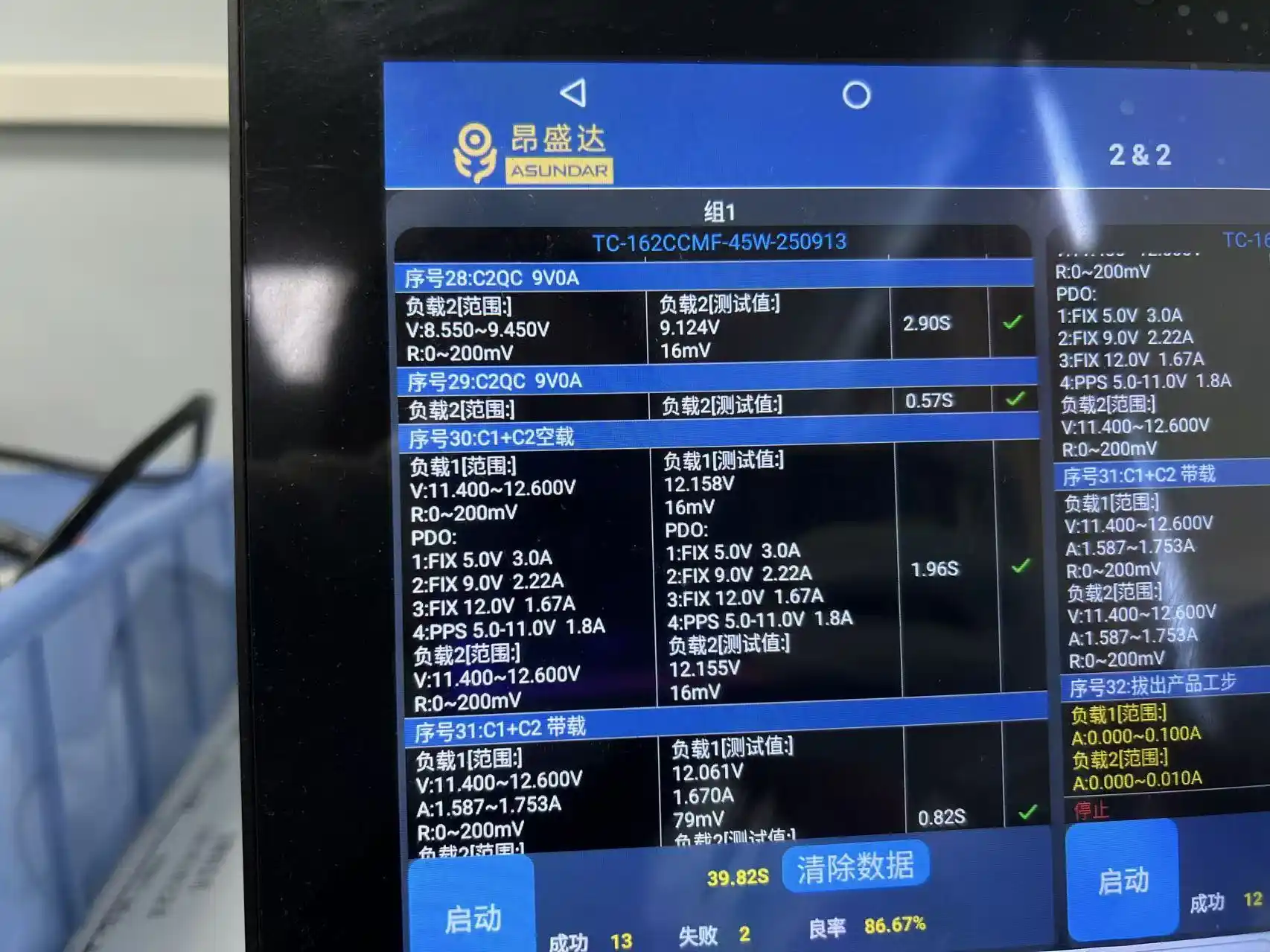
A multi-port charger is a power-sharing system. The total wattage matters less than the allocation table. Ask for the table for one, two, three, and four ports, and test a replug event: unplug one device and confirm the other port renegotiates without dropping the load.
For 140W and above, the charger needs PD 3.1 EPR support and a 240W e-marker cable. USB-IF defines the 28V, 36V, and 48V fixed voltages and the EPR mode. A 140W charger with a 100W cable is a 100W system.
Check: PD 3.1 EPR, PPS, port-allocation table, replug behavior, and cable e-marker rating.
5. Audit the SMT, aging, and traceability records
Ask for a video walk-through of the SMT line, assembly line, and aging room. Then ask for records: solder-paste inspection, AOI, functional test, 100% aging, and the AQL plan. A video tour without records is a marketing asset.
Traceability is the test most factories fail. Pick a carton from a recent shipment and ask for the batch record, date code, component lots, and test data. If the factory cannot trace the carton, it cannot contain a defect.
Check: SMT ownership, AOI, 100% aging duration, AQL level, and a sample batch trace.
6. Confirm who owns the tooling and design IP
Ask three questions in writing: Who owns the enclosure tooling? Who owns the PCBA design? What happens to both if the relationship ends?
In-stock ODM usually means the factory owns the platform and you license your brand. Platform redesign may involve shared tooling. Full OEM should put the tooling and design IP in your name, with an ownership clause and a handover process.
Check: tooling invoice, ownership clause, design files, firmware ownership, and exit terms.
7. Run a 300–500 unit pilot before mass production
A sample is not a production batch. A pilot run uses the production line, fixture, and BOM. It exposes the drift that a hand-built sample hides.
Test the pilot for thermal performance, port allocation, drop, and aging. Compare the results with the sample report. If the pilot drifts, fix the process before the mass order.
Check: pilot quantity, line used, test results versus sample, and the mass-production release sign-off.
6. GaN Charger Price Benchmarks
The table below is WOWOHCOOL's FOB Shenzhen pricing for GaN chargers. It excludes certification, tooling, and freight. Use it as a reference band, not as a quote from every factory on the list.
| Type | 500 units | 1,000 units | 5,000 units | 10,000 units |
|---|---|---|---|---|
| GaN 30W single port | $3.50–5.00 | $3.20–4.50 | $2.70–4.00 | $2.40–3.60 |
| GaN 65W multi-port | $6.00–8.50 | $5.40–7.20 | $4.80–6.50 | $4.20–6.00 |
| GaN 100W multi-port | $9.00–13.00 | $7.50–10.00 | $7.00–9.50 | $6.50–9.00 |
| GaN 140W PD 3.1 | $18.00–24.00 | $14.00–18.00 | $12.00–16.00 | $10.50–14.50 |
Three cost rules matter more than the headline price:
- Tiered pricing drops 10–18% at 5,000+ units. Intermediate volumes receive proportional discounts, not the full step.
- Factory-direct pricing runs 20–40% below trading-company quotes. If a trader is within 5% of a factory, ask who owns the line.
- Certification is a fixed cost that lands on the first order. A $2,500–4,500 CE/FCC/RoHS package costs $5–9 per unit at 500 pieces and $0.50–0.90 at 5,000.
The GaN charger market was valued at USD 1.2 billion in 2026 and is projected to reach USD 6.0 billion by 2033, a 25.7% CAGR, according to Persistence Market Research. Growth does not make a bad quote good. It does mean more factories will claim GaN capability, which makes the certificate and BOM checks more important.
7. MOQ and Lead Time
MOQ is a program definition, not a single number. The same factory can quote 500, 1,000, or 3,000 depending on who owns the design and whether a new mold is required.
| Program | MOQ | What it covers |
|---|---|---|
| In-stock ODM | 500 | Existing platform, logo, color, stock packaging |
| ODM development, stock packaging | 1,000 | Platform rework, no new enclosure mold |
| ODM development, custom packaging | 2,000 | Branded box, manual, cable, insert |
| ODM development, structural change | 2,000 | Platform-adapted tooling, no full new mold |
| Full OEM, new mold | 3,000+ | Client design IP and new tooling |
Lead time follows the same logic:
| Program | Sample / design | Mass production |
|---|---|---|
| In-stock ODM (500) | 3–7 days | 25–35 days |
| ODM development (1,000) | 25–45 days | 25–35 days |
| ODM development (2,000, custom packaging) | 25–45 days | 35–45 days |
| ODM development (2,000, structural change) | 25–45 days | 35–50 days |
| Full OEM (3,000+) | 7–14 days | 30–60 days |
| Full OEM with new mold | — | +2–3 months tooling; 2–4 months overall |
A 500-unit in-stock ODM order to Europe typically runs 10–12 weeks door to door: 1–2 weeks for the sample, 4–5 weeks for production, and 4–5 weeks by sea. Air freight shortens the last leg to 3–7 days at a higher cost.
8. Certification Scope by Market
| Market | Required or expected | Cost (USD) | Timeline |
|---|---|---|---|
| US | UL 62368-1 (retail/Amazon benchmark) | $1,500–3,000 | 4–8 weeks |
| US | FCC SDoC (non-wireless) | $500–1,200 | 1–2 weeks |
| EU | CE (LVD + EMC) | $1,500–3,500 | 2–4 weeks |
| EU | RoHS | $500–1,000 | 1–2 weeks |
| EU | REACH | $1,000–2,000 | 2–3 weeks |
| UK | UKCA | $800–1,500 | 2–3 weeks |
| Japan | PSE | $1,000–2,500 | 3–5 weeks |
| Korea | KC | $1,500–3,000 | 3–5 weeks |
A bundled CE/FCC/RoHS package costs $2,500–4,500 and takes 4–6 weeks. Adding UL 62368-1 and REACH brings the package to $3,000–8,000 and 6–10 weeks.
Two rules apply in every market:
- The certificate must name the exact model, wattage, and port configuration. A certificate for a 30W model does not cover a 65W model.
- The importer is responsible for the declaration. In the EU, the CE declaration and technical file must be available under the importer's name. In the US, the FCC SDoC compliance statement is the importer's responsibility. The factory supplies the test report; it does not take over your market obligations.
For wireless charging products, add Qi2/WPC certification. GaN wall chargers do not need it. Do not let a supplier bundle a wireless certification into a wall-charger quote to make the package look comprehensive.
9. Which Factory Fits Your Order?
Use this table to cut the eight-name list to two or three conversations.
| Your situation | Start with | Why |
|---|---|---|
| First order, 500–1,000 units, stock platform | WOWOHCOOL, WECENT | Low MOQ, existing tooling, faster sampling |
| 1,000–2,000 units, custom packaging | WOWOHCOOL, Zonsan | Platform redesign without a full new mold |
| 3,000+ units, new enclosure | WOWOHCOOL, Huntkey, Aohai | OEM tooling and production depth |
| 100W–240W desktop charger | Zonsan, Ricomm | Higher-wattage platforms and desktop experience |
| EU retail chain, audit-heavy | Ricomm, Huntkey | Retail documentation and audit experience |
| Amazon private label, US | WOWOHCOOL, Huntkey | UL/FCC support and packaging control |
| Brand-scale benchmark | UGREEN / Zhize | Certification and industrial-design reference |
| 200–500 unit market test | WECENT, WOWOHCOOL | Lowest entry quantities |
The table assumes a certified product for the US or EU. If your market is Japan, Korea, or the UK, add the local certification lead time before you fix the launch date.
10. Red Flags in GaN Charger Quotes
- "We have CE for the series." Ask for the report with your model number, wattage, and port count. If it does not exist, the certificate is not for your product.
- No thermal data. A GaN charger without full-load temperature data has not been tested in its shipping enclosure.
- No BOM freeze. If the factory can change the FET, capacitor, or transformer after sample approval without written notice, your sample is not the product you will receive.
- A price below the BOM floor. A 65W multi-port charger at $3 is not a GaN bargain. It is a different FET, a smaller transformer, or a missing certification.
- MOQ without a program definition. "MOQ 500" means nothing until you know whether it is in-stock ODM, platform redesign, or full OEM.
- No pilot run and no audit access. A factory that will not run 300–500 units on the production line, or show the SMT and aging rooms, is asking you to fund its learning curve.
Frequently Asked Questions
Which Chinese factories make GaN chargers for major brands?
Huntkey, Aohai, and Ricomm are contract manufacturers with public OEM/ODM programs. UGREEN and Baseus are brand-owned operations with selective OEM capacity. Ask each supplier for the exact model certificate and the brand authorization before treating a client logo as proof. A public client list is a starting point, not a verification.
What MOQ should I expect for a 65W GaN charger?
In-stock ODM with logo and stock packaging can start at 500 units. A platform redesign is 1,000–2,000 units, and full OEM with a new mold is 3,000+ units. Most competitors quote 1,000+ for the same in-stock work, so confirm which tier the quote assumes before you compare prices.
What certifications does a GaN charger need for the US and EU?
For the US, UL 62368-1 is the retail benchmark, FCC SDoC covers EMC, and DOE Level VI covers efficiency. For the EU, CE (LVD + EMC), RoHS, REACH, and ErP apply; the UK adds UKCA. The certificate must name the exact model, wattage, and port configuration.
How do I verify a GaN charger factory before placing an order?
Check five items: the business license and factory address, the certificate tied to the exact SKU, the GaN FET part number and BOM freeze, thermal data at full load in the shipping enclosure, and a 300–500 unit pilot run. A video tour is not a substitute for batch records.
What is the FOB price for a 65W GaN charger in 2026?
Factory-direct FOB Shenzhen is about $6.00–8.50 at 500 units, $5.40–7.20 at 1,000, $4.80–6.50 at 5,000, and $4.20–6.00 at 10,000. Prices exclude certification, tooling, and freight. A quote below the BOM floor usually means a downgraded FET, capacitor, or transformer.
Global Procurement & Sourcing Manager · 10+ years in 3C procurement & sourcing
Nina Nico is WOWOHCOOL's Global Procurement & Sourcing Manager with 10+ years in 3C procurement. She specialises in B2B hardware sourcing, OEM/ODM programme management, and supplier verification for charging accessories.
Factory Footprint
ISO 9001 Facility
Shenzhen, China
Export Countries
Engineers In-House
Shortlist a GaN Factory?
Send your target wattage, port count, market and first-order quantity. We will tell you which program fits and which evidence to request.
Sources & References
- Persistence Market Research, GaN Chargers Market 2026–2033
- USB-IF, USB Charger (USB Power Delivery)
- FCC, Equipment Authorization — FCC ID Search
- UL, Product iQ
- European Commission, CE marking
- Huntkey, corporate profile
- Aohai Technology, corporate disclosures
- Ricomm, corporate site
- Zonsan, corporate site
- WECENT, corporate site
- UGREEN, corporate site