GaN I vs III vs V: Complete Generational Guide for OEM Buyers
You are looking at GaN chargers from suppliers and seeing "GaN," "GaN III," and "GaN V" thrown around. Some factories label everything as the latest generation. Others just say "GaN" and leave you guessing.
If you are sourcing chargers for your brand, the difference between these generations is not academic. It affects your product size by 2x, your return rate by 3x, and how much you can charge at retail.
Here is what each generation actually delivers, how to tell them apart, and which one makes sense for your product line.
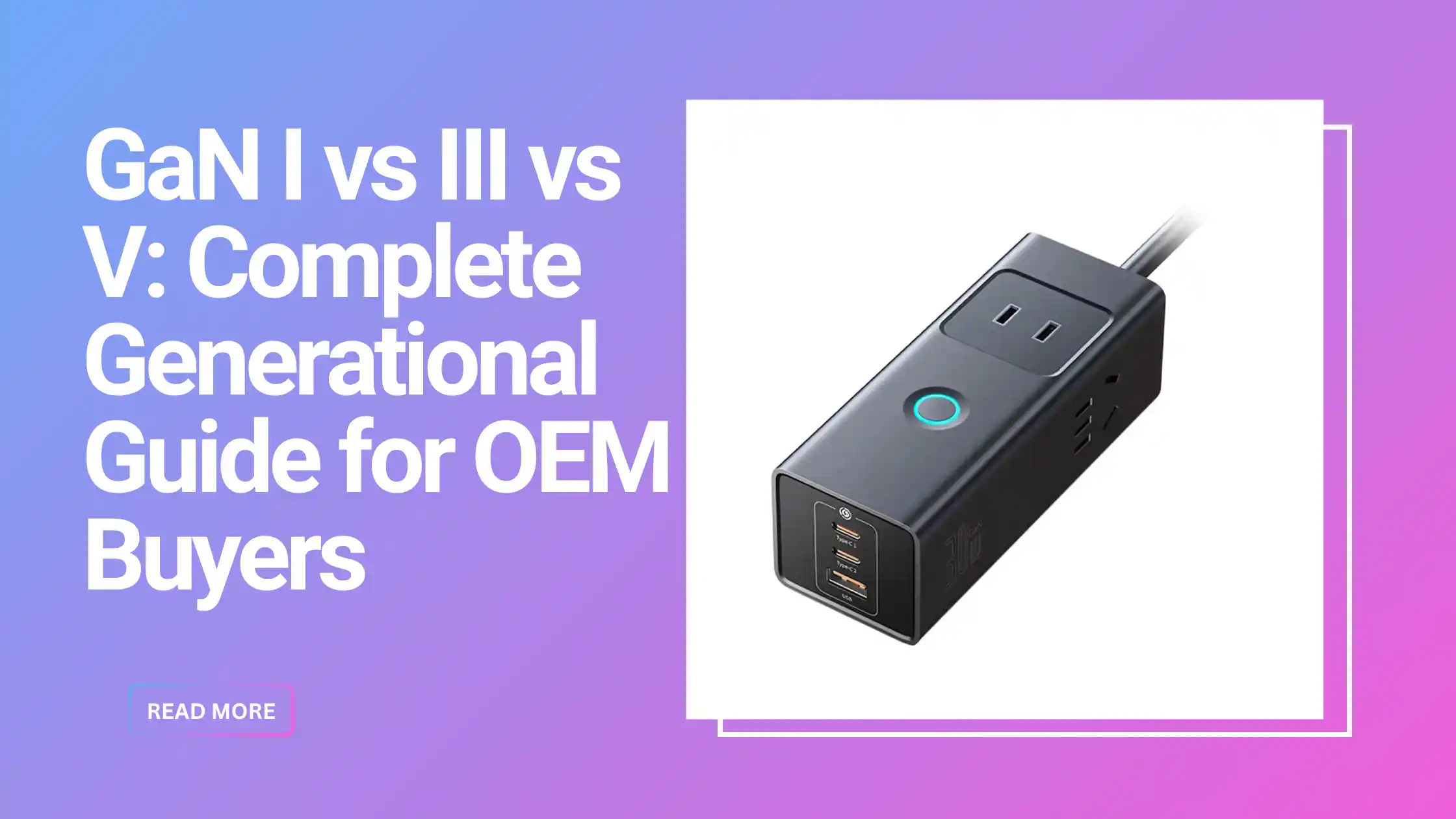
Table of Contents
Key Takeaways
- → GaN V runs at 5MHz+ vs. GaN III at ~3MHz and GaN I at ~1MHz —higher frequency means smaller chargers with less heat
- → GaN V supports PD 3.1 up to 240W; GaN III maxes out at 140W PD 3.0
- → Real GaN V runs 65-75C at full load —expect longer product life and fewer returns
- → The 20-35% BOM premium for GaN V is typically recovered through higher selling prices and lower shipping costs
1. Why GaN Generations Matter for OEM Sourcing
Gallium Nitride (GaN) power semiconductors have been through multiple commercial generations since hitting the market around 2018. Each generation brought real, measurable improvements: higher switching frequencies that allow smaller transformers, better thermal performance that extends product life, and higher power capabilities that open new product categories.
For OEM buyers, the generation directly impacts your product specs:
- — Size: GaN V chargers are roughly half the volume of equivalent GaN I designs
- — Heat: Lower operating temperatures mean fewer customer complaints about hot chargers
- — Power: PD 3.1 at 240W enables a single charger to power everything from earbuds to laptops
- — Cost: Each generation carries a different BOM premium that affects your margins
- — Marketing: "5th Generation GaN V" differentiates your product on crowded retail shelves
The three generations you will encounter in today's market are GaN I, GaN III, and GaN V. GaN II and GaN IV exist mostly in research literature and are not commercially significant for charger OEM sourcing. For a broader overview of GaN charging technology, see our complete GaN chargers guide.
According to Yole Group, the GaN power device market is projected to reach $2.5 billion by 2027, growing at a CAGR of 30%. This rapid expansion is driven by demand for smaller, more efficient chargers across consumer electronics, automotive, and data center applications. For OEM buyers, this means the technology is scaling fast and prices are dropping — but so is the window to be an early adopter in your category.
Want to see the actual products? WOWOHCOOL manufactures GaN V chargers from 35W to 100W+ with PD 3.1 support. Browse our GaN charger lineup.
2. GaN I: The Pioneer (2018)
GaN I hit the commercial market around 2018 and represented the first real alternative to silicon MOSFETs in power adapters. The key innovation was switching frequencies around 1MHz, roughly 10 times faster than silicon, which allowed manufacturers to reduce transformer sizes for the first time in decades.
Technical specs:
- — Switching frequency: ~1MHz
- — Peak efficiency: ~93%
- — Operating temperature: 85-90C at full load
- — Maximum PD: 100W (PD 3.0)
- — Size relative to GaN I: Baseline
GaN I devices used a depletion-mode architecture that required cascode configurations with silicon MOSFETs. According to the GaN semiconductor Wikipedia entry, this hybrid approach limited some of the theoretical advantages of pure GaN but still delivered meaningful size reductions, typically 20-30% smaller than equivalent silicon chargers in the 45-65W range.
Today's relevance: GaN I is effectively obsolete for new OEM designs. You will still find it in budget chargers from less reputable suppliers, but any established manufacturer has moved to GaN III or GaN V. If a supplier quotes pricing significantly below market averages for "GaN" without specifying the generation, there is a good chance they are using GaN I or even enhanced silicon.
OEM tip: Always request the specific GaN FET part number and datasheet during the quoting process. If the supplier cannot provide it, consider that a red flag. Genuine GaN V uses FETs from Navitas, Innoscience, GaN Systems, or EPC, and the datasheet will clearly state the generation.
3. GaN III: The Efficiency Leap (2020)
GaN III entered the market around 2020-2021 with a fundamental architecture change: enhancement-mode transistors that eliminated the need for cascode silicon configurations. This allowed GaN III to operate at approximately 3MHz switching frequencies with lower losses and better thermal characteristics.
Technical specs:
- — Switching frequency: ~3MHz
- — Peak efficiency: ~95%
- — Operating temperature: 75-80C at full load
- — Maximum PD: 140W (PD 3.0)
- — Size vs GaN I: ~30% smaller
Real-world example: A product manager at a mid-sized consumer electronics brand sourced 5,000 units of 65W GaN III chargers for his travel accessories line. The size advantage alone let him shrink packaging by 35%, cutting per-unit shipping costs by $0.80. The charger also ran cool enough to include a soft travel pouch. His line launched at $39.99 and held a 4.3-star average over 2,000 reviews.
Today's relevance: GaN III is the solid mid-range option. It delivers good performance at a 10-15% BOM premium over GaN I. For brands testing a new market or launching their first GaN product, GaN III offers a reasonable cost-risk profile. The main limitations are the lower maximum power (140W vs. 240W) and the lack of a distinct "5th Gen" marketing story.
OEM tip: GaN III works well for 65W and 100W SKUs targeting mid-market pricing. If you plan to keep the product in market for more than 12 months, consider whether the 10-15% cost saving over GaN V is worth sacrificing the "latest generation" positioning.
4. GaN V: Today's Peak Performance (2023)
GaN V represents the current state of the art in commercial GaN power semiconductors. Available since 2023-2024, GaN V pushes switching frequencies beyond 5MHz while maintaining excellent thermal characteristics.
Technical specs:
- — Switching frequency: 5MHz+
- — Peak efficiency: ~97%
- — Operating temperature: 65-75C at full load
- — Maximum PD: 240W (PD 3.1 EPR)
- — Size vs GaN I: ~50% smaller

WOP37 67W GaN V charger —retractable cable + Qi2 wireless charging in one device. View full specs
The higher switching frequency is the key enabler. It allows significantly smaller magnetic components such as transformers, inductors, and capacitors, which drives the 50% size reduction. A 100W GaN V charger is roughly the size of a traditional 30W silicon charger.
PD 3.1 at 240W: GaN V is the first generation capable of supporting the full USB-C PD 3.1 Extended Power Range (EPR). A single charger can power earbuds, phones, tablets, laptops, and monitors. For brands targeting the premium travel and workstation segments, this is a product category that simply did not exist before GaN V.
Real-world example: An outdoor gear brand launched a 100W GaN V travel charger in early 2025. The charger was small enough to fit in a shirt pocket, a feature that generated over 500 social media shares in the first month. At $59.99 retail, it commanded a 50% premium over their previous 65W GaN III model. The return rate was 1.2%, compared to 3.8% for the older model. Within six months, the GaN V line accounted for 40% of their charging accessory revenue.
Why the premium is worth it: GaN V carries a 20-35% BOM premium over GaN I, but the total cost of ownership tells a different story:
- — Shipping savings: 40% smaller and lighter reduces per-unit freight by $0.50-2.00
- — Return reduction: Lower operating temperature cuts thermal-related failures by an estimated 40-60%
- — Premium pricing: The "5th Gen GaN" story supports 20-50% higher retail pricing
- — Longer product life: Cooler operation extends component lifespan, reducing warranty claims
For a deeper look at GaN V manufacturing specifically, see our GaN V OEM Manufacturing Guide.
According to Yole Intelligence, GaN FET prices have declined 10-15% annually as production scales, with GaN V projected to reach price parity with GaN III by 2027-2028. "Starting with GaN V now positions your brand to benefit from falling costs rather than playing catch-up on a technology your competitors already own," says Nina Nico, OEM Technical Lead at WOWOHCOOL.
5. GaN I vs III vs V: Side-by-Side Comparison Table
Here is the GaN I vs III vs V comparison that matters for OEM sourcing decisions:
| Factor | GaN I | GaN III | GaN V |
|---|---|---|---|
| Switching Frequency | ~1MHz | ~3MHz | 5MHz+ |
| Peak Efficiency | ~93% | ~95% | ~97% |
| Operating Temp | 85-90C | 75-80C | 65-75C |
| Max PD Output | 100W | 140W | 240W (EPR) |
| Size vs GaN I | Baseline | ~30% smaller | ~50% smaller |
| Best For | Budget products | Mid-range | Premium / flagship |
| Marketing Position | Minimal | "GaN technology" | "5th Gen GaN V" |
| BOM Premium | Baseline | +10-15% | +20-35% |
| Return Rate Risk | Moderate (heat) | Low | Very low |
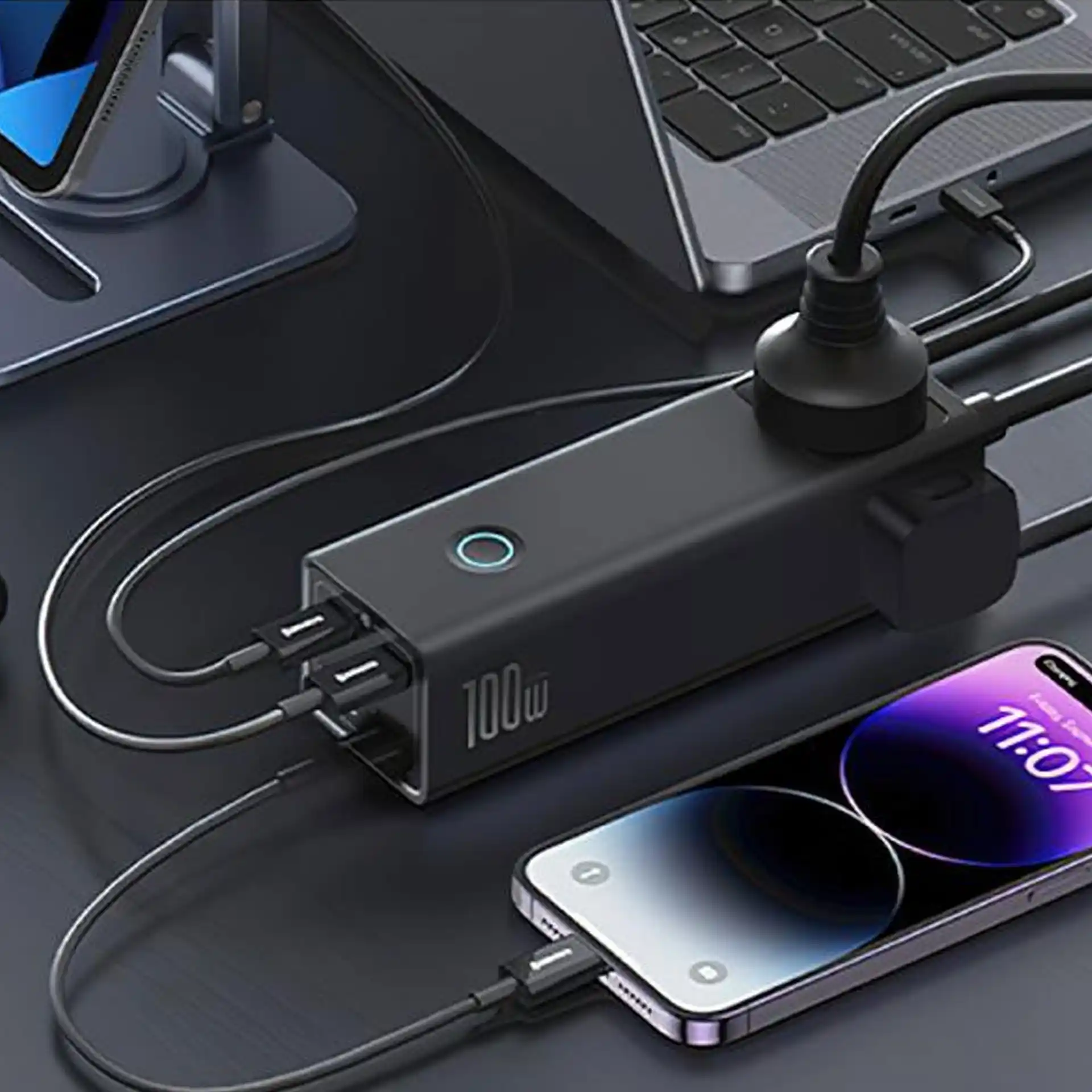
WOP80 100W GaN V charging station —4 ports, PD 3.1. View full specs
Which generation for which product?
- — Budget / economy line (sub-$25 retail): GaN I still works for basic 30-65W charging, but GaN III at +10-15% BOM is increasingly the minimum acceptable option for retail channels.
- — Mid-range value line ($25-$45 retail): GaN III is the sweet spot. Good thermal performance, adequate power for phones and tablets, reasonable BOM cost.
- — Premium / flagship ($45+ retail): GaN V is the clear choice. The 20-35% BOM premium is recovered through higher ASP, lower returns, and the marketing advantage.
Not sure which is right for your project? WOWOHCOOL offers OEM/ODM services across all GaN generations, with GaN V as our primary platform for new designs. Contact our engineering team to discuss your requirements.
6. How to Identify Real GaN V
The GaN labeling problem is real. Here are five verification methods for OEM buyers:
1. Check switching frequency. Genuine GaN V operates at 5MHz or higher. This number must appear in the technical datasheet. If a supplier cannot provide it, proceed with caution.
2. Verify the GaN FET manufacturer. Real GaN V uses FETs from Navitas, Innoscience, GaN Systems, or EPC. Request the specific part number and cross-reference it against the manufacturer's published specifications.
3. Request thermal images. A genuine GaN V charger should maintain 65-75C at full load after 30 minutes. If the supplier's charger runs at 85C+, it is using older generation GaN or enhanced silicon.
4. Confirm PD 3.1 EPR support. Only GaN V supports the full 240W Extended Power Range. If a "GaN V" charger maxes out at 100W PD 3.0, the labeling is incorrect.
5. Size check. A genuine 100W GaN V charger occupies approximately 70cm or less. If the product is significantly larger than a deck of cards, it is not using GaN V.
Real-world example: A European distributor tested samples from three different "GaN V" suppliers. Only one passed all five checks. The other two were using GaN III and enhanced silicon respectively, labeled as GaN V. The distributor saved an estimated $40,000 in potential returns and brand damage by verifying before committing to a 10,000-unit order.
Working with an established OEM partner eliminates verification risk. WOWOHCOOL sources GaN V FETs directly from Navitas and Innoscience, maintains full component traceability, and provides thermal test data with every sample shipment. Our OEM/ODM service page details the full manufacturing and verification process.
7. Which Generation Should You Choose?
Your choice depends on three factors: target retail price point, product lifecycle expectations, and brand positioning.
Choose GaN I only if you are building an absolute budget product (sub-$20 retail) and your customers do not expect premium performance. Be aware that many retailers and distributors now require a minimum of GaN III for new listings.
Choose GaN III if you are launching a mid-range product line, testing a new market with conservative volume, or need to hit a specific retail price point below $45. GaN III delivers solid performance at a 10-15% BOM premium and is well-understood by contract manufacturers.
Choose GaN V if you are building a premium brand, targeting retail price points above $45, or need PD 3.1 power above 140W. The 20-35% BOM premium is offset by higher average selling prices, lower return rates, and the marketing advantage of "5th Generation GaN" technology.
WOWOHCOOL FACTORY STAT
WOWOHCOOL is one of the earliest adopters of GaN V (5th generation) technology, producing OEM/ODM GaN chargers from 20W to 240W PD 3.1 with 10-layer circuit protection, 40% smaller size than silicon, and full certification support (CE, FCC, RoHS, PSE).
QUICK ANSWER
Which GaN generation should OEM buyers choose in 2026? GaN V is the recommended choice for most new charger OEM projects. It delivers 5MHz+ switching frequency, 97% peak efficiency, 65-75C operating temperature, and PD 3.1 support up to 240W. The 20-35% BOM premium over GaN I is typically recovered within 6-12 months through higher selling prices, lower shipping costs, and reduced return rates.
8. Frequently Asked Questions
How do I know what GaN generation a charger uses?
Check the datasheet for switching frequency (GaN V = 5MHz+), GaN FET part number, and supported PD version. Reputable OEM suppliers provide this information on request.
Is GaN V worth the premium over GaN III?
For premium brand positioning, yes. The 20-35% BOM premium is offset by higher selling prices, lower shipping weight, better thermal performance, and the marketing advantage. Most brands recover the premium within 6-12 months.
Can GaN III support PD 3.1?
Some advanced GaN III designs support PD 3.1 up to 140W, but 240W EPR requires GaN V's higher switching frequency and thermal headroom.
What is the MOQ for OEM GaN V chargers?
500-1,000 units for standard ODM configurations with branding. Custom OEM designs with tooling start at 2,000 units. WOWOHCOOL offers lower MOQ for pilot runs.
Will GaN prices drop further?
Yes. GaN FET prices have been declining 10-15% annually as production scales. Industry analysts project GaN V will reach price parity with GaN III by 2027-2028.
Conclusion
Choosing the right GaN generation is a strategic decision that impacts your product's size, thermal performance, power capability, and market positioning. GaN I is largely retired for new designs. GaN III serves the mid-range well with a balanced cost-performance profile. GaN V delivers the performance and marketing advantages needed for premium product lines in 2026 and beyond.
The cost gap between generations continues to narrow. Starting with GaN V now positions your brand for the next 2-3 product cycles rather than playing catch-up in a market where "GaN" alone is no longer a differentiator. The generation is what sets you apart.
Ready to discuss your next charger project? WOWOHCOOL manufactures genuine GaN V chargers with PD 3.1 up to 240W. MOQ starting at 500 units. Request OEM pricing and thermal test data.
Need Help Choosing Your GaN Generation?
WOWOHCOOL manufactures across all GaN generations with GaN V as our primary platform. Get a free consultation and thermal test data within 24 hours.

Supply Chain Expert · Wireless Charging Specialist
Nina Nico is a supply chain management expert with 10+ years experience helping global B2B clients develop custom GaN chargers. She specializes in GaN technology integration, OEM/ODM manufacturing processes, and bringing innovative charging products to market with WOWOHCOOL —a premium charging solution specialist in Shenzhen since 2013. She holds a degree in International Trade and is a certified supply chain professional (CSCP), with deep expertise in Qi2, GaN, and semi-solid-state battery manufacturing.