
Charger Safety Standards 2026: IEC 62368-1, UL 94 & Recall Data
The charger you import today will be judged by standards that took effect yesterday. Between IEC 62368-1 Edition 3 enforcement, UL 4th Edition's 2027 deadline, and China's new GB 47372 nail-penetration tests, 2026 is the year safety regulations reset. Here is what OEM buyers need to know — before a recall letter lands on your desk.
Between 2025 and 2026, the US CPSC recalled over 447,000 chargers linked to fire and burn hazards — involving 112 incidents and 1 fatality. HTRC and Haisito battery chargers were recalled after 33 reported fires and explosions across 4,800 units, causing 3 injuries and $224,000 in property damage. Approximately 40% of first-time certification submissions fail at least one critical safety test. Understanding charger safety standards is not optional — it is a market access requirement.
For a step-by-step walkthrough of US and EU certification processes, costs, and timelines, see our companion guide: US & EU Charger Certification Guide. This article focuses on the why behind the standards — the hazard models, protection circuits, material science, and real-world recall forensics that determine whether a charger is safe.
QUICK ANSWER
What charger safety standards matter in 2026? IEC 62368-1 Edition 3 is now enforced globally. UL 62368-1 4th Edition (published July 2025) becomes mandatory February 15, 2027. China's GB 47372-2026 adds nail-penetration testing for power banks under CCC. For US retail, you need UL 62368-1 + FCC Part 15B. For EU, EN 62368-1 + EMC Directive. Power banks add UL 2056 and UN38.3. WOWOHCOOL holds all certifications and runs 8-hour 100% burn-in on every unit.
Table of Contents
1. Why Charger Safety Is Critical in 2026
Three forces are converging to make 2026 a watershed year for charger safety:
Regulatory reset. IEC 62368-1 Edition 3 enforcement began January 1, 2026 across EU/UK/US markets. Australia and New Zealand follow July 1, 2026. UL 62368-1 4th Edition was published in July 2025 and becomes mandatory February 15, 2027 — but the transition starts now. China's new GB 47372-2026 power bank standard adds nail-penetration and thermal abuse tests, with a transition period ending March 31, 2027.
Recall velocity is accelerating. Anker recalled over 1 million power banks in 2025 due to fire risk. VC Group recalled 287,000 wireless power banks. Quad Lock recalled 74,000 MAG cases. Casely Power Pod faced a class-action lawsuit over burn injuries. These are not no-name brands — they are market leaders with revenue and reputation at stake.
GaN density amplifies risk. GaN chargers pack 65W–240W into shells 40% smaller than silicon equivalents. Higher power density means higher thermal stress, which means protection circuits can no longer be an afterthought — they must be architected from the PCB layout stage.
THE COST OF GETTING IT WRONG
A single recall can cost $500,000–$2M in logistics, refunds, legal fees, and brand damage. CPSC recall announcements are permanent and searchable. For context: the average charger certification costs $10,000–$25,000. The math is not close.
2. IEC 62368-1: The 5 Hazard Model (HBSE)
IEC 62368-1 is built on Hazard-Based Safety Engineering (HBSE) — a framework that identifies energy sources capable of causing injury, then prescribes safeguards for each. Unlike the prescriptive IEC 60950-1 it replaced, HBSE asks: what is the energy source, how does it transfer to a body part, and what safeguard breaks that transfer?
| Hazard | Energy Source | Safeguard Example | Relevant Standard Clause |
|---|---|---|---|
| Electric Shock | Mains voltage (120–240V AC) | Reinforced insulation, 4mm creepage, Y-capacitor pair | Clause 5 |
| Fire | Arcing, component overheating, short circuit | V-0 enclosure, input fuse, thermal fuse on transformer | Clause 6 |
| Thermal Runaway | Li-ion cell exothermic reaction | Dual NTC sensors, MCU cutoff at 80°C, hard shutdown at 105°C | Ed.3 Annex M |
| Mechanical | Sharp edges, moving parts, unstable enclosure | Ultrasonic welding, drop test (1m onto concrete), IPX rating | Clause 7 |
| Radiation / Energy | EMI emissions, USB PD over-voltage, acoustic noise | FCC Part 15B, output OVP clamp, e-marker authentication | Clause 8–9 |
The HBSE model is why modern standards require redundant safeguards: if one layer fails, a second must independently prevent the hazard from reaching the user. This "two-fault tolerance" philosophy runs through every section below.
3. Thermal Runaway: How It Happens & How to Prevent It
Thermal runaway is the most feared failure mode in any product containing a lithium cell. It is a self-accelerating exothermic chain reaction: once triggered, it cannot be stopped — only contained.
The Chain Reaction
- Trigger: Overcharge, internal short, physical damage, or external heat above 60°C
- SEI decomposition (~80°C): The solid-electrolyte interphase layer breaks down, exposing fresh lithium to electrolyte
- Electrolyte breakdown (~150°C): The organic electrolyte decomposes, releasing flammable hydrocarbon gases (H₂, CH₄, C₂H₄)
- Separator melt (~180°C): The polyolefin separator melts, creating a direct anode-cathode short
- Thermal peak (> 800°C): All remaining energy discharges in milliseconds — the cell vents flaming gas and can eject its contents
Prevention Architecture
- — NTC thermistor on the cell body: continuous temperature sampling at 10Hz
- — MCU charge controller: terminates charge if dT/dt exceeds 0.5°C/min — a leading indicator of internal shorting
- — Dual-sensor thermal derating (IEC 62368-1:2023 Ed.3): two independent NTC sensors must agree; if one fails or disagrees by >3°C, the system enters safe mode at 50% power
- — Hard shutdown at 105°C: a thermal fuse in series with the battery B+ line opens permanently
- — Physical containment: V-0 rated cell holder with individual cell separation walls
GB 47372-2026 NAIL PENETRATION TEST
China's new GB 47372-2026 standard mandates a nail-penetration test: a Ø3mm steel nail is driven through a fully charged cell at 150mm/s. The cell must not ignite or explode. This test is stricter than UL 2056 or UN38.3 and represents the new high-water mark for power bank safety. Factories that pass it have validated their cell sourcing and BMS design to the most demanding standard in the world.
4. 10-Layer Protection Circuit Map
Every certified charger contains a chain of protection layers, each addressing a specific failure mode. This is the full signal path — from wall outlet to your device — with the named components that guard each stage.
| Stage | Protection Layer | Key Component | Failure Mode Addressed | Regulatory Reference |
|---|---|---|---|---|
| INPUT | 1. Input Fuse | Ceramic tube fuse (2A/250V) | Catastrophic short circuit, mains surge | IEC 60127 |
| INPUT | 2. Input Over-Voltage Protection | MOV (Metal Oxide Varistor) + TVS diode | Grid surge, lightning-induced spike | IEC 61000-4-5 |
| INPUT | 3. EMI Filtering | Common-mode choke + X2/Y2 capacitors | Conducted/radiated emissions | FCC Part 15B, CISPR 32 |
| ISOLATION | 4. Galvanic Isolation | Transformer (triple-insulated wire) + optocoupler | Primary-secondary breakdown, lethal shock | IEC 62368-1 Clause 5 |
| SECONDARY | 5. Over-Current Protection (OCP) | Current-sense resistor + comparator IC | Output short, cable damage, device fault | IEC 62368-1 Clause 6 |
| SECONDARY | 6. Over-Voltage Protection (OVP) | Zener clamp + OVP IC (e.g., Richtek RT7202) | Feedback loop failure, VBUS overshoot >20V | USB PD 3.1 Spec §10 |
| THERMAL | 7. Over-Temperature Protection (OTP) | NTC thermistor + MCU ADC input | Enclosure >77°C, transformer >120°C | IEC 62368-1 Ed.3 Annex M |
| THERMAL | 8. Dual-Sensor Thermal Derating | Two independent NTCs with voting logic | Single-sensor failure, thermal runaway undetected | IEC 62368-1:2023 Ed.3 (new) |
| OUTPUT | 9. Short-Circuit Protection (SCP) | Dedicated SCP pin on PD controller | VBUS-to-GND short, damaged connector | USB PD 3.1 Spec §10 |
| OUTPUT | 10. E-Marker Authentication | ECDSA-P256 signed cable ID chip | Uncertified cable carrying >3A, fire | USB PD 3.1 §8.2 |
WOWOHCOOL INSIGHT
Across 200+ brand accounts, the three most common failure points we see are: (1) non-V-0 plastics that ignite during fault testing, (2) undersized Y-capacitors that fail dielectric strength tests, and (3) missing NTC on the secondary side — the charger has OTP on the primary but is blind to a hot USB-C connector. All three are invisible to the end user until a failure occurs.
5. Material Safety: UL 94 V-0 & Flame Retardancy
Plastic enclosures are the last line of defense between an internal fire and the user's environment. UL 94 is the standard that classifies how a material behaves when ignited.
| Rating | Self-Extinguish Time | Flaming Drips | Glow Wire Threshold | Required For |
|---|---|---|---|---|
| V-0 | < 10s (per flame application) | None | 850°C | GaN charger enclosures, power bank housings, PCB substrate |
| V-1 | < 30s | None | 750°C | Low-power adapters (<15W), internal brackets |
| V-2 | < 30s | Allowed | 650°C | Not acceptable for charger enclosures |
| HB | < 75mm/min burn rate | Allowed | 550°C | Not acceptable for any charger component |
UL 94 7TH EDITION (FEB 2026)
The 7th Edition introduces stricter requirements for thin-wall enclosures (<0.8mm). Materials that previously achieved V-1 may fail under the updated test methods. UL 94 markings must now include both the flame class and the sample thickness (e.g., "V-0 @ 0.75mm"). GaN chargers with ultra-slim designs should be re-verified against 7th Edition methods immediately — the thin-wall clause is where we see the most re-test failures.
Several 2025 charger recalls were traced to enclosure fire failures: the plastic ignited during internal arcing and continued to burn. In each case, the manufacturer had used recycled or non-V-0 material — sometimes unknowingly, when a material supplier substituted a lower grade. This is why IQC (Incoming Quality Control) with batch-level burn testing is non-negotiable.
6. 2025–2026 Standards Update Roundup
The following standard changes are either newly enforced or approaching mandatory status. If your current product certifications predate 2025, you likely have a gap.
| Standard | Status | Effective / Mandatory | Key Change | Applies To |
|---|---|---|---|---|
| IEC 62368-1:2023 (Ed.3) | ENFORCED | EU/UK/US: Jan 1, 2026 AU/NZ: Jul 1, 2026 |
Dual-sensor thermal derating; components under IEC 60950-1/60065 must transition | All IT/AV chargers |
| UL 62368-1:2025 (4th Ed.) | PUBLISHED | Published Jul 31, 2025 Mandatory Feb 15, 2027 |
No legacy component acceptance; new single-fault analysis documentation; stricter thin-wall enclosure tests | US market chargers; new designs should target now |
| GB 47372-2026 | TRANSITION | Transition ends Mar 31, 2027 | Nail-penetration test (Ø3mm, 150mm/s); thermal abuse test; mandatory CCC marking | Power banks in China CCC scope; relevant for any factory sourcing from CN |
| UL 4900 | ACTIVE | Published Feb 2025 | First dedicated safety standard for micromobility chargers (e-bike, e-scooter) | Micromobility chargers; fast-growing category |
| USB PD 3.1 E-Marker | ACTIVE | Effective for all >60W cables | ECDSA-P256 cryptographic signing mandatory; cables without e-marker limited to 3A (60W) | All USB-C cables >60W; 240W EPR cables |
ACTION ITEM
If your product was certified before January 2025, request an updated test report from your factory against the current edition. Specifically ask: "Is this product certified to IEC 62368-1:2023 Edition 3? Are all critical components (transformer, optocoupler, X/Y capacitors, fuse) individually certified to IEC 62368-1?" A "yes" to the first question without component-level traceability is a red flag.
7. Recall Forensics: 5 Case Studies
Each recall below has a publicly available CPSC report. The pattern is consistent: a single protection layer was missing, underspecified, or untested — and the failure cascaded.
Anker Power Bank Recall (2025)
~1M UnitsOver 1 million power banks recalled after reports of overheating and fires. The root cause: a lithium cell manufacturing defect (internal short from metallic particle contamination during cell winding) that the BMS failed to detect because it lacked dT/dt monitoring — the temperature rose too fast for the single-point NTC to trigger cutoff before thermal runaway began.
Missing protection: Dual-sensor thermal derating (IEC 62368-1 Ed.3) + cell-level dT/dt detection. A second NTC on the opposite side of the cell would have detected the asymmetric heating.
VC Group Wireless Power Banks (2025)
287K UnitsRecalled after multiple fire incidents. Investigation found the wireless charging coil's FOD (Foreign Object Detection) was calibrated too loosely — metallic objects between the coil and phone caused inductive heating to >200°C, which ignited the plastic enclosure. The enclosure material was rated V-1, not V-0.
Missing protection: Tight FOD calibration + V-0 enclosure. A V-0 enclosure would have self-extinguished before the fire spread beyond the device.
Quad Lock MAG Case (2025)
74K UnitsMAG wireless charging cases recalled for burn injuries. The failure: over-current protection was set too high for the Qi coil gauge, allowing the coil to overheat during extended charging sessions. No OTP was present on the receiver side — the thermal protection relied entirely on the transmitter, which had no visibility into the case's coil temperature.
Missing protection: Receiver-side OTP. Wireless power receivers need independent thermal sensing — the transmitter's FOD cannot detect a receiver coil overheating inside a sealed case.
Casely Power Pod (2025)
Class ActionClass-action lawsuit filed over burn injuries from a MagSafe-compatible power bank. The issue: no cell separator walls between the three parallel 18650 cells. When one cell experienced internal shorting, the heat propagated to adjacent cells within seconds, creating a cascading thermal runaway event across all three cells simultaneously.
Missing protection: Individual cell separation walls (V-0 material) + per-cell NTC. Parallel cells without physical isolation are a single failure point.
HTRC / Haisito Battery Chargers (2025)
4,800 Units33 reported fires and explosions, 3 injuries, $224,000 property damage. The charger's voltage feedback loop failed open, causing the output to drift to nearly double the rated voltage. Without independent OVP (the feedback and protection shared the same IC pin), the charger continued delivering over-voltage until the connected battery pack exploded.
Missing protection: Independent OVP. Feedback-loop regulation and over-voltage protection must use separate circuits — sharing a pin creates a single point of failure.
The common thread: no recall was caused by a single component failure. Each was caused by a protection architecture that assumed the component would never fail. Two-fault tolerance — the principle behind IEC 62368-1's HBSE model — would have caught every case above.
8. Factory Testing: How WOWOHCOOL Verifies Every Batch
Certification is a design audit — it proves the design is safe. Factory testing proves every unit built to that design is safe. These are different problems, and they require different equipment.
Test Equipment (Named)
- — Chroma 63600 Series electronic load: simulates 0–240W load steps, verifies OCP/OVP trip points
- — Hi-Pot tester (5kV AC): verifies primary-secondary isolation at 3,000V AC for 60s with leakage current <5mA
- — Salt spray chamber: 48-hour ASTM B117 corrosion test for coastal-market products
- — Thermal camera (FLIR): scans for hot spots during full-load burn-in; flags any component exceeding datasheet Tj(max)
- — Aging rack (45°C ambient): 8-hour 100% full-load burn-in on every single unit before OQC
4-Stage QC with AQL
- IQC — Incoming component verification. Batch-level burn testing on plastic enclosures, spot-check capacitance and ESR on every electrolytic capacitor reel.
- IPQC — In-process SMT monitoring. AOI (Automated Optical Inspection) after reflow, plus first-article Hi-Pot test on every production run.
- FQC — 100% functional testing. Every unit goes through Chroma load test at rated power for 30 minutes, then 8-hour burn-in at 45°C.
- OQC — AQL 0.65 (normal), AQL 0.25 (tightened) sampling. Final visual, dimensional, and packaging check against the golden sample.
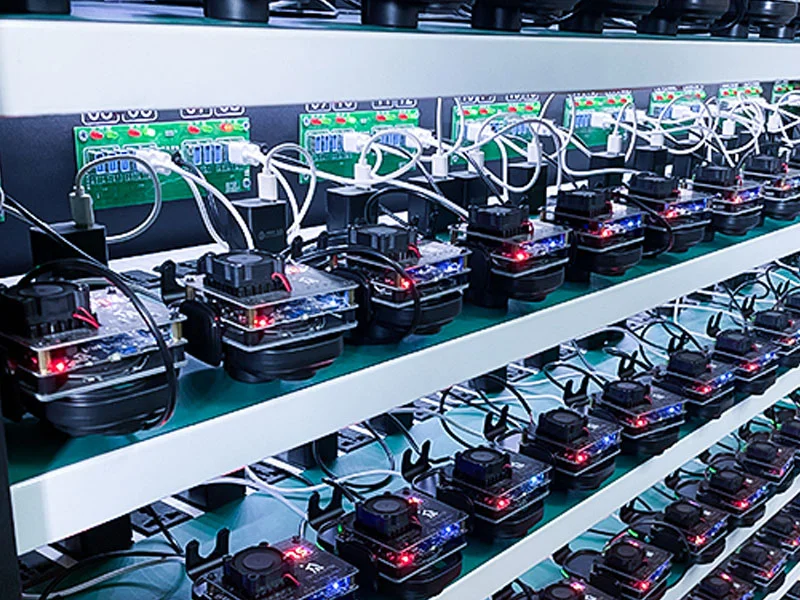
100% aging test laboratory

Automated SMT production line
WOWOHCOOL FACTORY STAT
UL, CE, FCC, RoHS, Qi2, and UN38.3 certified across all product lines. UL 94 V-0 materials rated to 850°C glow wire, dual-NTC thermal protection on every GaN charger, 100% 8-hour burn-in at 45°C. Field failure rate below 0.1% across millions of units shipped since 2013.
9. Buyer Checklist: 12 Questions to Ask Your Factory
Before placing a PO, send these questions to your supplier. If the answers are vague, delayed, or lack specific documentation references, treat it as a red flag. A competent factory answers all 12 within one business day.
Which edition of IEC 62368-1 is the product certified to?
Acceptable answer: "2023 Edition 3" with a test report from a recognized lab (UL, TUV, SGS, Intertek). Unacceptable: "IEC 62368-1" without edition number.
Can you provide the component-level certification list?
Every critical component (transformer, optocoupler, X/Y caps, fuse, PCB substrate) must have its own IEC 62368-1 certificate — not just the finished product.
Do you have the single-fault analysis documentation?
Required by UL 62368-1 4th Edition. The factory must show what happens when each protection component fails open or short. If they cannot produce this document, they have not done the analysis.
What is the UL 94 rating of the enclosure material, and at what thickness was it tested?
Acceptable: "V-0 at 0.75mm" with a test report from the material supplier. Unacceptable: "fireproof" or "flame retardant" without a rating number and thickness.
For power banks: has the cell passed the GB 47372 nail-penetration test?
Request the test video and report. A cell that passes this test validates both the cell manufacturer's quality and your factory's cell sourcing discipline.
How many NTC sensors monitor temperature, and where are they placed?
Minimum: one on the transformer primary and one on the secondary-side USB-C connector. For power banks: at least two on opposite sides of each cell. Single-NTC designs do not meet IEC 62368-1 Ed.3 dual-sensor requirements.
What is the OTP trip temperature and the hard-shutdown temperature?
OTP should trigger throttling at 80°C on the enclosure. Hard shutdown (thermal fuse) should open at 105°C. Both values must appear in the test report, not just the spec sheet.
Do USB-C cables above 60W have e-marker ICs with ECDSA-P256 authentication?
USB PD 3.1 requires cryptographic e-marker authentication for all cables rated above 3A (60W). Without it, the charger must limit output to 60W — your "100W charger" ships as a 60W product.
What is the burn-in protocol for production units?
Acceptable: 100% of units, minimum 4 hours at full rated load, 40°C+ ambient. Best practice: 8 hours at 45°C. Spot-check burn-in (e.g., "we test 10% of units for 2 hours") is inadequate — it will not catch infant-mortality failures.
Can we visit the factory and inspect the test lab?
A legitimate manufacturer says yes immediately. Hesitation, deflection, or "the lab is in another building" are red flags. WOWOHCOOL welcomes both in-person and video-call audits.
What is the documented field failure rate, and how is it tracked?
The factory should provide a precise number (e.g., "0.08% across 2.1M units in 2025") with a description of their tracking system. Vague answers like "very low" or "customers never complain" indicate no tracking exists.
What is your AQL sampling standard for OQC?
Acceptable: AQL 0.65 (normal) or 0.25 (tightened) per ANSI/ASQ Z1.4. The factory should know their AQL level without looking it up. If they cannot define their sampling standard, they do not have one.
READY TO AUDIT?
For a structured on-site verification walkthrough covering production lines, QC labs, and documentation review, download our Factory Verification Checklist — the companion guide to this article.
10. FAQ & Cross-References
The FAQ schema at the top of this page covers the most common questions. Here we connect the dots across the WOWOHCOOL knowledge base.
US & EU Certifications Guide
Step-by-step UL, CE, FCC certification process — costs, timelines, and required documentation for each market.
Power Bank Specs Guide
Battery capacity ratings, cell types (Li-Po vs 21700 vs 18650), and safety specifications for power banks.
GaN Chargers Guide
Gallium nitride technology deep-dive: thermal management, power density, and why GaN enables smaller chargers.
Quality Control Guide
4-stage QC process (IQC → IPQC → FQC → OQC) with AQL sampling methodology and defect classification.
Factory Verification Checklist
On-site audit checklist: production line inspection, QC lab verification, documentation review, and red flags.
Qi Certification Guide
Wireless charging certification requirements including Qi2 MPP, FOD calibration, and WPC compliance.
Safety Certification Cost Estimator
Estimated costs include testing, documentation, and initial factory audit. Actual costs vary by product complexity and chosen laboratory (UL, TUV, SGS, Intertek).
| Product Type | US Only | EU Only | US + EU | Timeline |
|---|---|---|---|---|
| USB Charger (5-30W) | $8,000–15,000 | $6,000–12,000 | $12,000–22,000 | 8–14 wks |
| GaN Charger (45–100W) | $12,000–20,000 | $8,000–15,000 | $18,000–30,000 | 10–16 wks |
| Wireless Charger | $10,000–18,000 | $8,000–14,000 | $15,000–26,000 | 10–14 wks |
| Power Bank | $10,000–16,000 | $7,000–13,000 | $14,000–24,000 | 8–14 wks |
| Car Charger | $10,000–18,000 | $8,000–14,000 | $15,000–26,000 | 10–16 wks |
Note: costs assume pre-certified critical components. If your design uses uncertified transformers, capacitors, or optocouplers, add $3,000–$8,000 and 4–8 weeks for component-level testing.





Need Certified Chargers for Your Brand?
Factory-direct OEM chargers with full IEC 62368-1 Ed.3, UL, CE, FCC, and Qi2 certification. Dual-NTC thermal protection, V-0 enclosures, 100% burn-in. Field failure rate below 0.1%.

Market Manager · Wireless Charging & Market Analysis
10+ years experience in wireless charging and power bank market analysis. Market Manager at WOWOHCOOL tracking global trends in GaN, Qi2, and battery technology.
EXPERT INSIGHT
"The most common mistake importers make is treating safety certification as a paperwork exercise. By the time a charger fails UL testing, you've already committed to tooling, packaging, and production timelines. The factories that pass on the first submission don't just have better products — they have a design process that treats every protection layer as a compliance requirement, not a cost to optimize away."
— Snowy May, Market Manager at WOWOHCOOL